PRIVACY & SECURITY
Your Bank Blocked You for Having a VPN On? Russia Just Made It Official Policy
For years the pitch was simple: turn on your VPN and the internet opens up. Russia just inverted it. Turn on your VPN and the internet shuts you out.
✓Why this breaks the standard✓The home IP difference✓What this means for remote workers
Quick Answer
Russia has escalated its VPN crackdown: banks, video streaming sites, online retailers like Ozon and Wildberries, and search engines now refuse service when they detect an active VPN connection, showing errors like “it seems you are using a VPN.” This flips the usual VPN pitch on its head. HomeIPVPN notes that a personal home IP looks like an ordinary residential connection, so it does not trip the VPN detectors that are now locking people out of everyday services.
- AFP journalists in Moscow were shown “access denied, turn off VPN” errors on major retailers
- The crackdown targets VPN users, not just VPN providers, a sharp escalation
- A home IP is indistinguishable from a normal resident, so detectors ignore it
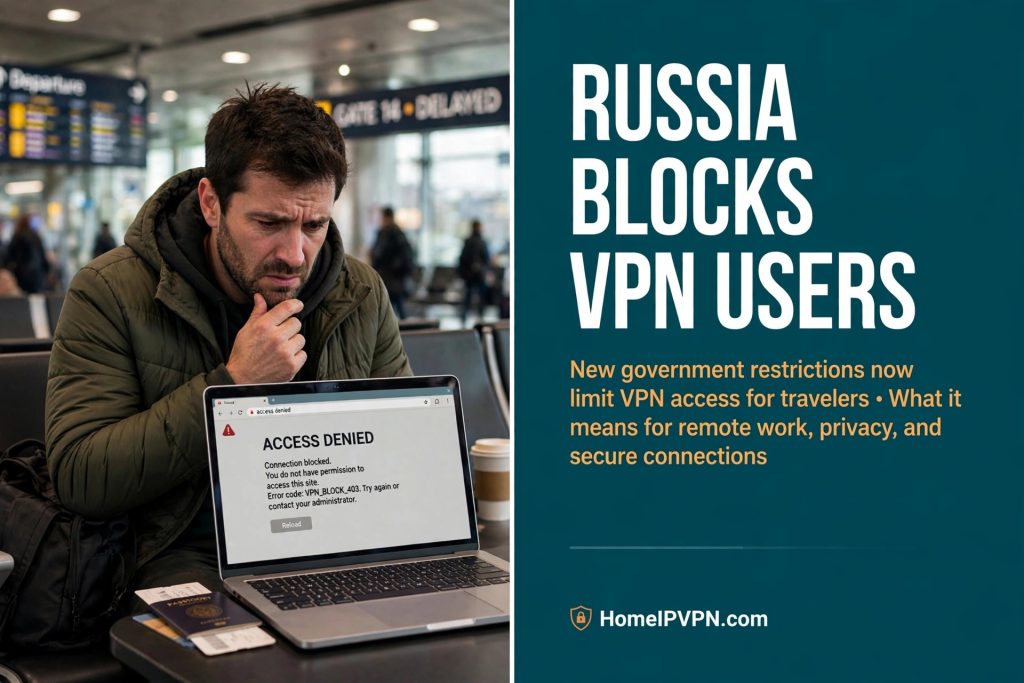
For years the pitch was simple: turn on your VPN and the internet opens up. Russia just inverted it. Turn on your VPN and the internet shuts you out.
On October 14, Russian state media reported that banks, video streaming sites, online retailers, and search engines are now blocking access wherever they detect an active VPN connection. AFP journalists in Moscow were shown the new reality firsthand: error messages reading “it seems you are using a VPN” and “access denied, turn off VPN connection if you are using one” when trying to shop on Ozon and Wildberries, the country’s two largest online retailers.
This is a sharp escalation. Until now, Russia’s campaign focused on the supply side: blocking VPN protocols, removing VPN apps from app stores, fining companies that advertised circumvention tools, and cutting off payment methods for VPN subscriptions. The new move targets the demand side. It does not matter which VPN you use or how well it is obfuscated. If a website can tell you are on one, you do not get in.
Why this breaks the standard playbook
The standard advice for anyone working abroad has been to route everything through a commercial VPN. That advice assumed the VPN itself was invisible to the sites you visit, or at least tolerated. Russia’s new posture removes that assumption entirely. The detection is the enforcement. There is no cat-and-mouse game to win when the other side simply refuses to serve anyone who looks like they are hiding.
And detection is getting easier, not harder. Commercial VPNs share a finite pool of IP addresses across thousands of users. Those addresses are well known, constantly scanned, and trivially catalogued by anyone motivated to do it. Data center IPs, hosting ranges, and the fingerprints of popular VPN protocols all give the game away. When a bank or a retailer decides to check, a commercial VPN user is not hard to spot.
The home IP difference
This is exactly the scenario a personal home IP was built for. Your home connection is a residential IP assigned to a real household. It carries no VPN protocol fingerprint, sits in no data center range, and is shared with nobody. To any detector, it looks like an ordinary resident browsing from their couch, because that is literally what it is.
When detection itself becomes the barrier, blending in beats hiding. A commercial VPN tries to hide who you are and gets flagged for the attempt. A home IP never looks suspicious in the first place, so there is nothing to flag.
That distinction matters far beyond Russia. Banks, streaming services, and fraud systems worldwide are all tightening the same screws. Shared VPN IPs already trigger extra verification steps, frozen logins, and blocked transactions in many countries. Russia just made the logic explicit and mandatory.
What this means for remote workers
If you work from abroad, or travel through countries tightening internet controls, the takeaway is practical. Audit which of your daily services already treat VPN traffic with suspicion. Many banking apps, payment processors, and government portals quietly do. Then separate your traffic: keep the services that punish VPN use on a clean residential path, and stop relying on a single shared tunnel for everything.
The era of one VPN for all purposes is ending. The future belongs to connections that do not need to hide, because they were never suspicious to begin with.

