REMOTE WORK & DIGITAL NOMAD
PayPal Holds and Reversals: What Traveling Sellers Need to Know
The notification arrived on a Tuesday morning in a hostel in Da Nang. “Your funds are on hold.” I had just been paid for a project, real money for…
✓Why PayPal holds money in the✓What “on hold”✓Reversals: the scarier cousin
Quick Answer
PayPal holds funds when it sees something unusual: a new account, a sudden spike in payments, or logins from unexpected countries. Most holds release automatically after the review period, and you can reduce the risk by keeping your account details consistent, shipping or delivering promptly, and avoiding sudden changes in how you log in.
- New accounts get held first: PayPal commonly holds payments for up to 21 days on new seller accounts until a track record is built.
- Location changes trigger reviews: logging in from a different country than usual is one of the classic hold triggers for travelers.
- Reversals are different from holds: a hold is temporary; a reversal means the money was taken back after a dispute or unauthorized claim.
- Keep your login location steady: many traveling sellers use HomeIPVPN so PayPal always sees their familiar home connection instead of a new country every week.
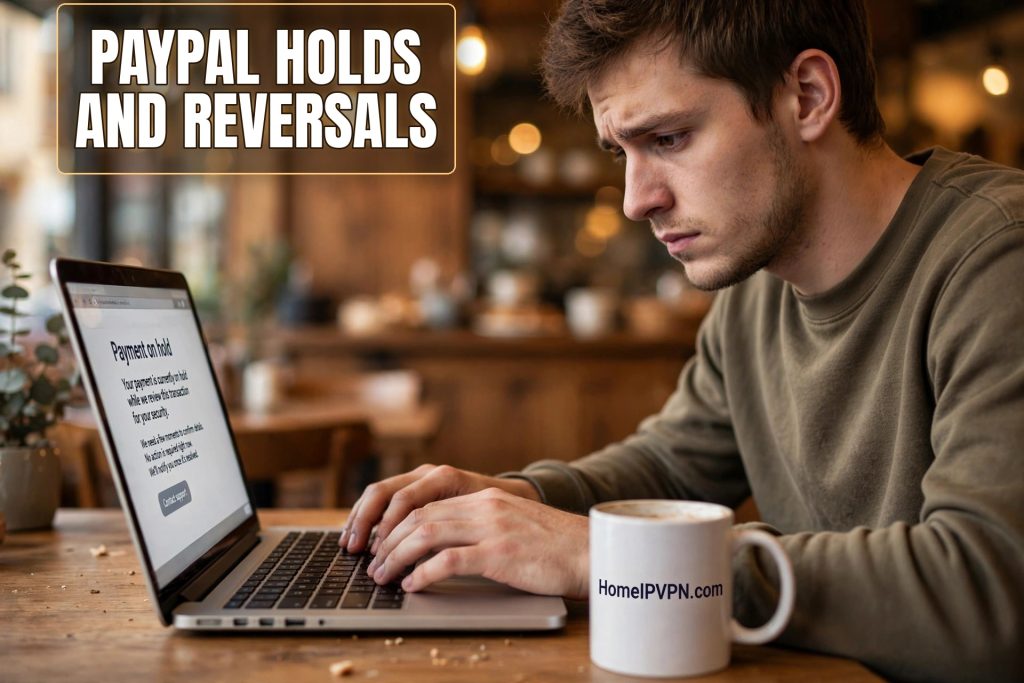
The notification arrived on a Tuesday morning in a hostel in Da Nang. “Your funds are on hold.” I had just been paid for a project, real money for real work, and PayPal was telling me I could look at it but not touch it. The balance sat there, visible and useless, while my rent was due in four days.
I did what everyone does first: panicked, then Googled, then panicked more efficiently. What I learned over the following weeks is that PayPal holds are not random punishment. They follow patterns, and once you understand the patterns, you can arrange your traveling work life to trigger fewer of them.
Why PayPal holds money in the first place
PayPal sits between buyers and sellers, and when something goes wrong, buyers complain to PayPal, not to you. To protect itself, PayPal holds funds in situations it considers risky, giving itself a window to make sure the transaction is legitimate before the money moves on. Think of it less like a punishment and more like a bouncer checking IDs: annoying when you are legitimate, but operating on rules you can learn.
The most common trigger is simply being new. New seller accounts routinely have payments held for up to 21 days. PayPal is watching to see whether buyers are happy and whether disputes appear. Once you have a history of successful transactions, holds usually become rare. This catches many traveling freelancers because they open the account, land a client quickly, and then discover their first real payment is frozen for three weeks.
The second big trigger is change. A sudden spike in payment amounts, a new type of transaction, selling in a new category, or logging in from a different country than usual. PayPal’s systems are tuned to notice when your pattern shifts, and travel is basically a lifestyle of shifting patterns. You are not doing anything wrong; you are just doing something different from last month, and different is what the system flags.
What “on hold” actually means for your money
A hold is temporary by design. The money is still yours, it is just not available yet. PayPal typically releases held funds after a set period, often up to 21 days, or sooner if the buyer confirms receipt or leaves positive feedback. For digital services and freelance work, where there is no shipping tracking number to prove delivery, the hold usually just runs its course.
What you can do during a hold is limited but not zero. You cannot withdraw the money or spend it. You can still see it in your balance, which is psychologically the worst part. Marking the order as processed or shipped in PayPal’s system sometimes speeds things up, because it signals to PayPal that you fulfilled your side. For service work, adding tracking information is not possible, but updating the order status still helps.
The key mindset shift: a hold is a delay, not a loss. Plan for it. If you know your first few payments on a new account will be held for three weeks, you invoice earlier, keep a buffer, and avoid the rent-due panic I experienced in Da Nang.
Reversals: the scarier cousin
Holds get the attention, but reversals are the ones that actually hurt. A reversal means money that was in your account gets taken back. This happens when a buyer files a dispute or chargeback, when PayPal decides a payment was unauthorized, or when a payment fails after the fact.
For freelancers, the classic reversal scenario is the unhappy client who pays, receives the work, then claims they never authorized the payment or never received anything. Because digital work is hard to prove delivered, PayPal often sides with the buyer unless you have documentation: contracts, message threads showing approval, delivery confirmations, timestamps.
Protecting yourself is mostly about paperwork. Keep written agreements for every project, even small ones. Deliver through channels that create a record. When a client approves work, get that approval in writing, a simple “looks great, thanks” in an email counts. If a dispute ever comes, this paper trail is your entire defense.
There is also a quieter kind of reversal: the eCheck or bank-funded payment that bounces days later. The money appears in your account, you spend it, then it vanishes. Prefer instant-funded payments when you have the choice, and do not treat a fresh payment as spendable until it has settled.
How travel specifically triggers reviews
Let us talk about the nomad-specific problem, because this is where most traveling sellers get blindsided. PayPal watches where you log in from. When your account history shows one country for months and suddenly you are logging in from Thailand, then Vietnam, then Portugal, the system notices. Each new country is a small flag. Enough flags and your account gets a review, a hold, or in bad cases a limitation.
This is not PayPal being hostile to travelers. From their side, a login from an unexpected country is one of the classic signs of a stolen account. They genuinely cannot tell the difference between you on a beach in Bali and someone who stole your password in another hemisphere. So they err on the side of freezing first.
The practical fix is consistency. If PayPal always sees you logging in from the same place, the travel becomes invisible to their risk systems. This is exactly why many traveling sellers route their connection through their home internet using HomeIPVPN: the login location never changes, so the account never has a reason to get nervous. It is a simple change that removes one of the most common hold triggers for people who move around.
Beyond connection consistency, keep the rest of your account boring in the best way. Do not change your linked bank account, phone number, and business details all in the same week you fly to a new continent. Spread changes out. Boring accounts do not get reviewed.
Reducing hold risk day to day
A few habits make a real difference. First, build history before you need it. If you are planning to receive significant payments through PayPal, start using the account for smaller transactions early so there is a track record when the big ones arrive.
Second, communicate with buyers inside PayPal’s system when possible. Messages attached to the transaction create a record that the buyer knew what they were paying for and received it. For freelancers, even a brief note in the invoice or payment request describing the work helps.
Third, withdraw on a rhythm. Leaving large balances sitting in PayPal indefinitely is not a strategy; regular withdrawals to your bank keep your exposure lower if something does get frozen. Just be aware that the withdrawal itself can take a few days, so do not wait until you need the money tomorrow.
Fourth, keep your account information complete and verified: confirmed email, linked and confirmed bank account, verified identity documents. Unverified accounts face stricter holds and lower thresholds for reviews. It takes an afternoon to verify everything properly, and it pays off every month after.
When funds are already held: what to do
If you are reading this with money currently on hold, here is the calm version of the playbook. First, check the reason PayPal gives in the Resolution Center. It will tell you the hold type and usually the expected release date. Most of the time, the correct action is simply to wait and let it release.
Second, complete any steps PayPal asks for. Sometimes it wants you to confirm shipment, provide documentation, or verify information. Do these promptly; an ignored request can extend the hold.
Third, if the hold seems wrong or has stretched past the stated timeframe, contact support. Be polite, be specific, have your transaction details ready. Support agents deal with angry people all day; a calm, organized inquiry gets better results. Ask what specifically triggered the hold and what would prevent it next time, then actually do that thing.
What not to do: do not open a second account to dodge the hold. PayPal links accounts aggressively, through devices, bank accounts, and personal details, and operating a second account to evade a hold is a fast track to having both accounts limited. Work through the hold on the account you have.
Have a backup way to get paid
The deepest lesson of the PayPal hold is not about PayPal. It is about single points of failure. Any freelancer whose entire income flows through one platform is one algorithmic decision away from a cash crisis. The fix is boring and effective: maintain at least two ways to receive money.
That might mean PayPal plus direct bank transfers, or PayPal plus a multi-currency account, or adding an invoicing platform with its own payment processing. The backup does not need to handle all your income. It just needs to exist, be tested, and be ready before the day you need it. Test it with a small amount first so you know the whole path works, from client payment to money in your hands.
Keep a small emergency buffer too, enough to cover a few weeks of essentials. Holds are temporary, but temporary still hurts when rent is due. A buffer turns a crisis into an inconvenience.
One less trigger to worry about
Most PayPal risk is about your behavior as a seller: deliver good work, document everything, keep records. But the location trigger is different, because it punishes you for the lifestyle itself rather than anything you did wrong. Logging in from a new country every few weeks will keep tripping the same wire no matter how honest your business is.
Removing that trigger is the problem HomeIPVPN was built to solve: your connection always appears from your own home internet, so PayPal sees one consistent, familiar location. If you would rather have someone set it up and verify it works, the Pre-Travel Audit & Advisory session is 1 hour, costs $79, and that fee comes straight off the $279 Secure Home IP VPN System session if you go ahead.
Holds will probably still happen occasionally; that is just life with payment platforms. But at least they will be about your business, not your boarding passes. Keep good records, keep a backup way to get paid, and keep moving.