TROUBLESHOOTING
Netflix Shows Different Movies in Every Country: Why That Happens
Picture this. You are three episodes into a series at home in Austin. You fly to Bangkok for a two-month work trip, settle into your condo, make tea, open…
✓Netflix Is a Landlord, Not an Owner✓How Netflix Decides Which Store to✓Why Your Home Library Feels Bigger
Quick Answer
Netflix does not own most of the movies and shows in its catalog. It rents streaming rights country by country from the studios, so the library you see depends entirely on where your internet connection appears to be. Land in a new country and your home library is replaced by that country’s licensed catalog.
- Netflix rents, it does not own: for most titles, Netflix buys the right to stream in specific countries only, and those deals expire and change constantly.
- Your IP address picks your catalog: Netflix reads the country attached to your connection the moment you open the app, and that decides which library loads.
- Your list follows you, but the titles may not: saved shows stay in your list, but titles that are not licensed in your new country show as unavailable.
- The traveler fix: stream through your own home connection so Netflix keeps showing your home catalog. HomeIPVPN sets up exactly that kind of appear-at-home connection for people who live on the road.
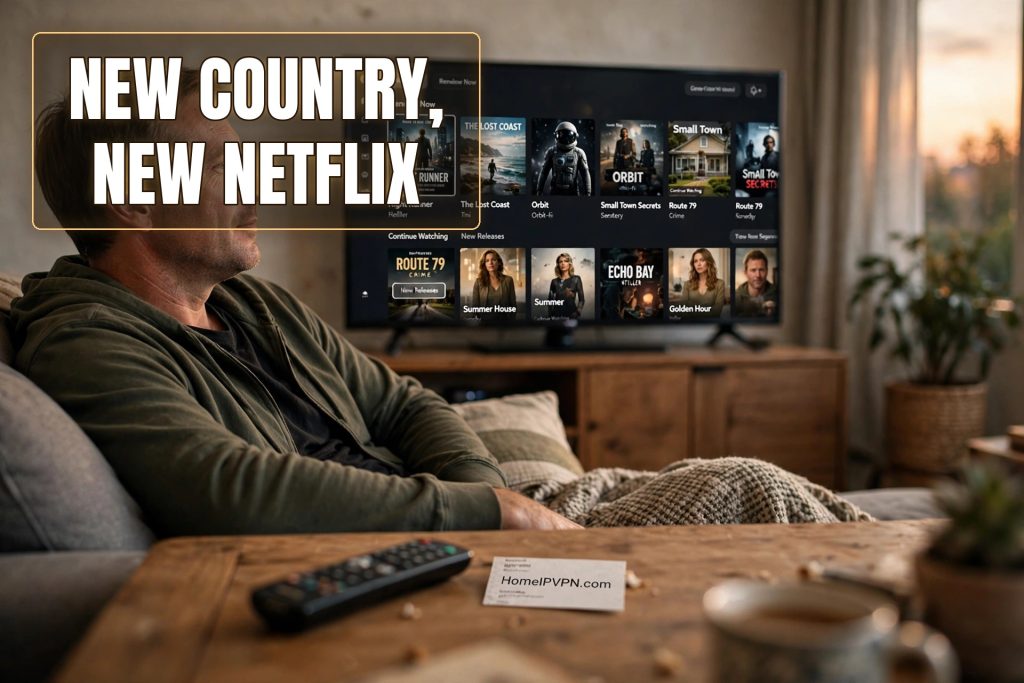
Picture this. You are three episodes into a series at home in Austin. You fly to Bangkok for a two-month work trip, settle into your condo, make tea, open Netflix, and your show is gone. Not paused. Not moved to a different row. Gone, as if it never existed. In its place: a wall of Thai dramas you have never heard of, a few Hollywood titles you already watched, and a search box that insists your show does not exist.
You did not change your account. You did not change your plan. You changed countries, and Netflix quietly swapped the entire store behind you.
This happens to every traveler eventually, and it always feels personal, like Netflix decided you do not get nice things anymore. It is not personal. It is paperwork. Let me explain the paperwork in plain English.
Netflix Is a Landlord, Not an Owner
The simplest way to think about Netflix is this: it owns a small slice of what it shows you and rents almost everything else. The shows with the little red “N” that Netflix made itself, like Stranger Things, are available pretty much everywhere. But the thousands of other movies and series, the sitcoms, the documentaries, the cozy crime shows you actually spend your evenings on, are licensed from studios. And licenses are sold by territory.
A territory, in this world, means a country or a group of countries. When a studio finishes a film, it does not sell “the streaming rights” as one global package. It sells the US rights to one buyer, the UK rights to another, the Japanese rights to a third, and so on. Each deal has a price, a start date, and an end date. Netflix buys the rights for the countries where the price makes sense, and skips the rest.
This is why your home catalog feels complete. Netflix bought a big bundle of licenses for your country, tuned to what people there watch. It is also why the catalog in Bangkok looks like a different store. A different team of Netflix buyers negotiated a different bundle with different studios, for a different audience, at different prices. Same red logo, different inventory.
And here is the part that surprises people: these deals expire. A show can be in your home catalog on Monday and gone on Friday because the license ran out and the studio sold the next window to a competitor. Now imagine that churn happening in 190 countries at once, on different schedules. The Netflix library is not a library at all. It is 190 rented storefronts being restocked on 190 different calendars.
How Netflix Decides Which Store to Show You
When you open the Netflix app, the first thing it does is check where your internet connection is coming from. Not your account country, not your billing address, not the language on your phone. Your IP address, the return address attached to your connection, which maps to a country.
This check happens every time you open the app, and it is the whole ballgame. Land in Bangkok, connect to the condo wifi, open Netflix: the app sees a Thai IP address and loads the Thai catalog. Fly home to Austin, open the same app on the same phone with the same account, and the American catalog is back like nothing happened. Your profile, your watch history, and your “My List” travel with you. The actual videos available to play do not.
This leads to the specific heartbreak travelers know well. Your list still shows the series you saved in Austin. But when you tap it in Bangkok, you get a message that the title is not available in your region. The bookmark survived the trip. The license did not.
Netflix is unusually upfront about this compared to other services. Its help pages say plainly that the catalog varies by country because of licensing. There is no mystery and no malfunction. It is the system working exactly as designed. The design just was not made for people who change countries the way other people change neighborhoods.
Why Your Home Library Feels Bigger (It Usually Is)
Not all catalogs are equal, and travelers notice fast. The US catalog is famously one of the largest, which is why Americans abroad feel the loss most sharply. But size is not the whole story. Every catalog is shaped by local taste and local competition.
In some countries, a local streaming service outbid Netflix for the big Hollywood titles, so the Netflix catalog leans heavily on local productions and Netflix originals. In others, Netflix is the dominant player and the catalog is enormous. Language matters too: dubbing and subtitling cost money, so a title that is cheap to license might still be skipped in a country where it would need a full dub to find an audience.
There is also the quiet factor of what you grew up expecting. If your comfort show is a 2000s American sitcom, you will find it in the US catalog and maybe a dozen others. In the other 170 countries, someone else bought those rights years ago, or nobody did, and the show simply is not there. It is not that Bangkok’s catalog is worse. It is that it was never built for you.
This is the moment many travelers start searching for workarounds, which brings us to the part of the story where things get annoying.
The VPN Merry-Go-Round
The obvious fix is a VPN, an app that routes your traffic through a server in your home country so Netflix sees a home IP address. Millions of travelers have tried this. Millions have watched it stop working.
Netflix fights VPNs harder than almost any other streaming service. It maintains enormous, constantly updated lists of IP addresses belonging to data centers and VPN companies. When your traffic arrives from one of those addresses, Netflix does not show an error message accusing you of anything. It just quietly serves you a tiny, generic catalog, the one reserved for connections it does not trust, or blocks playback with a proxy error. You are technically “connected,” but the store is empty.
VPN companies respond by renting new servers with fresh addresses. Netflix finds those within days or weeks and adds them to the list. The VPN moves again. Around it goes. Some premium VPNs stay a half step ahead, for a while, on some servers, for some titles. But “works on Tuesdays on the Chicago server if you clear your cookies first” is not a system. It is a hobby. And it is a hobby that breaks the night the season finale drops.
Free VPNs barely deserve a mention except as a warning. They are slow, they are the first addresses Netflix blacklists, and some fund themselves in ways you would not accept if they were printed on the box. If a service is free, your attention or your data is the product. Routing your banking, your email, and your work logins through that kind of product to watch a sitcom is a bad trade.
What Actually Works: Your Own Home Address
There is a reason Netflix’s detection is so good against VPNs and so blind to one particular setup. Netflix is not really detecting VPN software. It is detecting addresses that look like server farms. A commercial VPN, no matter how premium, sends your traffic out through a data center, and data centers are exactly what the blacklists catalog.
So travelers who got tired of the merry-go-round changed the game. Instead of borrowing a server address, they stream through their own home internet connection. A small device sits on their home network back in Austin. From the condo in Bangkok, their laptop connects to that device first, and everything bound for Netflix goes out through the house. Netflix sees a regular American household connection, because that is genuinely what it is. No data center, no blacklist, no proxy error.
People describe this as the moment streaming stopped being a project. The catalog is the home catalog, every title on the list plays, and there is no monthly ritual of hunting for a working server. The honest limitations: your stream quality leans on your home internet’s upload speed, since the video makes two trips, once to your house and once to you. And the initial setup takes real configuration, more than installing an app, because you are building your own private route home rather than renting someone else’s.
Some travelers set this up in their own home before a long trip. Others leave the device with family, a friend with good internet and a spare outlet is all it takes. Either way the principle holds: an address that belongs to a real household passes every check that a server farm address fails. Setting this up yourself means sourcing the device, configuring secure remote access, and testing it from abroad before you depend on it, which is why services like HomeIPVPN handle the whole build and verification for travelers who would rather skip the tinkering.
The Pattern Behind Every Vanishing Show
Once you understand the licensing map, you start seeing it everywhere. The show that disappears mid-season. The movie that is on Netflix in Canada but not in the US. The documentary your friend in London is raving about that does not exist in your search results. None of these are glitches. They are 190 separate rental agreements, expiring and renewing on 190 schedules, and your IP address decides which agreement applies to you tonight.
For people who live in one place, this is invisible. For people who live in motion, it is a monthly reminder that the internet still has borders, drawn not by governments but by contracts. Your account is global. Your money is welcome everywhere. But the videos themselves are fenced in, country by country, exactly the way the studios sold them.
That gap, between a traveler and the home catalog they pay for, is the problem HomeIPVPN was built to solve. A home IP setup carries your real home address with you wherever you go, so Netflix keeps showing the library you actually signed up for.
If you would rather have someone set it up and verify it works, the Pre-Travel Audit & Advisory session is 1 hour, costs $79, and that fee comes straight off the $279 Secure Home IP VPN System session if you go ahead. It happens remotely, on your screen, and everything is configured and tested while you watch.
May your list always play, wherever you land next.