TROUBLESHOOTING
No Working From Abroad Policies: What Actually Happens When People Get Caught
The message arrives at 2:14 in the afternoon, Lisbon time. It is from your manager, and it is one line: “Quick call when you have a minute?”
✓How people actually get caught✓The warning: the best bad outcome✓Losing remote privileges
Quick Answer
People do get caught working abroad against company policy, and the outcomes travelers report range from a quiet warning to being fired within days. The most common endings are a formal warning, losing remote work privileges, or termination, often with a messy payroll and laptop return process attached. What follows is a summary of what nomads report, not legal advice.
- How they get caught: Timezone slips, social media posts, and login location alerts cause more trouble than any surveillance tool. Often a colleague mentions something casually and it snowballs.
- The common outcomes: A formal warning and an order to return home is the mild end. At the sharp end, travelers report being locked out of company systems the same day they were confronted.
- The messy middle: Payroll gets complicated fast when a company learns you worked from a country where it is not registered to employ anyone, and sorting it out can take months.
- The safer path: Travelers who asked permission first, or who kept their work traffic routed through a HomeIPVPN home connection, report far fewer of these stories.
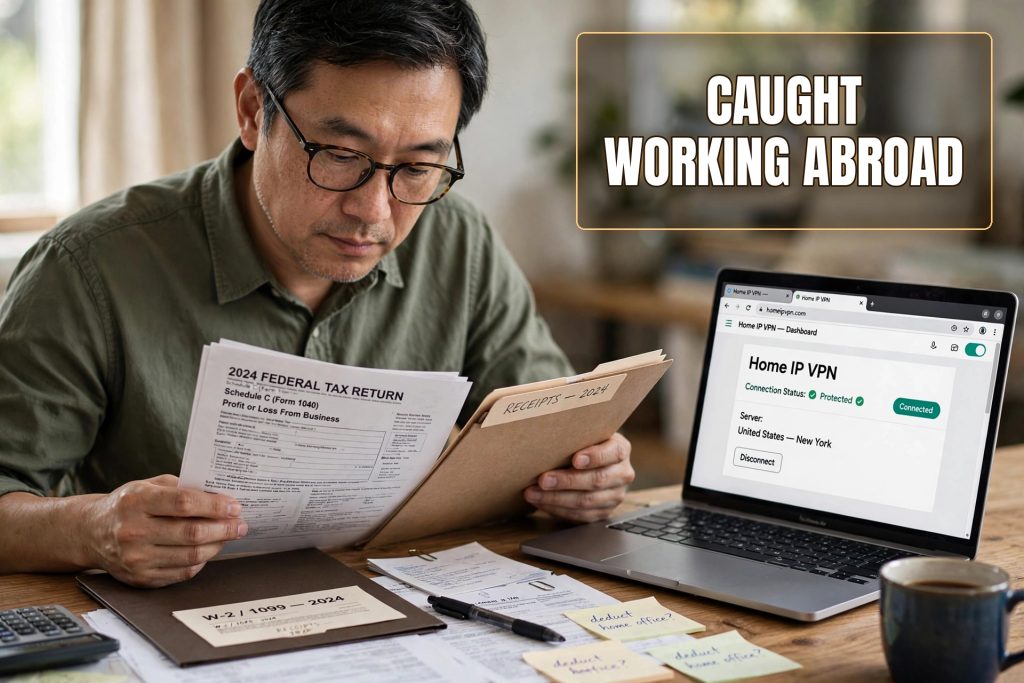
The message arrives at 2:14 in the afternoon, Lisbon time. It is from your manager, and it is one line: “Quick call when you have a minute?”
You have worked remotely for two years. You know what a quick call means. You also know that yesterday you posted a photo of custard tarts with a geotag, and that your Slack status has said “in a meeting” through what is clearly lunchtime in Chicago. You close the laptop lid halfway, as if that helps, and click the link.
Your manager is kind about it, which somehow makes it worse. HR joins after five minutes. They know. They have known for a while, apparently. What follows is the most awkward forty minutes of your professional life, and it ends with you booking a flight home for Sunday and a formal warning in your file.
This is one of the milder versions of this story. Nomad forums and group chats are full of them, and they do not all end with a warning and a plane ticket. Some end with a same-day termination. Some end with a payroll tangle that takes half a year to unwind. If you are working abroad quietly right now, or thinking about it, you should know what the real outcomes look like, told the way travelers tell them to each other, practically and without legal jargon.
How people actually get caught
Almost nobody gets caught by a sophisticated surveillance operation. They get caught by small, ordinary slips, usually several of them stacking up at once.
Social media is the classic one. You are careful for three weeks, and then on week four you post a sunset with a location tag, or a friend tags you at a beach bar, or your Instagram story shows a street sign in another language. It only takes one colleague seeing one post. People underestimate how many coworkers idly watch each other’s stories.
Timezone math is the quiet one. Your calendar says you are in Chicago, but you keep declining the 8 a.m. standup and you are weirdly energetic at 7 p.m. Someone does the arithmetic. Or your “good morning” messages arrive at what is obviously midnight your time. Humans are pattern matching machines, and your team has two years of your patterns memorized.
Then there is the technical trail: a login alert from a new country, a VPN IP address that is obviously a data center rather than a home, latency that tripled overnight. Any one of these can sit unnoticed for months. But the moment a human gets suspicious for any other reason, the technical trail is right there waiting, timestamped and unambiguous. The geotag starts the conversation. The connection logs end it.
And sometimes it is just a colleague. Not maliciously. Someone asks where you are in a casual chat and you freeze, or you say “home” a beat too quickly, or you mention the weather and it does not match. Offices run on small talk, and small talk is a terrible place to maintain a cover story.
The warning: the best bad outcome
When companies catch someone and decide to be lenient, the outcome usually looks like this: a formal conversation with your manager and HR, a written warning placed in your file, and a clear instruction to return to your approved work location within a set number of days. Travelers who have been through this describe it as deeply embarrassing but survivable.
The warning tends to come with conditions. You may lose the right to work from anywhere but the office, or your home address, for a set period, sometimes a year. Future travel requests get scrutinized. Your manager, who may have genuinely liked you, now has a trust problem to manage. Several people report that the working relationship never fully recovered, even when the job itself survived.
Here is what surprises people about the warning track: the company often knew longer than you think. Multiple travelers report being told, in that awful meeting, that IT had flagged their location weeks or months earlier. The company waited, watched, and built a file. If you are reading this mid-trip and feeling clever, sit with that for a moment.
Losing remote privileges
A step up from the warning is losing the remote arrangement itself. The company keeps you, but the deal changes: you are now expected in the office, or at minimum at your registered home address, on a schedule someone checks. For people who built their whole life around location flexibility, this lands like a pay cut.
Travelers describe this outcome as the slow punishment. Nobody fires you, but every future request, a week visiting family, a long weekend somewhere, gets a raised eyebrow. One person put it well in a forum thread: “I kept my job and lost the reason I liked my job.” The trust that made remote work function, the unspoken agreement that you are a professional who can be left alone, is gone, and rebuilding it takes far longer than the trip that broke it.
This outcome is especially common at companies that technically allow remote work but draw a hard line at the country border. From their perspective, you did not just break a rule, you exposed them to tax and legal risk they never agreed to carry. We will get to why that matters so much to them shortly, because understanding their side is the key to understanding why the punishments feel disproportionate.
Termination: how fast it can happen
At the sharp end, people get fired. Travelers report terminations happening within days of being confronted, sometimes the same day. The pattern usually involves the company deciding that the deception itself, not just the location, is the firing offense. Working from Portugal when you said Chicago is a policy violation. Hiding it for three months is a trust violation, and trust violations are what HR departments are built to act on.
A few recurring details show up in these stories. The termination meeting is short. Access gets revoked during the call or immediately after: laptop locks, accounts deactivate, Slack goes dark while you are still reading the goodbye messages. Companies do this for security reasons, not cruelty, but travelers consistently describe the speed of it as shocking. One morning you have a job and a routine. By lunch you have a bricked laptop and a shipping label.
Whether you get a warning or a termination often comes down to factors you cannot control: how strict the company’s written policy was, whether HR or your manager drives the decision, how long you hid it, and whether the company has recently been burned by someone else doing the same thing. Two people can do the identical trip and get completely different outcomes. That randomness is itself worth understanding, because “my friend did it and nothing happened” is the most dangerous sentence in nomad planning.
The payroll mess nobody warns you about
Here is the part of the story that surprises even the people who expected to get in trouble. When a company discovers you worked from a country where it has no legal presence, payroll becomes a problem, and payroll problems move at the speed of bureaucracy.
In plain English: companies pay you through payroll systems tied to specific countries. Taxes get withheld, social contributions get paid, and everything assumes you are where your employment contract says you are. When you worked from somewhere else, the paperwork was wrong for every one of those pay periods. Fixing it can mean amended filings, and in some countries the company was technically supposed to register as an employer the moment you started working there. That is their liability, created by your trip, and it is a big reason the reaction feels so outsized.
Travelers report final paychecks delayed while payroll untangles the mess, bonus payments held up, and in a few cases demands to repay expenses or allowances tied to the home location. If you were receiving any kind of location-based pay adjustment or stipend, expect questions about every dollar of it. None of this is quick. Payroll departments do not move fast on routine tasks, and you are not a routine task anymore.
There is also the equipment question. That laptop is company property with company data on it, and the moment the employment relationship ends badly, getting it back becomes urgent for them and awkward for you. People describe courier labels arriving within hours, remote wipe commands, and stern emails about data handling. If you are in another country when this happens, shipping a laptop internationally on short notice is its own special headache.
What people say they would do differently
Ask travelers who lived through this what they would change, and the answers are remarkably consistent. Almost nobody says “I would have hidden it better.” The technology for hiding it better barely exists, and the social side, friends, photos, small talk, is essentially unfixable. The consistent answer is that they would have handled the front end differently.
The most common regret is not asking. A surprising number of companies say yes to short stints abroad when asked properly, especially when the request comes with a plan: dates, timezone coverage, and reassurance that the work setup will look exactly like home. “I assumed the answer was no, so I never asked” shows up in these stories constantly. The irony is painful. Many of these careers could have survived a two week request and did not survive a two month secret.
The second most common regret is lying when asked directly. Several travelers describe a moment, a casual question from a manager, a check-in from IT, where a vague answer bought a week and cost them everything. Once the company has proof, the earlier evasions become the story. “They might have forgiven Portugal” one person wrote. “They did not forgive being lied to about Portugal.”
The third is the technical footprint. People who kept their connection routed through their actual home, so that every login, every call, and every session looked exactly like a normal workday at home, describe a completely different experience: there was simply nothing to find. No location alerts, no suspicious IP addresses, no latency spikes for anyone to stumble across. It does not fix the social side, and it is not permission, but travelers consistently report that a clean technical footprint removes the most common tripwire. The team at HomeIPVPN sets up exactly this kind of home-routed connection for remote workers who travel.
The honest summary
Working abroad without your employer knowing is a bet, and the stakes are higher than most people realize when they book the flight. The likely outcomes, as travelers report them: a formal warning and a damaged relationship, loss of the remote flexibility you were trying to enjoy in the first place, or termination with a payroll tangle attached. The detection methods are mundane, a photo, a timezone, a login alert, and the technical evidence is automatic and timestamped.
None of this is legal advice, and every company’s policy and every country’s rules are different. But the pattern across hundreds of these stories is clear: the people who fare best are the ones who asked first, told the truth when asked, and kept their technical footprint indistinguishable from home. Everything else is gambling with a career.
The root cause underneath most of these stories is the technical trail: logins, IP addresses, and latency that quietly document every mile. Eliminating that trail is the problem HomeIPVPN was built to solve. If you would rather have someone set it up and verify it works, the Pre-Travel Audit & Advisory session is 1 hour, costs $79, and that fee comes straight off the $279 Secure Home IP VPN System session if you go ahead.
Whatever you decide, decide it with your eyes open. The beach will still be there after you have had the honest conversation. Your career might not survive the alternative.