HARDWARE REVIEWS & GUIDES
Beryl AX vs Slate 7: GL.iNet Travel Router Comparison
Choosing between the Beryl AX vs Slate 7 is the most common dilemma for travelers shopping GL.iNet's lineup. Both are pocket-sized VPN-capable travel…
✓Key differences: Wi-Fi 7,✓Price-to-performance for VPN✓Which traveler profile fits each
Quick Answer
For most remote workers, the Beryl AX (GL-MT3000) is the right buy: excellent WireGuard and OpenVPN performance at a mid-range price in a truly pocket-sized body. Pick the Slate 7 only if you want WiFi 7 future-proofing, the touchscreen, and maximum throughput headroom; the comparison HomeIPVPN walks clients through.
- Wireless: Slate 7 has WiFi 7; Beryl AX has WiFi 6, still plenty, since the bottleneck abroad is almost always the hotel’s internet.
- Throughput and size: The Slate 7’s stronger processor pushes higher VPN speeds; the Beryl AX is smaller and lighter, and both run over USB-C.
- Value: The Beryl AX wins on price-to-performance for pure VPN travel; the Slate 7 is the better buy if you keep gear for five-plus years.
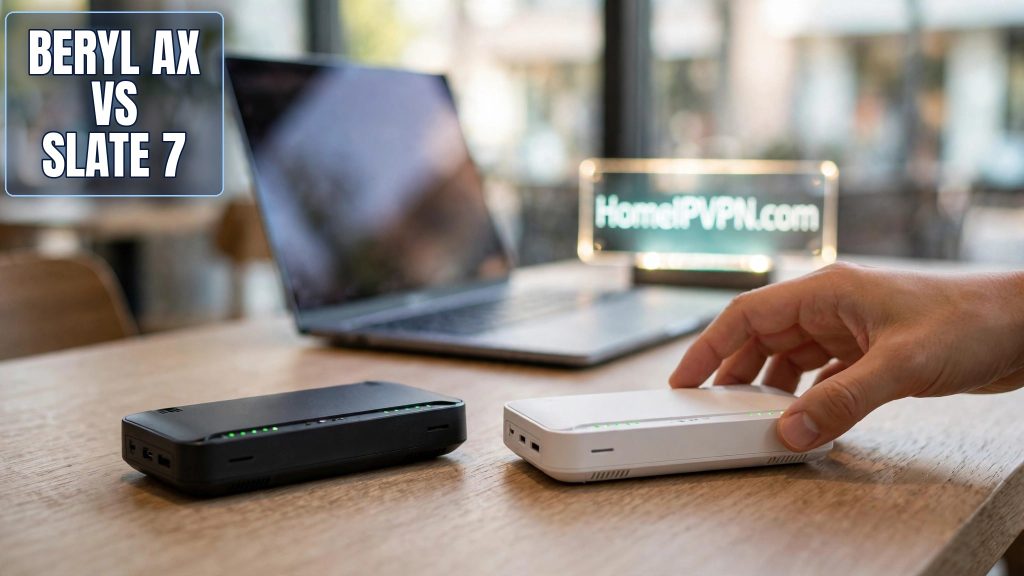
Choosing between the Beryl AX vs Slate 7 is the most common dilemma for travelers shopping GL.iNet's lineup. Both are pocket-sized VPN-capable travel routers built for remote workers, digital nomads, and expats, but they target different needs. The Beryl AX (GL-MT3000) is the beloved Wi-Fi 6 workhorse, while the Slate 7 is GL.iNet's newer Wi-Fi 7 flagship with a touchscreen and beefier hardware. This guide compares them honestly so you buy the right one for how you actually travel.
Key differences: Wi-Fi 7, touchscreen, and throughput
The headline difference is the wireless standard. The Slate 7 supports Wi-Fi 7, the newest generation, which brings features like Multi-Link Operation (MLO), which lets a device use multiple bands at once, plus wider channels and lower latency. The Beryl AX supports Wi-Fi 6, which is still fast, stable, and more than enough for hotel and coworking connections. In practice, your bottleneck abroad is almost always the hotel's internet, not the router's Wi-Fi.
The most visible difference is the Slate 7's touchscreen display. It shows connection status, connected clients, and VPN state at a glance, and lets you tweak basic settings without opening a browser. The Beryl AX has no screen; everything happens through the GL.iNet admin panel or app. Nice to have, but rarely a dealbreaker.
Under the hood, the Slate 7 packs a more powerful processor and more memory than the Beryl AX. That translates into higher VPN encryption throughput: the maximum speed the router can sustain while running WireGuard or OpenVPN. Both routers handle WireGuard at speeds well beyond what most hotel and café connections provide, so the gap only matters if you have fast home broadband and want to move large files through your home IP tunnel at near line rate.
Size and power differ too. The Beryl AX is smaller and lighter, a true pocket router that slips into a laptop sleeve. The Slate 7 is slightly larger and heavier, reflecting its bigger hardware. Both power over USB-C, so they run fine from a laptop port, power bank, or travel adapter.
Price-to-performance for VPN travel use
Here's the honest math. The Beryl AX sits in the mid-range of travel routers: affordable enough that many remote workers buy two (one for home as the VPN server, one for the road as the client). Its WireGuard performance is strong enough that your home IP tunnel rarely feels like the limiting factor.
The Slate 7 commands a premium as the flagship. You pay for Wi-Fi 7, the touchscreen, extra ports, and headroom you'll only fully use if your home connection is very fast and you routinely push it. For pure VPN-travel value, the Beryl AX wins on price-to-performance for most people. You're not giving up reliability or compatibility, just peak headroom.
That said, "best value" depends on how long you'll keep the router. If you upgrade travel gear every few years, the cheaper Beryl AX is the rational pick. If you buy once and keep devices for five-plus years, the Slate 7's Wi-Fi 7 support and extra power make it the better long-term investment, since Wi-Fi 7 will become the standard in hotels and airports.
| Beryl AX (GL-MT3000) | Slate 7 | |
|---|---|---|
| Wi-Fi generation | Wi-Fi 6 | Wi-Fi 7 |
| Display | None (web/app only) | Touchscreen |
| Relative VPN throughput | Strong, ample for travel | Higher headroom |
| Size/weight | Smaller, lighter | Slightly larger |
| Relative price | Mid-range, budget-friendly | Premium flagship |
| Best for | Most remote workers | Power users, future-proofing |
Which traveler profile fits each
Pick the Beryl AX if: you travel light, your priority is a reliable home IP VPN tunnel, and you want the best bang for your buck. It's the sweet spot for remote workers who join video calls, use banking apps, and stream from a hotel room. It also makes the ideal pair: many people run a Beryl AX at home as the VPN server and carry another as the travel client.
Pick the Slate 7 if: you want the latest Wi-Fi standard, you transfer large files or run bandwidth-heavy work through the tunnel, you appreciate the touchscreen for quick status checks, or you simply want the most capable device GL.iNet makes and don't mind the premium.
Either works for a home IP VPN setup. Both run GL.iNet's firmware with built-in WireGuard and OpenVPN client and server support, captive-portal handling for hotel Wi-Fi, and the "Block Non-VPN Traffic" kill switch. Your choice changes comfort and headroom, not capability.
FAQ
Can both routers act as a home VPN server?
Is Wi-Fi 7 worth it for hotel travel?
Which one is better for video calls over VPN?
Do I need the touchscreen?
Can I use a Beryl AX at home and a Slate 7 for travel?
Which router should a first-time buyer choose?
Need help setting this up?
If you'd rather skip the spec-sheet homework and the fiddly admin panels, that's exactly what our done-for-you service covers: we configure your home and travel routers end to end, test the tunnel, and hand you a setup that just works. Book it at https://homeipvpn.com.

