HARDWARE REVIEWS & GUIDES
USB-C Powered Travel Routers: What to Know Before You Buy
Somewhere along the way, travel routers grew up: the good ones now run off USB-C, the same cable charging your phone and laptop. That sounds like a footnote,…
✓Why USB-C Power Matters for Travel✓Power Bank and Laptop-Port✓What to Check on the Spec Sheet
Quick Answer
Good travel routers now run on USB-C power: one GaN charger and one cable type for your whole bag, and a power bank that doubles as a router UPS. Check voltage and amperage before you buy. HomeIPVPN recommends USB-C power as standard kit.
- The win: one charger powers laptop, phone, and router, and hotel rooms rarely offer more than one outlet.
- Power banks: capacity means runtime, but the output spec decides if the router runs at all; look for 18W+ PD.
- Check the draw: compact routers want 5V/2A, while stronger ones may need 9V or 12V via Power Delivery.
- Test under load: VPN throughput draws far more than an idle page, so test on the bank before you fly.
USB-C Powered Travel Routers: What to Know Before You Buy
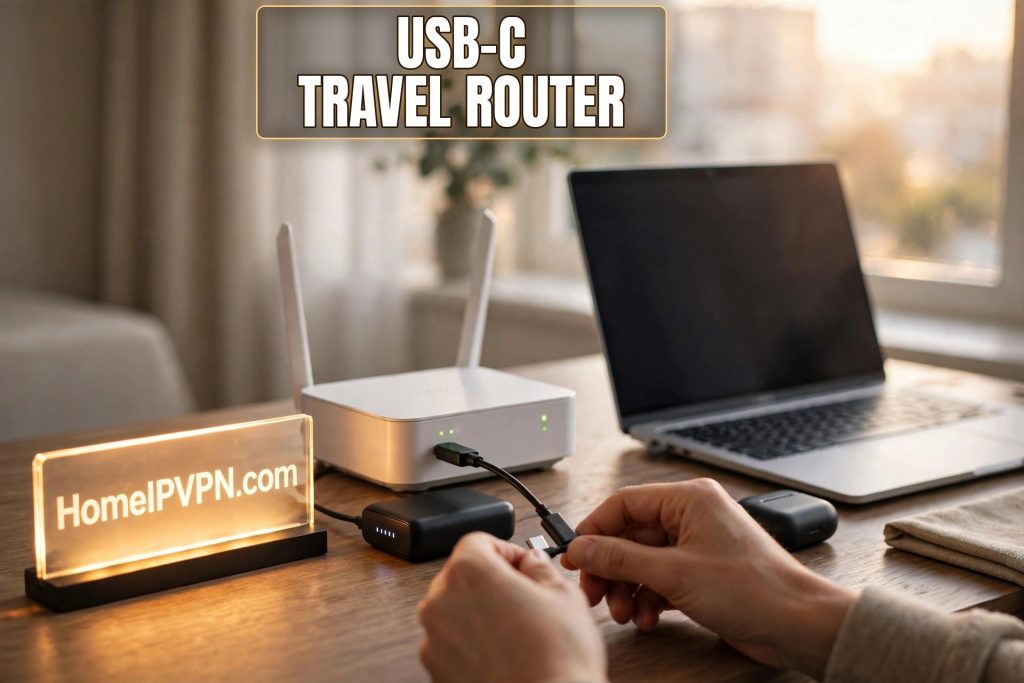
Somewhere along the way, travel routers grew up: the good ones now run off USB-C, the same cable charging your phone and laptop. That sounds like a footnote, but for travel it changes the logistics completely: one charger, one cable type, and a router you can run off a power bank on a beach. If you're shopping, here's why USB-C powered travel routers matter, what power sources actually work in practice, and what to check on the spec sheet before you buy.
Why USB-C Power Matters for Travel
The old world: every gadget with its own barrel plug and wall wart, a tangle of adapters, and the dreaded "I forgot the router's charger" moment. USB-C consolidates all of that:
- One charger for everything. A compact GaN charger with two or three USB-C ports powers your laptop, phone, and router simultaneously. Less weight, fewer things to forget, one outlet needed instead of three (and foreign hotel rooms are famous for having exactly one accessible outlet).
- Power banks become router UPSes. A USB-C router plus a power bank means your network survives outlet scarcity, power blips, and the long layover. The router sips power compared to a laptop, so even a modest bank runs it for many hours.
- Laptop-as-power-source. Stuck with no outlet at all? Most laptops can power a travel router from a USB-C port while running. It's a niche trick until the day it's the only trick.
- Cable redundancy. If one USB-C cable dies, any other USB-C cable in your bag substitutes. Proprietary barrel plugs don't offer that mercy.
There's a subtler benefit too: USB-C power delivery is negotiated. The router requests what it needs; the charger supplies it. That standardization is why a router bought this year will work with a charger bought three years from now, which is not something you could say about the barrel-plug era.
Power Bank and Laptop-Port Realities
"USB-C powered" covers a range of actual power needs, and this is where buyers get tripped up. Not every USB-C source can run every router:
- Check the router's power draw. Compact travel routers typically want 5V at 2A (10W) or similar; more powerful models with faster WiFi and VPN throughput may ask for 9V or 12V via Power Delivery. The spec sheet lists input requirements: read them, don't guess.
- Power banks: capacity vs. output. A bank's mAh rating tells you runtime; its output spec tells you whether the router runs at all. A bank that only outputs 5V/1A won't satisfy a router demanding 5V/2A: the router may boot-loop or brown out under VPN load. Look for banks with 18W+ USB-C PD output for headroom.
- Under load vs. idle. A router idling on a config page draws little; the same router pushing WireGuard at full throughput with both radios blasting draws notably more. Test on the power bank under load (test your VPN connection speed) before trusting it for a workday. Brownouts under load are the classic failure: fine until the video call starts.
- Laptop ports vary. Some laptop USB-C ports deliver plenty; others (especially on thin ultrabooks, or ports shared with other functions) current-limit. If the router flaps when powered from the laptop, that's usually the port, not the router. A powered bank or wall charger settles it.
- Cable quality matters. Thin, cheap USB-C cables drop voltage over length. A 2-meter bargain cable can starve a router that a 0.5-meter good cable runs fine. For the router, carry a short, decent cable: it's the highest-leverage dollar in the kit.
- Airplane and train USB ports. Those seatback USB ports are typically low-power (often 5V/0.5-1A): enough to trickle-charge a phone, usually not enough for a router under load. Don't plan around them; bring the bank.
What to Check on the Spec Sheet
Shopping checklist, in the order I'd prioritize:
- Input power spec. Voltage and amperage (e.g., 5V⎓2A, or USB-C PD ranges). This determines what chargers and banks will run it. Wider input ranges (5V-12V PD) mean more compatible sources.
- VPN throughput, not just WiFi speed. Spec sheets trumpet WiFi numbers (AX3000!); the number that matters for a home IP setup is WireGuard/OpenVPN throughput in Mbps. A router with blazing WiFi and a weak CPU gives you a fast local network stapled to a slow tunnel.
- Actual USB-C port (not just "USB powered"). Some "USB powered" routers use micro-USB or USB-A for power: functional, but you lose the cable-consolidation benefit. True USB-C PD input is what you want.
- Repeater/WISP + tethering modes. For travel, the router must join hotel WiFi as upstream and accept USB-tethered phones. Most do; verify rather than assume.
- Weight and size. Pocketable matters more than it sounds: the router that lives in your daypack gets used; the one that needs its own pouch gets left behind. Compare dimensions, not just marketing photos.
- Firmware and update cadence. A router is network infrastructure: check that the vendor ships security updates and that the firmware is OpenWrt-based (or similarly maintainable). Abandoned firmware on a VPN endpoint is a liability.
- Ethernet port. Even one gigabit LAN/WAN port is worth having for the occasional wired hotel or Airbnb connection. Wired upstream beats wireless repeating every time.
What not to over-index on: maximum WiFi link rates (your bottleneck is the hotel's internet, not the WiFi), number of antennas (diminishing returns in a hotel room), and gaming-oriented features (QoS profiles for consoles don't help WireGuard throughput).
FAQ
Can I really run a travel router off a power bank all day?
Will any USB-C charger work?
Does USB-C power affect VPN performance?
USB-C vs. built-in battery routers: which is better?
What cable should I carry for the router?
Can the router charge from my phone?
Need Help Setting This Up?
Picking the router is the fun part; the part that eats weekends is everything after: VPN profiles, DNS, subnets, failover, testing it all before you fly. Our done-for-you setup takes whatever hardware you chose (or helps you choose) and delivers it configured, tested, and documented: https://homeipvpn.com.