PRIVACY & SECURITY
The Fake Landlord: Rental Scams Targeting Digital Nomads
Quick Answer Fake landlord scams target digital nomads with beautiful rental listings for apartments that do not exist, or that the “landlord” has no right to rent. The scammer collects a
Quick Answer
Fake landlord scams target digital nomads with beautiful rental listings for apartments that do not exist, or that the “landlord” has no right to rent. The scammer collects a deposit and first month’s rent by wire transfer, then disappears. Never send money for a rental you have not verified, and never pay by wire transfer or crypto.
- The scam: a too-good-to-be-true apartment listing, a charming “landlord” who is conveniently out of town, and pressure to wire a deposit before someone else takes it.
- Why nomads fall for it: you are booking from another country, you cannot view the place, and you need somewhere to land when your flight arrives.
- The red flags: prices far below market, no video viewing possible, wire transfer or crypto only, and urgency manufactured around your arrival date.
- Booking safely: verify every listing independently and handle deposits over connections you trust, which is easier when your online life runs through a home IP from HomeIPVPN wherever you travel.
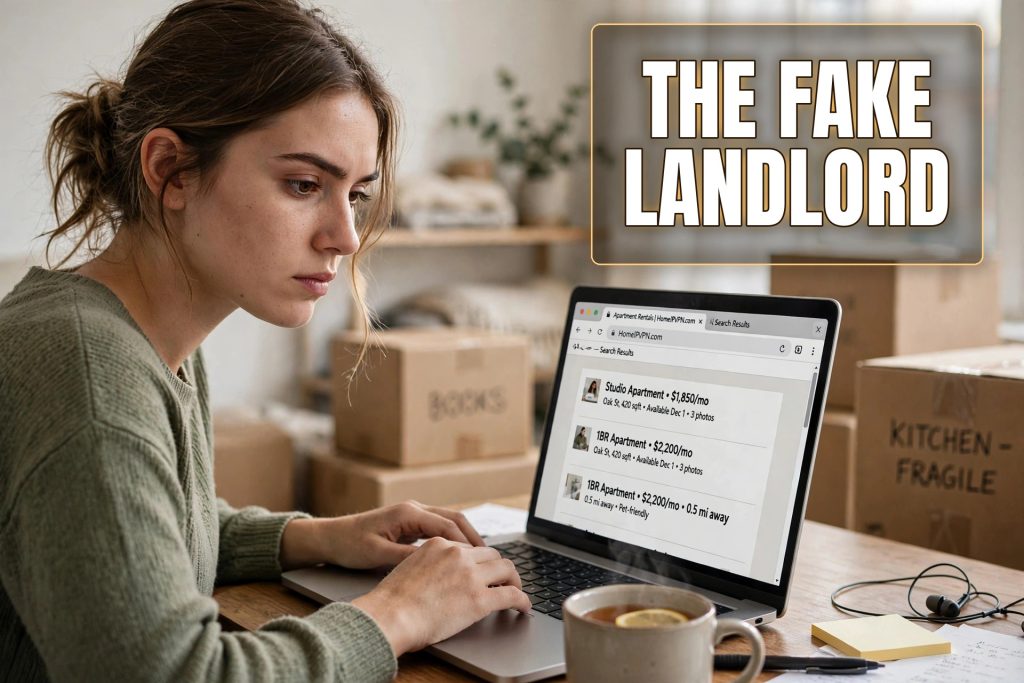
You land in Tbilisi at midnight after fourteen hours of travel. Your phone has 4 percent battery, your back aches, and the taxi driver is asking for the address in a language you do not speak. You give him the address of the apartment you found three weeks ago in a digital nomad Facebook group: two bedrooms, fast wifi, a balcony overlooking the old town, $600 a month. The photos were gorgeous.
The taxi pulls up to a dark building. The address does not quite match. You call the landlord. The number is disconnected. You message him on WhatsApp. One grey tick, then nothing. You stand on a strange street at 1am with two suitcases, and it dawns on you slowly, the way bad news does when you are exhausted: there is no apartment. There never was. The $1,200 deposit and first month’s rent you wired last week went to a man who does not exist, for a flat he never owned.
This happens to nomads every single week, in every popular remote-work city on earth. The fake landlord scam is simple, cruel, and perfectly tuned to the way digital nomads find housing: from far away, in a hurry, through strangers on the internet. Here is exactly how it works and how to make sure it never works on you.
How the fake landlord scam works
It starts with a listing that makes your heart beat faster. The apartment is beautiful, the location is perfect, the wifi speed is stated right there in the description (a detail that tells you this listing was written for nomads), and the price is just below what you would expect. Not absurdly cheap, because that would be suspicious. Just cheap enough to feel like a lucky find.
The “landlord” is friendly, responsive, and full of plausible detail. He is often out of town, which is why he cannot show you the place in person, but he is happy to do a video call “tomorrow” that keeps getting postponed. He answers your questions about the neighborhood convincingly, because he has copied the listing, photos and all, from a real rental site, sometimes from a property that is genuinely for rent by someone else entirely.
Then comes the pressure. Another nomad is interested. The price is only guaranteed if you commit this week. Your flight is soon and you need certainty. He suggests a wire transfer or a crypto payment for the deposit and first month, because it is “faster” and “avoids fees.” He may even send you a rental agreement that looks impressively official. It is worth exactly nothing.
You send the money. The replies slow down, then stop. The listing disappears. The WhatsApp profile picture changes. By the time you land, there is nobody to call, no address that exists, and no realistic way to get the money back, because wire transfers and crypto payments are designed to be irreversible. That irreversibility is the whole reason the scammer insisted on them.
Why digital nomads are the ideal victims
Think about the nomad housing hunt from the scammer’s perspective. Their ideal victim needs a place in a city they have never visited, cannot view the property in person, is working against a flight date, and is accustomed to sending money to strangers on the internet. That is not a description of a gullible person. That is a description of every digital nomad, including the careful ones.
Nomads also hunt in the exact places scammers fish: Facebook groups, Telegram channels, expat forums, and classified sites with minimal verification. These communities run on trust and move fast. A listing posted at 9am can have a deposit wired by noon, with nobody in between asking hard questions. Scammers join these groups by the dozen, post stolen listings, and harvest.
There is a psychological layer too. Finding housing from abroad is stressful, and the relief of finding “the one” is powerful. Once you have mentally moved into the apartment, pictured your desk by the window, told your friends the neighborhood, your brain starts protecting the decision. Warning signs get reinterpreted: the landlord being out of town becomes “he is busy,” the wire transfer becomes “that is just how they do it here,” the urgency becomes “the market is competitive.” Scammers do not need to be brilliant. They just need you to be tired and hopeful at the same time.
The red flags, before you send a cent
Run every long-distance rental through this checklist. One flag is a caution. Two or more means walk away.
The price is wrong. Compare the listing against similar apartments on established platforms. If it is 30 to 40 percent below market for the quality shown, it is bait. Scammers price for desire, not for the market.
You cannot see it live. A landlord who cannot manage a live video walkthrough in 2026 is either not the landlord or not near the property. Excuses about broken cameras, bad signal, or being abroad indefinitely are the oldest tells in this scam. Insist on live video, and watch for the walkthrough that is clearly a slideshow of the listing photos.
Payment by wire or crypto only. This is the brightest red flag there is. Legitimate landlords and agencies accept traceable, reversible payment methods: bank transfers to verifiable accounts, platform payments, cards. Wire transfers and crypto are the scammer’s choice precisely because you cannot undo them.
Urgency tied to your flight. “Someone else wants it” is the oldest pressure tactic in sales, legitimate or otherwise. A real landlord with a real apartment will still have it tomorrow. The apartment that vanishes if you sleep on it was never real.
The story is slippery. The landlord’s name does not match the name on the agreement. The email address is brand new. They contacted you rather than the other way around. They are oddly uninterested in who you are; a real landlord wants to know their tenant, while a scammer just wants your deposit.
Too perfect, too easy. No deposit protection, no questions, no paperwork hassle, immediate availability in a competitive market. Real rentals involve friction. The absence of friction is the warning.
How to verify a rental from another country
Here is the verification routine that experienced nomads use, and it takes less than an hour.
Reverse image search the photos. Drag the listing photos into a reverse image search. If the same “Tbilisi apartment” is also listed as a flat in Lisbon and a villa in Bali, you have your answer. Stolen photos are the backbone of this scam, and this check kills most fake listings in sixty seconds.
Demand a live video tour. Not a recorded video, a live one, where you can ask the person to show you something specific: “open the balcony door,” “show me the street from the window.” A scammer with stolen photos cannot do this. A real landlord can, and will not be offended by the request.
Verify the person. Ask for a full name and check it against the property. In many countries you can check land registries or ask a local contact. At minimum, video call the person and make sure the face matches any ID they show you. If they refuse every form of identity verification while asking for your money, the asymmetry tells you everything.
Use platforms with protection. For your first month in a new city especially, book through platforms that hold your payment and offer rebooking if the place does not exist. Yes, the fees sting. They are insurance, and they are cheaper than losing a deposit.
Get a local eyes-on. This is the gold standard. A friend, a fellow nomad already in the city, a coworking space community, anyone who can walk past the building and confirm it exists. Nomad communities are generous with this; ask in the group chat. “Can anyone check an address for me?” gets answered fast, because everyone has either been scammed or nearly scammed.
Never wire money from a sketchy connection. When you do pay a legitimate deposit, handle it like the significant financial transaction it is: from your own device, over a connection you trust, through your normal banking. Doing money moves over hostel wifi or a random cafe network adds risk to an already stressful moment. Travelers who keep a home IP setup do their financial admin through their own home connection from anywhere, which removes one variable from an already complicated process. It is a quiet piece of infrastructure, and it is part of what HomeIPVPN sets up for people who live on the road.
“I already sent the money.” Now what?
Act fast, though you should know the odds are tough. If you paid by bank transfer, call your bank immediately and ask about recalling the transfer; there is a short window where this sometimes works. If you paid by card through any platform, start a chargeback. If you wired cash or sent crypto, recovery is unlikely, but report it anyway.
Report the listing to every platform where it appeared, and report the scammer’s accounts. File a police report in the city where the “property” was listed; you will need the report number for any bank or insurance claim. If you are in a nomad community, warn them with specifics: the listing text, the photos, the phone number. You will be saving the next person, and the community will remember it.
Then handle the practical emergency: you need somewhere to sleep tonight. This is why experienced nomads always book the first few nights in a cancellable hotel or hostel, even when they have a “confirmed” apartment. It feels like wasting money right up until the night it saves you.
Booking housing like a scam-proof nomad
The long-term defense is boring, which is why it works. Default to platforms with payment protection for anything you cannot verify in person. Build a network of local contacts in your regular cities who can do quick address checks. Keep a shortlist of trusted landlords and agencies in the places you return to; repeat business is the opposite of the scammer’s one-shot model.
Slow down the decision. The single most protective habit is refusing to be rushed. Tell every landlord you need 48 hours, as a policy, no exceptions. Scammers cannot survive a 48-hour verification window; real landlords can. That one rule, applied consistently, filters out nearly all of them.
And keep your money logistics as steady as the rest of your digital life. The same principle that protects your banking, doing sensitive things through your trusted home connection instead of whatever network is nearby, applies to rental deposits too. When your online life is anchored to home, you make calmer decisions and leave fewer openings. A home IP arrangement gives you that anchor in every country, and it is exactly the kind of setup HomeIPVPN builds for travelers.
The root cause is simple: nomads have to trust strangers with large sums of money from thousands of miles away, and scammers have built an entire industry around that necessity. That exposed position, doing high-stakes admin through unfamiliar networks with no one nearby to double-check, is what HomeIPVPN was built to steady, by keeping your online life routed through your home connection wherever you are. If you would rather have someone set it up and verify it works, the Pre-Travel Audit & Advisory session is 1 hour, costs $79, and that fee comes straight off the $279 Secure Home IP VPN System session if you go ahead.
The right apartment is out there, and its landlord will happily show it to you live on video. Anyone who will not is telling you everything you need to know.