PRIVACY & SECURITY
“Your Package Is Held at Customs”: The Delivery Text Scam
Quick Answer The “your package is held at customs” text is one of the most common delivery scams in the world. Real customs agencies never ask for payment or personal details by text messa
Quick Answer
The “your package is held at customs” text is one of the most common delivery scams in the world. Real customs agencies never ask for payment or personal details by text message with a link. If you get one, do not click, do not reply, and check your parcel only through the official website or app of the carrier you actually used.
- The scam: a text claims your parcel is stuck at customs and demands a small “release fee” through a link, which leads to a fake payment page designed to steal your card details.
- Why travelers fall for it: when you are abroad waiting on a package from home, a customs message feels completely plausible, and urgency shuts down your skepticism.
- The red flags: an unknown sender, a strange shortened link, a tiny fee, bad grammar, and pressure to act within hours.
- Staying safe on the road: always verify parcels through your real accounts over a connection you trust, which is one more reason travelers keep a home IP from HomeIPVPN for their banking and sensitive logins.
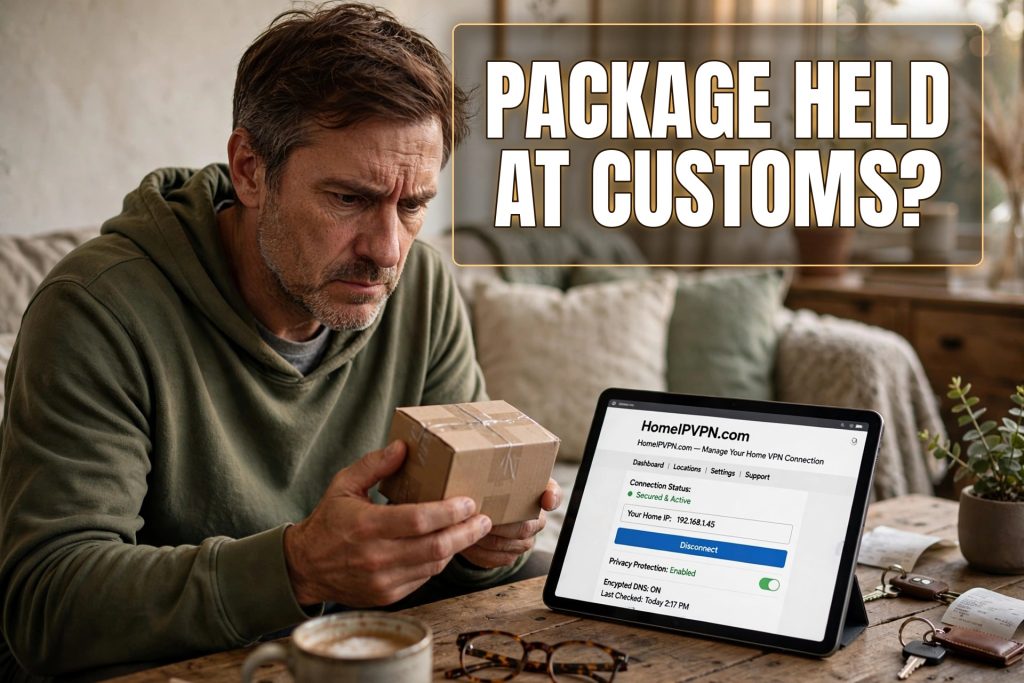
You are three weeks into a work stint in Mexico City. Your sister mailed you a package from home two weeks ago: some documents you need, a spare charger, a few comforts from your own kitchen. The tracking has been vague for days, just sitting at “in transit,” and you have been checking it every morning with your coffee.
Then, at 2:14 in the afternoon, your phone buzzes. “USPS: Your package is held at customs. Pay $2.99 release fee within 24 hours to avoid return: [link].” Your stomach drops. Two ninety-nine is nothing. The link looks sort of official. And if you do not act, your documents go back across the ocean.
Your thumb is hovering over the link when something nags at you. Why would customs text you? How did they get this number, your new Mexican SIM? You show it to a friend, who laughs and says, “Oh yeah, I get those every month. It is a scam.” You delete it, check the real tracking in the official app, and your package is moving along just fine.
That text, or one very much like it, lands on millions of phones every year, and travelers are among its favorite targets. Let us walk through exactly how it works, why it is so convincing when you are far from home, and what to do in the thirty seconds after you receive one.
How the “package held at customs” scam actually works
It starts with a text message, and the details change with the season. Sometimes it says USPS, sometimes DHL, FedEx, or the postal service of whatever country you are in. Sometimes it mentions customs specifically; sometimes it says the package needs a redelivery fee or an address correction. The amount is always small: $1.99, $2.99, a few euros. Small enough that your brain files it under “not worth investigating” instead of “possible crime.”
The link is the whole point. It goes to a page dressed up to look like the carrier or the customs agency: the right colors, the right logo, sometimes even your tracking number if the scammers bought leaked data. The page asks for the small fee, and to pay it you enter your card number, expiry, CVV, and usually your name and address “for verification.”
Here is what happens next. The scammers do not care about the $2.99. They now have your full card details, your name, and your address. Within hours or days, that card gets tested with small purchases, then bigger ones. Sometimes the page also installs nothing at all and just harvests; sometimes it asks for more “verification” and walks you into handing over your banking login. The package, of course, never existed in their system. There was no package. There was only a text.
The operation is industrial. Scammers blast these texts to millions of random numbers, often bought in bulk from data leaks. They do not know you are waiting for a package. They do not need to. Enough people are waiting for a package at any given moment that the hit rate pays for the whole operation many times over.
Why travelers are the perfect target
Now think about why that text felt so believable in Mexico City. When you are traveling, almost everything about the scam’s setup is true in your life. You actually are waiting for a package from home. You actually do not know how customs works in this country. The sender number is unfamiliar, but so is every number here, because you are on a foreign SIM. The link looks odd, but every official website looks slightly different in another country anyway.
Travel strips away your normal reference points. At home, you know what a real USPS text looks like, or you know that your national post does not text at all. Abroad, you are guessing. Add jet lag, a work deadline, and the anxiety of important documents floating somewhere in the international mail system, and your skepticism is running on fumes. Scammers do not need you to be gullible. They just need you to be tired, busy, and far from anyone you could ask.
There is another layer. Travelers are constantly doing unfamiliar admin: new SIM cards, new addresses, forwarding mail, dealing with banks from hotel wifi. A message about a package fits seamlessly into the background noise of travel logistics. It does not stand out as weird, because everything is slightly weird when you are living out of a suitcase.
This is also why the scam spikes around holidays and big travel seasons. More people traveling, more packages in the mail, more distracted recipients. If you are reading this in November or December, consider yourself warned twice.
The red flags, in plain sight
Once you know what to look for, these texts practically announce themselves. Run through this checklist in the ten seconds after one arrives.
An unknown or weird sender. Real carriers send from short codes or verified sender IDs you recognize. Scam texts come from random long numbers, often with foreign country codes, or from an email address. If the sender looks like a phone number that could belong to anyone, it belongs to a scammer.
A link you are supposed to click. This is the big one. Real postal services and customs agencies do not send you links by text and ask you to pay. If there is a link, especially a shortened one, treat the whole message as guilty until proven innocent.
A small, urgent fee. The amount is engineered to feel too small to question and the deadline engineered to feel too tight to think. “Pay $2.99 within 24 hours or your package is returned.” Real bureaucracy does not work at that speed. Customs holds are measured in days and weeks, not hours, and they notify through official channels, not panic texts.
Sloppy details. Bad grammar, odd phrasing, a carrier name that does not quite match (“US-Postal-Service” instead of USPS), or a message about a carrier you never used. Scammers work at volume and their copy shows it.
It asks for card details at all. No legitimate customs process collects payment through a link in a text message. Full stop. If money is changing hands because of a text, it is a scam.
What to do in the thirty seconds after you get one
Do not click the link. Do not reply, not even with “STOP” or an angry message, because replying confirms your number is active and gets you more spam. Do not call any number in the text. Just do this instead.
First, if you are genuinely expecting a package, open the carrier’s official app or type their real website address into your browser yourself. Never use the link from the text. Check the tracking number there. Nine times out of ten, your package is fine and moving normally, and the text had nothing to do with it.
Second, if you want to be thorough, you can forward the scam text to your carrier’s fraud reporting number. In the US, that is 7726 (SPAM). Many countries have an equivalent. It takes five seconds and helps carriers shut the operation down.
Third, delete the text and block the sender. Done. That is the whole incident response, and it took less time than reading this section.
One more thing worth doing, especially on the road: if you need to log in to your bank or your real carrier account to double-check something after a scare like this, do it over a connection you trust. Hotel and cafe wifi is exactly where you do not want to be typing card numbers. Travelers who keep a home IP setup can check their real accounts through their own home connection from anywhere, which removes a whole category of worry. It is a small habit, but it is the kind of quiet infrastructure that makes travel feel safe, and it is part of what services like HomeIPVPN are set up to provide.
“But I already clicked.” Do not panic.
It happens. The text arrived at the worst moment, you were half asleep, you clicked. Here is the calm, practical recovery.
If you only clicked the link but entered nothing, you are almost certainly fine. Close the page, clear your browser data if you want to be thorough, and move on. Just clicking rarely does damage on a modern phone.
If you entered card details, call your bank or card issuer now, not later. Tell them exactly what happened. They will cancel the card and issue a new one, and they deal with this every single day, so there is no lecture coming, just a process. Then watch your statements closely for the next month or two for small test charges you do not recognize.
If you entered a password you reuse elsewhere, change it everywhere you used it, starting with your email and your bank. Yes, everywhere. Password reuse is how one scam text turns into a full account takeover. A password manager makes this ten times less painful, and if you do not have one, a scare like this is a fine reason to start.
If you downloaded anything or granted the page any permissions, run your phone’s security scan and consider it compromised until proven otherwise. This is rare with pure text scams, but worth mentioning for completeness.
The emotional part matters too. People feel stupid after falling for these, and that shame keeps them from calling the bank quickly, which is the one thing that actually limits the damage. You are not stupid. You are a busy person who got targeted by professionals. Call the bank.
How real customs and carriers actually contact you
It helps to know what the real process looks like, so the fake one stands out. When a parcel is genuinely held at customs, the carrier handling it notifies you through their official tracking system: the status changes in their app or on their website, which you check yourself. If duties or fees are owed, you typically pay through the carrier’s official site or at pickup, not through a surprise text.
Customs agencies themselves almost never contact individual recipients directly about a single parcel. They deal with the carrier or the broker, who deals with you. No customs officer anywhere is texting travelers links to pay $2.99. The whole premise falls apart the moment you picture how actual bureaucracy works: slowly, on paper, through official channels, with reference numbers you can verify independently.
So the rule is beautifully simple. Any message about a package that arrives uninvited, contains a link, and asks for money or details is fake. Check your parcel the way you always do, through the official app, and let the text die in your deleted folder.
Making yourself a harder target while you travel
You cannot stop the texts from arriving; your number is out there and the blasts are automated. But you can make yourself nearly immune. Keep your real tracking in the official apps so you always know the true status of anything you are waiting for. Never click package links from messages, as a blanket rule, no exceptions, even when you are tired. And keep your sensitive logins, banking, email, carrier accounts, on connections you trust rather than whatever wifi the hostel offers.
That last one deserves emphasis because it is the thread connecting all of this. Scams work best on people who are stretched thin and improvising. The travelers who sail through are the ones whose digital life has a stable home base: the same trusted connection, the same verified apps, the same habits, no matter which country they woke up in. A home IP setup is one way to get that stability, keeping your online life anchored to your own house’s internet even when your body is on another continent. It is the kind of thing HomeIPVPN installs for travelers who are tired of doing sensitive admin over strange networks.
The root cause behind all of this is that scammers love travelers: new numbers, unfamiliar networks, packages in transit, and nobody nearby to ask “does this look right to you?” That exposed, in-between feeling is exactly what HomeIPVPN was built to reduce, by keeping your online life routed through your home connection wherever you are. If you would rather have someone set it up and verify it works, the Pre-Travel Audit & Advisory session is 1 hour, costs $79, and that fee comes straight off the $279 Secure Home IP VPN System session if you go ahead.
Your sister’s package will arrive. The scammer’s text will not. Learn the difference once, and you will never hover over one of those links again.