PRIVACY & SECURITY
What to Do in the First 24 Hours After You Think You Have Been Scammed
Quick Answer If you think you have been scammed, the first 24 hours matter most. Change the passwords on your email and banking first, then call your bank to freeze or replace compromised cards, then
Quick Answer
If you think you have been scammed, the first 24 hours matter most. Change the passwords on your email and banking first, then call your bank to freeze or replace compromised cards, then work through your other accounts methodically. Document everything and report the scam to the proper channels. Speed limits the damage, and panic makes it worse.
- First hour: change your email password and banking passwords from a device you trust, then call your bank about any exposed cards or transfers.
- First day: sweep every account that shares a password, turn on two-factor authentication everywhere, and check statements for transactions you did not make.
- Document as you go: screenshots, transaction IDs, wallet addresses, URLs. You will need them for the bank, the police, and any platform reports.
- Rebuild on solid ground: once the dust settles, the HomeIPVPN blog’s security guides help you set up travel habits that make the next scam far less likely to find you.
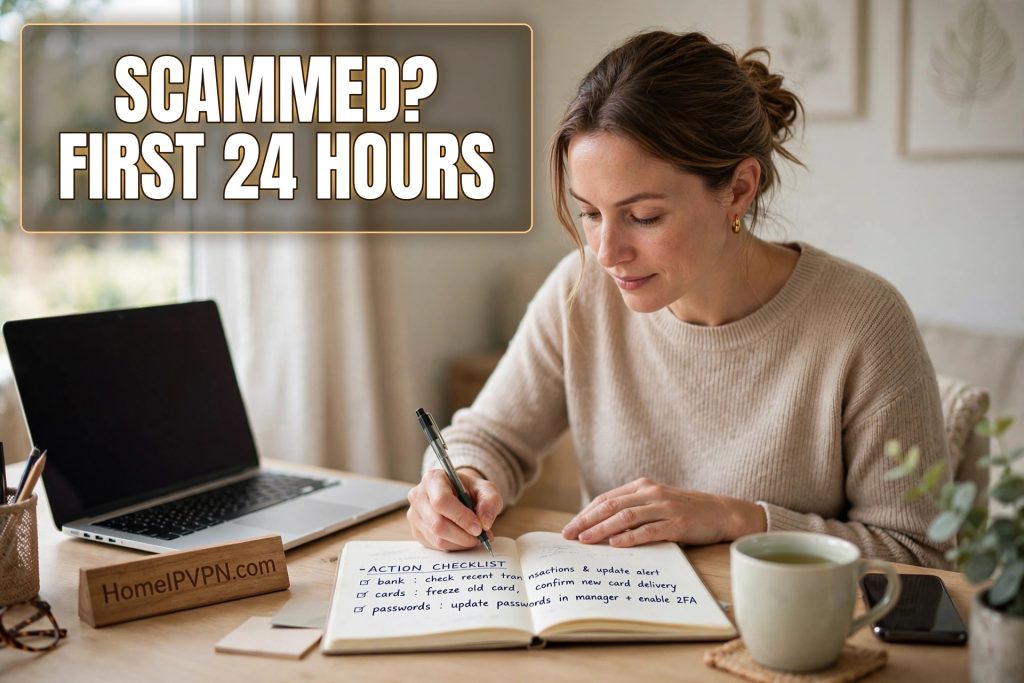
Your hands are shaking a little. Maybe you just realized the “bank” email was fake, twenty minutes after you typed in your password. Maybe the trading platform went dark overnight. Maybe a hostel “friend” has stopped answering messages and your wallet is empty. Whatever happened, you are reading this because the worst part already happened, and now you need a plan.
Here it is. This post is the calm, ordered checklist I wish someone had handed to every traveler I have watched go through this. It is organized by urgency: what to do in the first hour, the first day, and the first week. You do not need to think. You just need to follow the steps. Thinking comes later, when the accounts are safe.
The first hour: stop the bleeding
Minute one: breathe. I mean that literally. Sit down, take three slow breaths, and unclench your jaw. Panic is the scammer’s second attack. Every bad decision in the next hour will come from rushing, so the most important security tool you own right now is your own calm. You have time. Most damage from scams unfolds over hours and days, not seconds.
Now, change your email password. Not your bank password first. Your email. Here is why: your email account is the master key to everything else. Password resets go to email. Bank alerts go to email. If the scammer has your email, they can lock you out of your own recovery process. Change it now, from a device you trust, to a long password you have never used anywhere else. If you can, do this on mobile data rather than the hostel wifi, just to remove one variable.
Next, your banking and payment apps. Change those passwords too, in order of importance: the bank holding your main funds, then payment apps like PayPal, Wise, or Revolut, then anything else financial. Use unique passwords for each. If your brain is fried, this is the moment a password manager earns its place: let it generate and remember them so you do not have to.
Now call your bank. Not tomorrow, not after you finish reading this post. Now. Use the number on the back of your card or in your banking app, never a number from a suspicious email. Tell them exactly what happened, in plain words: “I think I gave my login details to a phishing site,” or “I authorized a transfer to what I now believe is a scam.” They hear this every day. They will not lecture you. They will freeze cards, flag transactions, and start the fraud process. Ask specifically: are there any pending transactions I should know about, and can you put a watch on the account?
If you gave away a card number, have the card replaced. If you approved a transfer, ask about reversal options and time limits. Wire transfers and crypto move fast, so every hour matters for those. Card payments have better consumer protections and longer dispute windows. Knowing which kind you are dealing with tells you how urgent the next steps are.
Hours two through six: the systematic sweep
With the immediate fires out, work methodically. Open a notes app or grab paper, because you are going to make a list and check things off. Scattered panic-checking misses things. Lists do not.
First, list every account that shared the compromised password. Be honest with yourself. If you used the same password, or a variation, on your email, your bank, your social media, and that forum from 2019, all of them are now compromised. Change every one, prioritizing anything tied to money or identity: banks, payment apps, crypto exchanges, email, cloud storage, then social media. This is tedious. Do it anyway. Attackers run automated tools that try stolen credentials on hundreds of sites within minutes.
Second, turn on two-factor authentication everywhere that offers it. Every bank, every email provider, every exchange, every social account. Use an authenticator app rather than text messages where you have the choice. Text messages can be intercepted, especially when you are roaming on foreign networks with a local SIM. An authenticator app lives on your device and does not depend on the phone network at all. This single step would have prevented a huge share of the account takeovers travelers report.
Third, review your statements. Go through the last few weeks of every bank account, card, and payment app, line by line. Look for small test charges, scammers often run a tiny transaction first to check the card works, and for anything you do not recognize. Flag everything suspicious with your bank, even small amounts. Small charges are how they check; big charges are how they cash out.
Fourth, check your email for rules or filters you did not create. This is a step most people miss, and it is important. Sophisticated attackers who get into your email set up hidden forwarding rules or filters that delete bank alerts and password-reset emails, so you never see the warning signs while they work. In your email settings, look at filters, forwarding addresses, and connected devices or sessions. Remove anything you do not recognize, and sign out all other sessions.
Document everything, starting now
While the details are fresh, build your evidence file. Screenshot the phishing email with its headers visible if you can. Screenshot the fake website. Save transaction confirmations, reference numbers, wallet addresses, usernames, phone numbers, and URLs. Write down the timeline: when you received the message, when you clicked, when you realized, what you did after. Memory fades fast under stress, and this record becomes the backbone of every report you file.
Store this file somewhere safe and backed up: cloud storage, plus a copy sent to someone you trust back home. If your devices are compromised or confiscated, you do not want your only evidence living on them. Email the file to yourself at your newly secured email address as a backup.
Why does documentation matter so much? Because from here on, you are dealing with institutions, and institutions run on records. Your bank’s fraud team needs transaction IDs. The police need specifics. The platform you report to needs URLs and usernames. “I got scammed” opens no doors. “On this date, at this time, this amount went to this address, and here are the screenshots” opens all of them.
Reporting: who to tell and in what order
Report in this order. First, your bank and any payment provider involved. You already called them in hour one; now follow up with the documentation and get a case or reference number. Ask what the dispute or chargeback process looks like and what the deadlines are. Write down names, reference numbers, and dates of every call. Banks are bureaucracies, and bureaucracies respect paper trails.
Second, the platform where it happened. If it was a phishing email, report it through your email provider’s phishing report tool and forward it to your bank’s fraud address. If it was a fake website, report it to the hosting provider and to Google’s Safe Browsing. If it was a social media or dating app contact, report the profile in the app. If crypto was involved, report the wallet addresses to the exchange you sent from. Each report is a small thing. Together, they get infrastructure shut down.
Third, law enforcement. File a report with the police where you are, and with the cybercrime or fraud reporting body in your home country. Be realistic: local police in a foreign country are unlikely to recover your money, especially for online fraud. File anyway. Reports create statistics, statistics drive task forces, and task forces do take down operations. Your report might be the one that completes someone else’s case file. Some travel insurance policies also require a police report for any claim, so check yours.
Fourth, tell people. I know this is the hardest one. Shame is the scammer’s best retention tool: victims who stay silent do not warn others and do not get help. Tell your travel friends, tell your family, post in your nomad groups. You will be surprised how many people respond with their own stories. Scams thrive on the illusion that they only happen to careless people. Every story told in public weakens that illusion.
The first week: recovery and watching
The acute phase is over. Now comes the watchful week. Check your accounts daily for unfamiliar activity. Fraudulent transactions sometimes appear days later, after the scammer has tested the waters or sold your details to someone else. Keep that daily check going for at least a month. It takes five minutes and it catches the slow-burn follow-ups.
Consider a credit freeze or fraud alert with the credit bureaus in your home country, especially if identity documents or enough personal data were exposed. A freeze is free, reversible, and it stops anyone from opening credit in your name. If you are American, that means all three bureaus. Other countries have their equivalents; look yours up now, before you need it in a hurry.
Watch for the recovery scam. I mentioned this in the crypto post and it bears repeating here because it targets scam victims specifically. Within days or weeks, someone may contact you offering to recover your lost money for a fee, or you may find “recovery services” while searching for help. They are all scams. Every single one. Nobody can pull back a completed transfer for an upfront fee. Legitimate help, from banks, exchanges, and law enforcement, does not charge victims for recovery.
Take care of yourself, too. Being scammed is a genuine psychological blow, and travelers often go through it alone, far from their support network. The shame spiral is normal and it is lying to you. You were targeted by professionals. Talk to someone you trust. If the amount was significant, consider that financial counseling exists and is not only for other people. You will recover faster if you treat the emotional damage as seriously as the financial kind.
Rebuilding so it does not happen again
Once the dust settles, turn the experience into armor. Do a full security reset: unique passwords everywhere via a password manager, authenticator-app two-factor on everything, notification previews hidden on your lock screen, software updated on all devices. Review what actually went wrong, without judgment, and fix that specific hole. Clicked a link while tired? Build the 30-second check habit. Trusted a stranger? Memorize the four questions. Reused a password? The manager fixes it forever. The HomeIPVPN blog’s security series walks through each of these habits step by step in plain language.
Then look at the structural stuff, the background conditions that made you vulnerable. Were you doing banking on hostel wifi? Were your logins scattering across a dozen countries, training you to ignore security alerts? Were you exhausted and distracted when it happened? Scams do not happen in a vacuum. They happen at the intersection of a clever attacker and a chaotic setup. Fix the setup and the attacker loses most of their leverage.
One of the highest-leverage structural fixes is also the simplest: make your connection boring. When every session routes through your own home IP, your banks stop flagging your logins, you stop drowning in “unusual activity” noise, and phishing emails that rely on that noise stop working. It does not replace vigilance, but it removes the fog that vigilance has to peer through. Calm infrastructure, fewer surprises, harder target.
That is the entire reason HomeIPVPN exists: one trusted home connection, everywhere you travel, so your digital life stops looking like a fraud alert waiting to happen. If you would rather have someone set it up for you and verify it actually works, the Pre-Travel Audit & Advisory session is 1 hour, costs $79, and that fee comes straight off the $279 Secure Home IP VPN System session if you decide to go ahead.
You got through the worst 24 hours. Now make them the last time. Safe travels, and be kind to yourself.