REMOTE WORK & DIGITAL NOMAD
Barcelona vs. Madrid for Remote Workers: Internet and Coworking Compared
Every remote worker who has ever considered Spain has had this argument, usually with themselves, usually late at night, usually involving a map. Barcelona:…
✓Internet and infrastructure:✓Coworking: two different flavors✓Cost of living: Madrid is kinder,
Quick Answer
Barcelona and Madrid both give remote workers fast fiber internet, plenty of coworking spaces, and big international communities. Barcelona wins on sea, weather, and lifestyle; Madrid wins on space, slightly lower costs, and feeling like a real working city rather than a resort. Your workdays will be solid in either one.
- Internet: both cities have widespread fiber, with travelers routinely reporting 100 to 600 Mbps in apartments and fast, reliable connections in coworking spaces.
- Costs: expect a one bedroom in a decent area to run roughly 1,200 to 1,800 euros a month in Barcelona and a bit less in Madrid, though both keep climbing.
- Community: Barcelona has the denser nomad scene and more beach social life; Madrid has a bigger local professional scene and more Spaniards in the mix.
- Work from either without login headaches: whichever city you pick, your home accounts may flag the Spanish login, so some nomads use HomeIPVPN to reach their home connection from abroad.
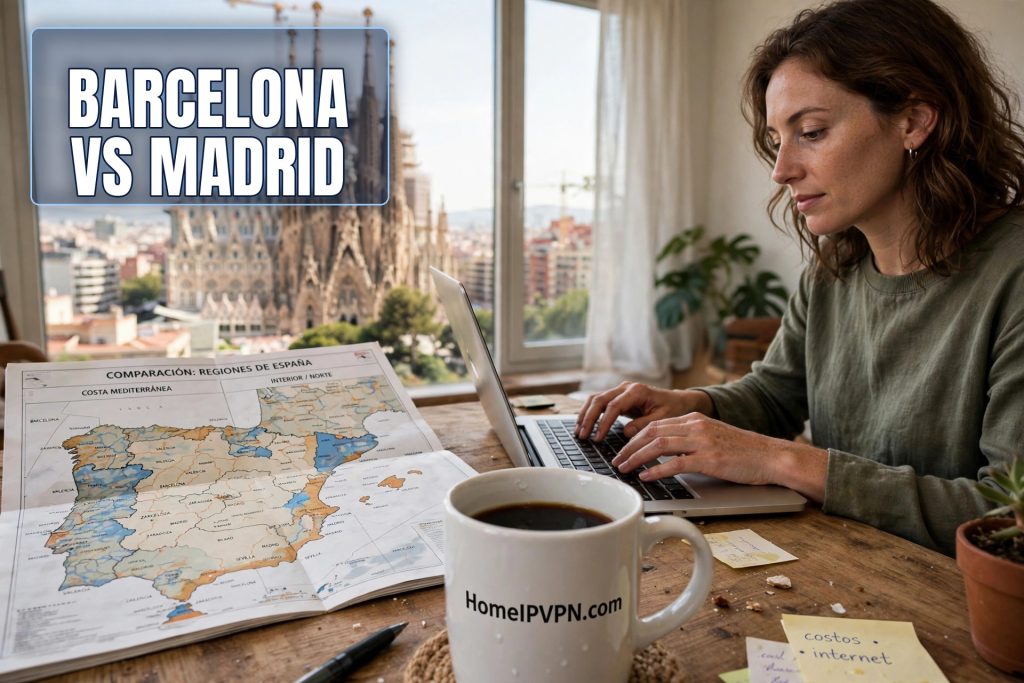
Every remote worker who has ever considered Spain has had this argument, usually with themselves, usually late at night, usually involving a map. Barcelona: the sea, the architecture, the promise of finishing work and being on the beach in twenty minutes. Madrid: the capital energy, the bigger apartments, the feeling that you are living in Spain rather than visiting it. Both cities are full of nomads who will tell you, with total confidence, that they chose correctly.
I have spent real working time in both, not just long weekends, and the honest truth is that the internet will not be the thing that decides for you. Both cities will keep your video calls crisp and your uploads fast. What actually separates them is everything around the work: the cost, the rhythm, the people, and the version of daily life you want. Let us compare them the way a remote worker actually experiences them.
Internet and infrastructure: basically a tie
Let us get the practical stuff out of the way first, because it is the least dramatic part of this comparison. Spain invested in fiber early and aggressively, and both Barcelona and Madrid are blanketed in it. Travelers routinely report apartment connections between 100 and 600 Mbps, and in practice most rentals you will find as a nomad land somewhere comfortably in the middle. Video calls, screen sharing, big file uploads: all fine, in both cities, with no heroic measures required.
Coworking spaces in both cities run on business grade connections that are fast and stable, with proper backup lines in the better ones. Mobile data is excellent too. Spain’s 4G and 5G coverage in both metros is strong, and a local SIM with generous data costs a few euros a month, which makes your phone a perfectly good backup hotspot for the rare day your apartment router has opinions.
The one infrastructure difference worth knowing is about buildings, not cities. In both Barcelona and Madrid, the old town center apartments, the charming ones with the balconies, sometimes have older wiring or awkward router placement. When you are apartment hunting, ask the host to run a speed test during the video tour. It takes thirty seconds and saves you from discovering the dead zone behind the bedroom wall on your first workday.
Coworking: two different flavors
Both cities have deep coworking scenes, but they feel different. Barcelona’s coworking world grew up around the nomad and startup crowd, especially in Poblenou and the Eixample. The spaces tend to be design forward, social, and full of internationals. Day passes typically run 15 to 25 euros, monthly memberships a few hundred, and the event calendars are packed: skill shares, after work drinks, founder talks. If you want to make friends fast, Barcelona’s coworking scene is a cheat code.
Madrid’s coworking scene is bigger in absolute terms but more mixed. You will find the same international nomad spaces, especially in Malasana and Chamberi, alongside spaces full of Spanish professionals, agencies, and startups working in Spanish. For some nomads that is a drawback. For others, especially those learning the language or tired of the expat bubble, it is the whole point. Madrid gives you more chances to have a work life that is not 100 percent in English.
Cafe working, the other great nomad office, works in both cities but with different energy. Barcelona’s cafe culture leans Mediterranean and lingering, with laptop friendly spots everywhere in the center. Madrid’s is more traditional Spanish, which means some beautiful old cafes where working for four hours on one coffee will get you a look. Know the room. The chains and the modern specialty shops in both cities are the safe bets for long sessions.
Cost of living: Madrid is kinder, barely
Neither city is cheap anymore, and anyone telling you otherwise has not rented an apartment lately. But between the two, Madrid generally costs a bit less, especially for housing. A decent one bedroom in a good nomad neighborhood currently runs roughly 1,200 to 1,800 euros a month in Barcelona, with Madrid often coming in a couple hundred lower for comparable space. Both cities keep creeping upward, so treat any figure as a snapshot and budget with margin.
Day to day costs are close enough that lifestyle matters more than the city. Eating out is affordable in both if you follow the local rhythm: the menu del dia, the fixed price lunch, remains one of Europe’s great bargains, typically 12 to 18 euros for three courses in both cities. Groceries are reasonable. Transport is cheap and excellent in both, with monthly passes that cover metro and bus for around 20 to 35 euros depending on the zone setup.
The real cost difference is space. Madrid gives you more square meters per euro, which matters more than people expect when your apartment is also your office. A separate room with a door you can close for calls is worth real money to a remote worker, and Madrid makes that easier to afford. Barcelona compensates with the sea and the weather, which are free, but you cannot take a client call on the beach.
Neighborhoods that actually work for remote life
In Barcelona, the nomad map centers on a few areas. Eixample is the practical choice: central, well connected, full of good apartments and coworking spaces, slightly businesslike. Poblenou is the startup beach hybrid, with the coworking density and the sea a short walk away, though it is getting pricey. Gracia has the village feel, plazas, and community, great for social life, a bit further from the main coworking clusters. Avoid choosing purely on vibes: check the commute to wherever you will actually work.
In Madrid, Malasana is the classic pick: central, lively, full of cafes and young professionals, with the kind of streets you will never get tired of walking. Chamberi is the grown up version, quieter, more residential, excellent for long stays. Salamanca is polished and pricey. Lavapies is diverse and affordable with real character. Madrid’s neighborhoods feel more distinct from each other than Barcelona’s, which makes choosing one feel more consequential, and more fun.
One thing both cities share: the short term rental market is tight and competitive. Start looking early, be ready to decide fast when you find something good, and be suspicious of anything priced far below the going rate. The scam listings target newcomers in both cities equally.
Weather, lifestyle, and the thing nobody quantifies
Here is where the comparison stops being practical and starts being personal. Barcelona has the Mediterranean: mild winters, beach summers, that light that makes everything look like a postcard. You will work with the balcony doors open ten months a year. The tradeoff is August, when the heat and the tourist crowds make the center feel like a theme park, and the fact that the city’s beauty comes with a constant background hum of tourism.
Madrid has real seasons. Summers are seriously hot, dry and intense, and winters are genuinely cold, with crisp blue days that surprise people who assumed all of Spain was warm. But spring and autumn in Madrid are glorious, the city empties of tourists in August which locals love, and there is something grounding about living in a city that is not performing for visitors. Madrid feels like it belongs to the people who live there. Barcelona sometimes feels like it is on loan.
The social question matters too. Barcelona’s nomad community is denser and easier to plug into, which is wonderful for your first few months and can start to feel like a bubble after a year. Madrid’s international scene is smaller but the city pushes you toward Spanish life faster: colleagues, neighbors, the bar where they know your order. Neither is better. They are just different answers to the question of what you want your life to feel like.
The practical friction both cities share
Whichever city you choose, the same unglamorous logistics await, and it is better to hear them now. Setting up as a longer term remote worker in Spain means paperwork: the NIE, the foreigner identity number, comes up constantly, for rentals, for bank accounts, for everything. Appointments for it can book weeks out, so start early. Bank accounts for non residents are doable but require patience and documents. Phone plans are easy. Apartments are the hard part, in both cities, as discussed.
And then there is the digital friction that follows you from the airport. Your bank back home sees logins from a Spanish IP address, which is basically your internet’s return address, and some banks respond by freezing things or demanding verification at the worst moments. Streaming libraries change. Work tools with location based security can get twitchy. It is all solvable, but it is one more layer of new country admin on top of the apartment hunt and the NIE appointment.
The nomads who handle it smoothest tend to be the ones who kept a line back to their home internet. Some run a HomeIPVPN setup on their home connection before they fly, so their laptop in Barcelona or Madrid reaches the internet through their own house and their home accounts never notice they left. It is deeply unglamorous and completely effective, which describes most of the best nomad infrastructure.
So which one?
Choose Barcelona if the sea matters to you more than square meters, if you want the densest nomad community in Spain, if mild winters and balcony working sound like the dream, and if you do not mind sharing your city with several million visitors. It is the easier landing and the prettier postcard.
Choose Madrid if you want more space for your money, a city that feels lived in rather than visited, better odds of building a life in Spanish, and glorious springs and autumns. It is the deeper cut, the one that rewards staying longer.
And if you are truly torn, here is the secret both cities’ nomads eventually share: the high speed train between them takes about two and a half hours and is lovely. Plenty of remote workers split their time, a season in each, before deciding. The comparison does not have to be permanent. That is the whole point of working remotely.
Making either city feel like home base
Look past the beach versus capital debate and the real question is simpler: which city’s daily rhythm will keep you productive and happy for months, not weeks? Both have the internet, the coworking, and the community to support serious remote work. The difference is the life around the laptop, and only you know which version of it you want.
One thing is true in both cities, though. The moment your IP address says Spain, your home accounts back home start paying attention, and the resulting verification loops and locked logins are nobody’s idea of a Mediterranean lifestyle. That friction, looking foreign to the accounts that expect you at home, is exactly the problem HomeIPVPN was built to solve. If you would rather have someone set it up and verify it works, the Pre-Travel Audit & Advisory session is 1 hour, costs $79, and that fee comes straight off the $279 Secure Home IP VPN System session if you go ahead.
Pick your city, book the train just in case, and enjoy the part where your biggest daily decision is which sunny terrace to work from. That is a very good problem to have.