REMOTE WORK & DIGITAL NOMAD
Cafe Culture in Vietnam: How Remote Workers Actually Get Work Done
It is 8 in the morning in District 1, Saigon, and the cafe on the corner is already full. A woman in the corner has been there since seven, noise canceling…
✓How the cafe office actually works✓The unwritten etiquette that keeps✓WiFi: fast, free, and not actually
Quick Answer
Working from cafes in Vietnam is one of the best deals in the nomad world: strong coffee for about a dollar, fiber WiFi in most city cafes, and owners who are genuinely happy to have laptop workers settle in. The tradeoffs are real: shared networks, scarce power outlets at busy hours, and home services like your bank that sometimes lock you out when they spot a Vietnamese login.
- Buy before you camp: order a drink when you arrive and another every couple of hours, and the staff will treat you like a regular instead of a squatter.
- WiFi is fast but shared: most city cafes run on fiber, but you are on a public network with dozens of strangers, so treat it like one and keep sensitive logins to your phone hotspot when it matters.
- Sit near the walls: outlets go fast at peak hours, so a small power strip in your bag makes you the most popular person in the room.
- Keep your home logins smooth: when your bank or streaming accounts get fussy about foreign logins, some remote workers use HomeIPVPN to route through their own home connection while they are abroad.
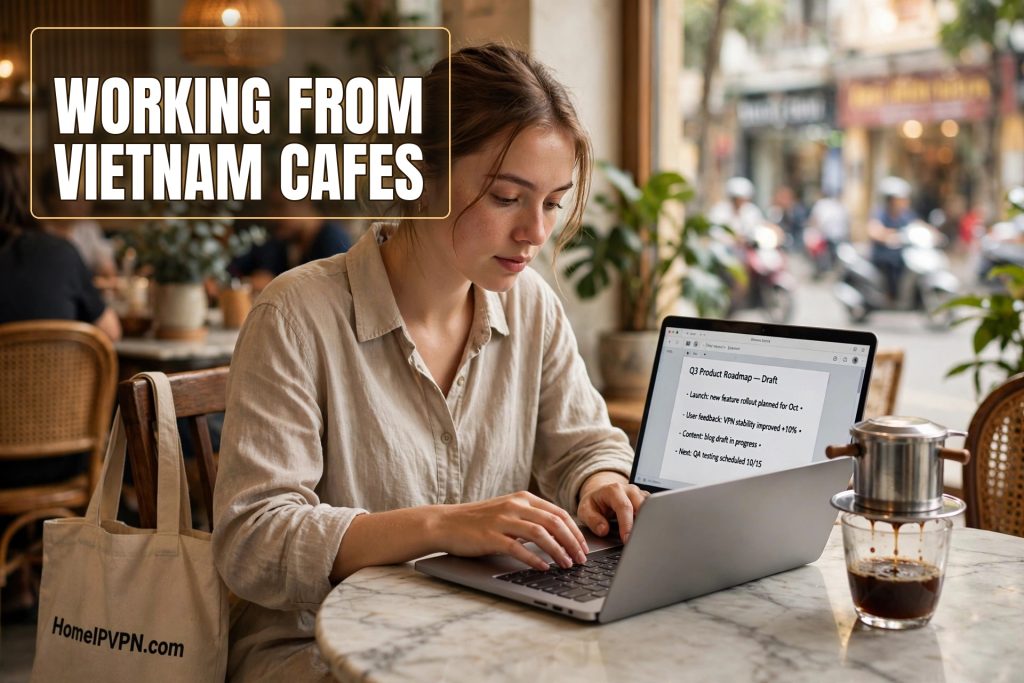
It is 8 in the morning in District 1, Saigon, and the cafe on the corner is already full. A woman in the corner has been there since seven, noise canceling headphones on, a half finished ca phe sua da sweating next to her laptop. Two German guys are running a standup call at the long table. The owner weaves between them with a tray of coffees, unbothered, like this is the most normal thing in the world. Because here, it is.
Vietnam might be the easiest country on earth to work from a cafe. The coffee is strong and costs about a dollar. The WiFi, in most cities, is shockingly good. And unlike some places where laptop campers get side eye, Vietnamese cafe culture was built for lingering. People sit for hours over one coffee. Nobody is rushing you out.
But there is a difference between surviving on cafe WiFi and actually getting work done, day after day, with deadlines and client calls. The nomads who thrive here have figured out a system. Here is what it looks like.
How the cafe office actually works
First, the rhythm. Most serious cafe workers in Vietnam do their deep work in the morning, roughly 8 to 11, before the lunch crowd rolls in. Cafes are quieter then, outlets are free, and the WiFi is at its fastest because you are sharing it with fewer people. The afternoon belongs to lighter tasks, emails, admin, the stuff you can do while a tour group argues about the menu next to you.
Second, the geography of a good work cafe. You want three things: air conditioning or at least strong fans, outlets you can actually reach, and a seating layout where you are not blocking the main walkway. The big chains, Highlands Coffee, The Coffee House, Cong Ca Phe, are the reliable defaults in every city. They are spacious, the WiFi is consistent, and nobody blinks at a laptop. But the real gems are the independent shops, the ones with a second floor or a quiet back room, where the owner learns your order by day three.
Third, the backup plan. Every long term nomad in Vietnam has a phone plan with generous data, because cafe WiFi will betray you exactly once a week, usually five minutes before an important call. A local SIM with 4G or 5G data costs a few dollars a month and turns your phone into a hotspot that saves the day. Do not work from cafes without one. It is the cheapest insurance you will ever buy.
The unwritten etiquette that keeps you welcome
Cafe owners in Vietnam are remarkably tolerant of laptop workers, and the way you repay that tolerance is simple: spend money. The rule of thumb most nomads follow is one drink every two hours, minimum. If you are camping for a full workday, buy lunch there too. A full day of air conditioning, WiFi, and a great seat for the price of three coffees and a banh mi is still an absurd bargain. Act like you know it.
A few more rules that separate the welcome regulars from the annoying tourists. Do not take the big table for six when a two top would do. Keep calls short and quiet, or step outside, because nobody wants to hear your sales pipeline review at full volume. Do not spread your gear across three seats. And if the cafe is packed at lunch and you are just nursing an empty glass, that is your cue to relocate. These are not written rules anywhere. They are just how you stay welcome.
One more thing that surprises newcomers: tipping is not really part of Vietnamese cafe culture, so do not stress about it. Being a pleasant, paying regular who learns a few words of Vietnamese will earn you far more goodwill than any tip. The staff at my regular spot in Da Nang started bringing my coffee without asking by week two. That is worth more than money.
WiFi: fast, free, and not actually yours
Let us talk about the WiFi honestly, because it is both the best and the trickiest part of the deal. Vietnam has invested heavily in fiber, and in Ho Chi Minh City, Hanoi, and Da Nang, cafe speeds of 50 to 100 Mbps down are completely normal. Travelers routinely report video calls running smoothly and big uploads finishing without drama. For a dollar coffee, that is remarkable.
But here is the catch everyone learns sooner or later: you are on a public network. Dozens of strangers, one router, no encryption between you and them. For browsing, writing, and video calls, that is fine. For logging into your bank, your accounting software, or anything with client data, it deserves a second thought. At minimum, make sure the sites you log into use HTTPS, which is the little padlock in your browser, and avoid doing sensitive money moves on cafe WiFi when your phone hotspot is right there.
The other catch is consistency. That 80 Mbps at 8am can become 8 Mbps at noon when the cafe fills up and everyone is streaming. If your work depends on stable calls, the morning shift is not a preference, it is a strategy. And always, always have the hotspot ready. The nomads who look calm when the cafe router dies are the ones who planned for it.
The power outlet economy
Ask any Vietnam nomad about their biggest daily frustration and half of them will say the same thing: outlets. Vietnamese cafes were designed for drinking coffee, not for charging twelve MacBooks, and the outlet situation reflects that. The good seats, the ones near walls and pillars, go first, and by 9am they are gone.
The fix is embarrassingly simple. Buy a small power strip or a multi plug adapter before you arrive, or grab one at any electronics market for a couple of dollars. One strip turns a single outlet into a workstation for you and instant friendship with the nomad next to you who is at 4 percent. I have watched lifelong friendships start over a shared power strip in a Da Lat cafe. Slight exaggeration. Only slight.
Also worth knowing: Vietnam uses a mix of plug types, mostly the two flat pin style and the two round pin style, at 220 volts. Most modern laptop chargers handle the voltage fine, but check the tiny print on your charger before you plug in. A cheap universal adapter solves the rest.
The rhythm of the Vietnamese workday
Vietnam runs early. Cafes open at 6 or 7am without breaking a sweat, which is perfect if you are syncing with European or American time zones and want your deep work done before your team wakes up. The midday heat, especially in Saigon, drives everyone indoors from about 11 to 2, which is when cafes get crowded and loud. Plan around it.
Evenings are the social shift. The laptop crowd thins out, the iced teas come out, and the same cafe becomes a completely different place. A lot of nomads use this natural rhythm to their advantage: hard work in the morning, lighter tasks after lunch, laptop closed by six. It is one of the healthier work rhythms you will find anywhere, mostly because the heat enforces it whether you like it or not.
One practical note for call heavy workers: the background noise in a busy Vietnamese cafe is real. Motorbikes, blenders, conversation. Good noise canceling headphones are not a luxury here, they are work equipment. Your clients will never know you took their call from a plastic stool next to a pho stand, and honestly, that is part of the fun.
The login problem nobody warns you about
Here is the thing that blindsides newcomers, and it has nothing to do with coffee or WiFi speed. You settle into your routine, everything is working, and then one morning your bank locks your account. Or your email demands extra verification. Or your streaming service suddenly shows you a completely different library. Nothing is broken. Your accounts just noticed you are logging in from Vietnam now, and their fraud systems got nervous.
An IP address is basically your internet’s return address, the thing that tells websites where you are connecting from. When yours suddenly says Ho Chi Minh City instead of Chicago, automated security systems do exactly what they were designed to do: they get suspicious. Most of the time you can clear it with a text code. But when it happens before a payroll run or while you are trying to pay rent back home, it stops being a minor annoyance.
This is the quiet, unglamorous problem underneath the cafe laptop lifestyle. The work itself is fine. It is your home accounts, the banking, the tax software, the services that expect you to be where you usually are, that create friction. Some remote workers solve it by keeping a HomeIPVPN setup running on their home connection, so their laptop abroad reaches the internet through their own house and their logins look completely normal. It is the kind of boring infrastructure you never think about until the morning your bank decides you might be a thief.
When a cafe is not enough
For all its charms, the cafe is not always the answer. Some weeks you need guaranteed quiet, guaranteed outlets, and guaranteed fast internet with no lunch rush. That is when Vietnam’s coworking spaces earn their keep. In Saigon, Hanoi, and Da Nang, day passes typically run a few dollars and monthly memberships are a fraction of Western prices, often with proper desks, meeting rooms, and coffee that does not quit at noon.
The smart play most long term nomads land on is a hybrid: cafes for the pleasant everyday grind, coworking for deadline weeks and important call days. You get the lifestyle and the reliability. And on the days when even the coworking space feels like too much structure, there is always that corner cafe where they know your order.
The setup that makes it all boring, in a good way
Step back and look at what the cafe working life in Vietnam actually demands from your internet setup. It is not one problem, it is three stacked on top of each other: public networks you should not fully trust, foreign IP addresses that make your home accounts nervous, and the occasional cafe router that dies mid call. The nomads who look relaxed are not lucky. They just solved all three before they became emergencies.
That stacked problem, staying secure on public WiFi while keeping your home accounts happy from abroad, is exactly the problem HomeIPVPN was built to solve. It gives you your own home internet connection to work through, no matter which cafe in Da Nang you are sitting in. If you would rather have someone set it up and verify it works, the Pre-Travel Audit & Advisory session is 1 hour, costs $79, and that fee comes straight off the $279 Secure Home IP VPN System session if you go ahead.
Now go find your corner table. The coffee is waiting, the WiFi is fast, and with the right setup underneath it all, the only thing you will need to worry about is whether to get the egg coffee or the coconut coffee. Get both. You have earned it.