REMOTE WORK & DIGITAL NOMAD
Getting Paid in Colombia as a Remote Worker: Banking Basics
My first ATM withdrawal in Colombia cost me eleven dollars. Not the withdrawal itself, which was maybe sixty bucks worth of pesos for a weekend in Guatape. The
✓Start with the big picture: two✓Receiving your pay: keep it simple✓Turning dollars into pesos: the
Quick Answer
Getting paid in Colombia as a remote worker means receiving foreign income and turning it into pesos without losing chunks to fees. Most nomads use a mix of a home-country bank account, a low-fee transfer service, and local cash withdrawals, and keep their home accounts fully reachable from abroad.
- Receiving pay: keep getting paid into your home-country account; most employers and clients prefer it that way
- Moving money: transfer services typically beat bank wires on fees and exchange rates for regular transfers
- Local spending: a mix of a no-foreign-fee card and ATM cash covers nearly everything in Colombian cities
- Stay reachable: banks lock accounts when logins jump countries, so keep a home IP with HomeIPVPN to avoid security flags
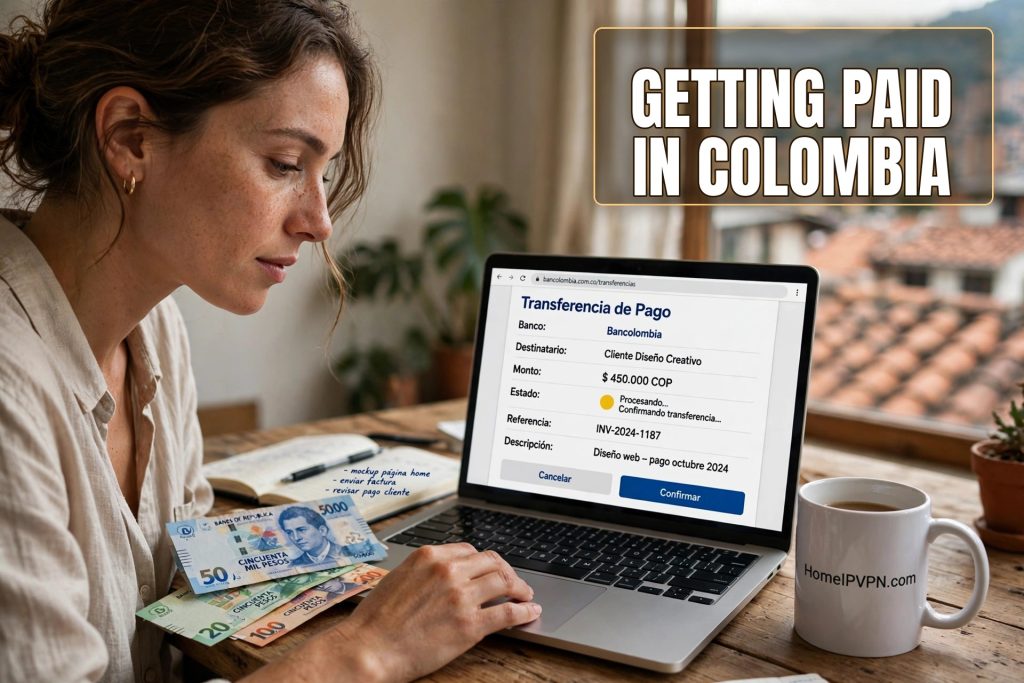
My first ATM withdrawal in Colombia cost me eleven dollars. Not the withdrawal itself, which was maybe sixty bucks worth of pesos for a weekend in Guatape. The eleven dollars was the pile of fees stacked on top: my bank’s foreign ATM fee, the local ATM’s surcharge, and a quietly terrible exchange rate. I stood there in the Poblado sunshine doing the math and feeling like an idiot.
Nobody teaches you the money plumbing of nomad life. You learn it the expensive way, one fee at a time, until you build a system. This post is the system, explained simply: how to receive your foreign income, how to turn it into pesos you can actually spend, and how to keep your home bank accounts from locking you out while you do it.
No finance degree required. Just the practical stuff that works.
Start with the big picture: two money worlds
As a remote worker in Colombia, you live in two money worlds at once. There is the world where you get paid: your employer or clients, usually paying in dollars, euros, or pounds into an account in your home country. And there is the world where you spend: pesos, in Colombia, for rent, food, transport, and weekend trips.
Your job is to build a cheap, reliable bridge between those two worlds. Every fee you pay is a toll on that bridge. The goal is to pay as few tolls as possible, and the smallest ones you can manage.
The single most important decision: do not try to move your whole financial life to Colombia. Keep your home-country bank account as your financial home base. Get paid there, keep your savings there, keep your credit history there. Colombia is where you spend, not where you bank. This keeps your taxes simpler, your credit intact, and your options open when you move to the next country.
Receiving your pay: keep it simple
If you are employed remotely, nothing changes when you move to Colombia. Your salary keeps landing in your home-country account on the same schedule. Your employer’s payroll department does not need to know or care about your time zone, though it is polite to tell them you have moved countries for tax and compliance reasons.
If you are a freelancer, keep invoicing the way you always have. Most international clients pay by bank transfer, PayPal, or platforms like Wise or Payoneer. These all work fine from Colombia; the money lands in your home account or your platform balance regardless of where your laptop sits.
One thing to watch: some payment platforms ask you to verify your location or re-verify your identity periodically. This is where nomads run into trouble, because a verification prompt that arrives while you are in Medellin can trigger the same location-based security flags as a bank login. We will come back to this, because it matters more than most people expect.
The golden rule of receiving: change as little as possible. Your income setup worked at home. It works in Colombia too, as long as you can reach it reliably.
Turning dollars into pesos: the transfer game
Now the bridge itself. You have dollars (or euros, or pounds) in your home account, and you need pesos in Colombia. Here are your options, from best to worst.
Transfer services are the nomad standard. Companies like Wise let you move money from your home account to a Colombian account (or to yourself) at close to the real exchange rate, with a small transparent fee. For regular monthly transfers, this is almost always the cheapest option. The money typically arrives within a day or two, and you can see exactly what rate you are getting before you commit. If you do one thing from this post, open an account with a low-fee transfer service before you leave home.
Bank wires are the old way, and they show it. Your home bank will happily wire money to Colombia, and will charge you $25 to $45 for the privilege, plus a markup on the exchange rate that they do not advertise loudly. For a large one-off transfer this can be acceptable. For monthly living expenses, it is a slow leak in your budget.
PayPal and similar platforms sit in the middle. Convenient if your clients already pay you through them, but the currency conversion fees are steep, often several percent worse than the real rate. Fine for receiving client payments, expensive for converting to pesos. Move the money to your bank or a transfer service before converting.
Crypto is the option some nomads swear by and others avoid entirely. Stablecoins can move across borders fast and cheap, and Colombia has a growing crypto scene with local exchanges. But the volatility, the tax questions, and the learning curve make it a poor choice as your primary money bridge. If you are already comfortable with crypto, it is a useful backup. If you are not, do not learn it under pressure in a foreign country.
How much to transfer at a time? Most nomads move a month of living expenses at once, roughly $1,200 to $1,800 for a comfortable Medellin month. This balances the per-transfer fees against the risk of holding too many pesos if the exchange rate moves. Some people transfer quarterly to minimize fees further. Find your own rhythm, but do not let a huge peso balance sit idle for months.
Spending locally: cards and cash
Once you have pesos, or a card that spends well abroad, daily life is easy.
Get a debit or credit card with no foreign transaction fees before you leave home. This is the single highest-value financial move a nomad can make. A standard card charges 2 to 3 percent on every foreign purchase, which means every coffee, every grocery run, every metro ride costs you extra. A no-foreign-fee card eliminates that entirely. Many travel-focused cards also reimburse ATM fees worldwide, which solves the eleven-dollar-withdrawal problem I started with.
In Colombia’s bigger cities, cards are widely accepted: restaurants, supermarkets, malls, ride apps, coworking spaces. You can live a mostly cashless life in Laureles or El Poblado without trying hard.
But cash still matters. Markets, street food, small shops, some taxis, and smaller towns run on cash. Keep a few hundred thousand pesos on hand (that sounds like a lot; it is roughly $75 to $125, because the exchange rate makes everyone a millionaire on paper). Withdraw from ATMs inside banks or malls rather than standalone machines on the street, and decline the ATM’s offer to convert the withdrawal for you: always choose to be charged in pesos and let your own bank do the conversion, because the ATM’s rate is always worse.
Nequi and Daviplata are Colombia’s popular mobile wallets, and you will see QR codes for them everywhere. They are handy, but they generally require a Colombian phone number and sometimes a local ID to set up fully, so many short-stay nomads skip them. If you are staying long term, they are worth the setup effort.
Should you open a Colombian bank account?
The honest answer for most nomads: probably not, at least not at first.
Opening a Colombian bank account as a foreigner is possible but bureaucratic. You typically need a valid long-stay visa (the digital nomad visa qualifies), a local tax ID number, proof of address, and patience. The process involves visits to branches, forms in Spanish, and waiting periods. It is doable, and some long-term nomads do it for convenience, but it is not a first-month task.
What a local account gets you: easier rent payments (some landlords prefer local transfers), access to Nequi and local payment rails, and no transfer fees on the receiving end. What it costs you: another account to manage, another tax reporting consideration, and the bureaucracy of opening and eventually closing it.
For stays under six months, the transfer-service-plus-good-cards combo covers everything with far less hassle. For a year or more, a local account starts to make sense, especially if you have the nomad visa and a settled address. There is no prize for opening one early.
The account lockout problem
Here is the part of nomad banking that causes the most panic, and it has nothing to do with fees.
Banks protect your money partly by watching where you log in from. Your home bank has a picture of your normal life: logins from your home city, on your devices, at your usual hours. When that picture changes overnight to logins from Medellin, Colombia, the bank’s security system has to decide whether that is you on a trip or someone who stole your password.
Sometimes it decides wrong. The symptoms are familiar to every long-term nomad: a login that suddenly demands extra verification, a code sent to a phone number you left behind, a temporarily locked account, or a transfer flagged for review. It always happens at the worst moment, usually when rent is due or a client payment needs to move.
It gets worse with time. A two-week trip barely registers. But month after month of logins from Colombia trains the system to see Colombia as your location, and then a login from anywhere else, or a large transfer, can trigger a fresh round of suspicion. Digital nomads are, from a bank’s perspective, permanently suspicious.
You can reduce the risk. Keep your home phone number active for verification codes, ideally on an eSIM you carry with you. Set up backup authentication methods before you leave. Tell your bank you are traveling, though be aware that “traveling” for six months stretches the definition.
But the structural fix is to stop the location from changing at all, as far as your bank can see. HomeIPVPN routes your internet through a small device at your home, so every login, every transfer, every verification looks like it is coming from your house. Your bank sees the same home IP address it has always seen. The security system stays calm because nothing, from its point of view, has changed.
This matters most for the accounts you cannot afford to lose access to: your primary bank, your brokerage, your payment platforms. A HomeIPVPN setup before you leave means you land in Colombia and your financial life just works, month after month, with no 2 a.m. calls to fraud departments.
A simple setup that works
Let us put it all together into a concrete system you can set up in a week.
Before you leave: open a no-foreign-transaction-fee card and a low-fee transfer service account. Keep your home bank account as your base. Keep your home phone number alive on an eSIM. Set up your home IP solution so your accounts stay reachable. Tell your banks you are traveling.
When you arrive: withdraw some pesos from a bank ATM (decline the conversion offer), pay your first rent and deposit, and settle in. Transfer your first month of living expenses through your transfer service once you know your actual costs.
Monthly rhythm: get paid into your home account as normal, transfer a month of expenses to pesos, spend on your no-fee card where accepted and cash where not, and keep an eye on the exchange rate without obsessing over it. Review your fees once a quarter; if something is leaking money, you will spot it.
The whole system fits on an index card, and once it is running it fades into the background. That is the point. Money plumbing should be boring. Boring means it works.
Here is the bottom line on getting paid in Colombia. The root cause of nearly every nomad money headache is the same: your financial life assumes you stay in one place, and your actual life does not. Transfer fees, card surcharges, and account lockouts are all symptoms of that mismatch. The fees you can minimize with the right accounts. The lockouts, your bank treating you like a stranger because your location changed, are exactly the problem HomeIPVPN was built to solve: your connection looks like home, so your accounts keep treating you like you never left.
If you would rather have someone set it up and verify it works, the Pre-Travel Audit & Advisory session is 1 hour, costs $79, and that fee comes straight off the $279 Secure Home IP VPN System session if you go ahead.
Set up the boring plumbing before you fly, and Colombia gets to be about the good stuff: the coffee, the mountains, the eternal spring, and the work getting done. Buena suerte.