REMOTE WORK & DIGITAL NOMAD
Cape Town for Digital Nomads: Internet, Safety, and the 2026 Reality
Picture this: you finish your last call of the day, close the laptop, and walk ten minutes to a beach where the sun is setting behind the Atlantic. Behind you,
✓Why Cape Town made the 2026 lists✓Internet: the question every nomad✓Safety: the honest conversation
Quick Answer
Cape Town earned a spot on Forbes’ 2026 list of the eight best cities in the world for digital nomads and creators, alongside Lisbon, Medellin, Chiang Mai, Da Nang, Austin, Miami, and Asheville. It offers a mature coworking scene, fiber internet in most central neighborhoods, a comfortable $1,200 to $2,500 monthly budget, and a timezone that lines up with Europe. The honest caveats are safety awareness, neighborhood choice, and having a connectivity backup plan.
- Internet: Fiber is widely available in nomad neighborhoods with speeds fine for video calls, though you should still confirm the actual connection before signing a lease, not the advertised one.
- Safety: Cape Town rewards street smarts. Choose well-known neighborhoods like Green Point, Sea Point, or the City Bowl, use Uber after dark, and ask locals rather than guidebooks.
- Visa: South Africa has introduced a remote work visa pathway for people employed abroad, a real improvement over the old tourist-visa shuffle, though processing can be slow, so apply early.
- Stay connected to home: Banking logins, streaming, and client systems often behave better through a home IP, and HomeIPVPN can set that up for you before you fly south.
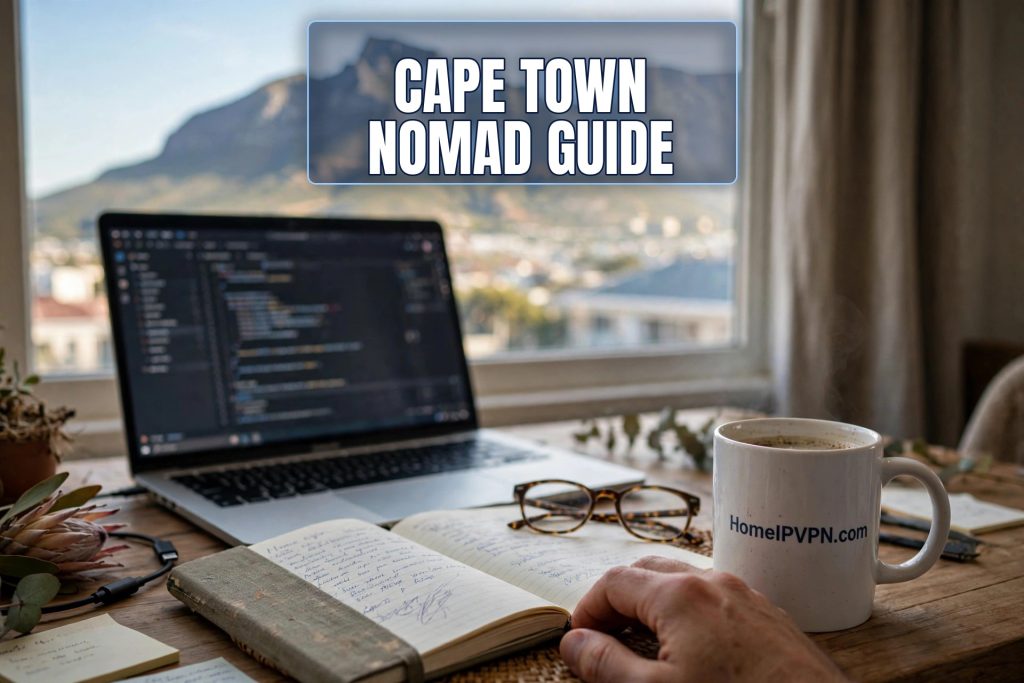
Picture this: you finish your last call of the day, close the laptop, and walk ten minutes to a beach where the sun is setting behind the Atlantic. Behind you, Table Mountain is doing that thing it does at golden hour where it looks like a film set. Your rent is half what it was in Berlin. Your morning started with a flat white that cost less than a bus ticket back home. This is the Cape Town pitch, and honestly, most of it is true.
But you have also heard the other version. The safety warnings. The stories about power cuts. The friend of a friend who had a bad experience and tells everyone to stay away. So which Cape Town is real in 2026? I have dug through the current rankings, the visa situation, and the on-the-ground reality to give you the honest version: a city that genuinely deserves its hype, with caveats you should take seriously and a setup checklist that makes the whole thing work.
Why Cape Town made the 2026 lists
In 2026, Forbes published its list of the eight best cities in the world for digital nomads and creators: Lisbon, Medellin, Chiang Mai, Da Nang, Cape Town, Austin, Miami, and Asheville. What made this ranking interesting was not just who made it, but how Forbes judged. The old formula was basically cheap rent plus decent wifi. The 2026 criteria shifted toward what Forbes called the digital entrepreneur: visa infrastructure, founder ecosystems, healthcare access, coworking density, and banking access. Cost of living still counts, but it is no longer the whole game.
Cape Town fits the new formula unusually well. It has Africa’s most mature nomad infrastructure: established coworking spaces like Workshop17, Ideas Cartel, and Cube Workspace, a real startup and creative scene, international flight connections, and a lifestyle that is genuinely hard to match. Other 2026 rankings tell the same story: Cape Town topped the list of best African destinations for digital nomads, ahead of Marrakech and Nairobi. This is not a city that is “up and coming” anymore. It has arrived.
The timezone deserves its own mention. Cape Town runs on SAST, which is UTC+2, the same as much of continental Europe for half the year and one hour off for the other half. If your clients or your team are in London, Berlin, or Amsterdam, you work normal hours. No 6 a.m. calls, no midnight standups. For Europeans, this alone puts Cape Town ahead of Southeast Asia and Latin America.
Internet: the question every nomad asks first
Let us talk about the thing that actually determines whether you can work there. Cape Town’s internet is good, not perfect, and the difference between the two is preparation.
Fiber is widely available in the neighborhoods nomads actually live in: Green Point, Sea Point, the City Bowl, Woodstock, Observatory. Speeds commonly land in the 50 to 200 Mbps range on fiber, which handles video calls, screen sharing, and uploads without drama. Most short-term rentals and Airbnbs in these areas advertise fiber, and many deliver it. The key word is verify. Before you commit to a month-long rental, ask the host for a speed test screenshot, or better, a live video call from the apartment. Advertised speeds and real speeds are different things everywhere in the world, and Cape Town is no exception.
Coworking spaces are your backup plan and your social life in one. Workshop17 has multiple locations around the city with reliable connections and proper office infrastructure. Day passes and monthly memberships run roughly $150 to $300, which buys you fast wifi, meeting rooms, coffee, and a room full of people who understand what you do. On days when your apartment connection misbehaves, the coworking space is fifteen minutes away.
Mobile data is the third leg of the stool. South African mobile networks are solid in the city, and a local SIM with a generous data bundle is cheap. Keep a hotspot-ready phone with local data as your failover for important calls. Two connections is one, one connection is none: that is the nomad rule, and it applies in Cape Town like everywhere else.
About load shedding, the rolling blackouts that used to dominate every conversation about South Africa: the situation has improved dramatically, with long stretches of stable supply. But “improved” is not “gone forever,” and the nomad playbook is simple. Choose accommodation or coworking with backup power, which many now advertise, keep your devices charged, and keep a power bank in your bag. It is a minor planning item now, not the dealbreaker it was a few years ago.
Safety: the honest conversation
Here is the part that deserves straight talk. Cape Town has real safety issues, and anyone who tells you otherwise is selling something. Street crime, muggings, and smash-and-grabs happen, and the statistics look scary from a distance. But the reality on the ground is more nuanced than the headlines, and thousands of nomads live there happily by following rules that become second nature within a week.
Neighborhood choice is everything. Green Point, Sea Point, the City Bowl, Camps Bay, and parts of Woodstock are the established nomad zones for a reason: they are walkable, well-trafficked, and full of other remote workers. Areas change quickly, sometimes street by street, so the golden rule is to ask people who live there now, not a guidebook from 2022. Your coworking space community is the best source of current street-level advice.
The daily habits are simple: do not walk alone late at night in unfamiliar areas, use Uber or Bolt after dark instead of walking, do not flash expensive gear on the street, keep your phone in a front pocket in busy areas, and lock car doors the moment you get in. None of this is exotic. It is the same awareness you would bring to any big city where you do not know the map yet. Within a couple of weeks, it stops feeling like a rulebook and starts feeling like normal.
One thing worth saying plainly: the safety conversation about Cape Town sometimes carries an unexamined bias, where the same precautions people accept without comment in Rio or Mexico City become reasons to write off an entire African city. Take safety seriously, but take it seriously on its own terms, with current local knowledge, not fear.
Money, visas, and daily life
The budget math is one of Cape Town’s strongest arguments. A comfortable nomad lifestyle runs roughly $1,200 to $2,500 a month all in, depending on your standards. A decent one-bedroom in Green Point or Woodstock, coworking membership, eating out regularly, Ubers, and weekend trips up the coast: all of it costs a fraction of London or New York. The famous line about a five-star lifestyle on a three-star budget is an exaggeration, but only a mild one.
On visas, the big 2026 development is South Africa’s remote work visa pathway, designed for people employed by companies outside the country. This is a genuine improvement over the old routine of stringing together tourist entries and hoping nobody asks questions at the airport. The honest caveat is that new visa programs everywhere start slow: processing times can be long and requirements can shift, so start early, keep your paperwork immaculate, and have a backup plan for your first entry.
Daily life is where Cape Town quietly wins people over. The food scene is excellent and affordable, from neighborhood cafes to serious restaurants. The wine regions are an hour away and absurdly cheap by international standards. Hiking, surfing, paragliding off Signal Hill, weekend trips to the Winelands or down the Cape Peninsula: the outdoors is not a vacation activity here, it is the default setting. Nomads who planned a month routinely stay for six. That tells you more than any ranking.
Setting up your digital life before you fly
There is one practical wrinkle that surprises nomads in Cape Town: how much of your digital life notices that you moved. Your bank may flag logins from a South African IP. Streaming libraries change. Some client tools and admin panels restrict access by country. None of this is catastrophic, but it is annoying, and it tends to surface exactly when you are busiest, mid-project, mid-deadline, mid-Zoom-call with a client who does not care about your timezone adventure.
The fix is to anchor your digital presence at home before you leave. A home IP setup means your connection appears from your home country no matter where you are physically, so your bank, your streaming, and your work systems behave exactly as they did at your desk. It is the kind of one-time setup that quietly removes a whole category of travel friction, and it is exactly what HomeIPVPN configures for remote workers heading abroad.
That gap between the life you planned and the login screens that fight you is the root cause of so much nomad tech stress: your body is in Cape Town but your digital identity has no stable home. That is the problem HomeIPVPN was built to solve, a home IP connection set up for you so your online life stays anchored while you roam. If you would rather have someone set it up and verify it works, the Pre-Travel Audit & Advisory session is 1 hour, costs $79, and that fee comes straight off the $279 Secure Home IP VPN System session if you go ahead. Book a Pre-Travel Audit & Advisory session before your flight, and land with one less thing to troubleshoot.
Cape Town rewards the prepared and the street-smart. Do the homework, pick the right neighborhood, verify the wifi, and then go watch the sun set over the Atlantic. You will understand the hype within a week.