REMOTE WORK & DIGITAL NOMAD
Digital Nomad in Greece: Home IP VPN Essentials
Greece will spoil you and then test you, sometimes in the same afternoon. A digital nomad in Greece learns fast that the internet in an Athens apartment and…
✓Athens vs. the Islands: Two✓A Lightweight Kit for Island✓Keeping a Stable Home IP While
Quick Answer
Greece is two internets: easy mode in Athens, rough on small islands in August, so make your VPN setup the stable layer: a pocket travel router holding your home IP tunnel over whatever uplink the day offers. Set WireGuard to auto-recover and keep a fallback ready. HomeIPVPN keeps the whole kit pocket-sized for ferry life.
- The kit: Travel router with WireGuard and repeater mode, a compact GaN charger, a 10,000 mAh power bank, and a Greek or EU eSIM.
- Greek portals: Tax systems, banking apps, and government services can be twitchy about foreign IPs; a home IP keeps them predictable.
- Portal trick: Join the router to hotel WiFi, complete the captive portal once to whitelist the router’s MAC, then bring up the tunnel.
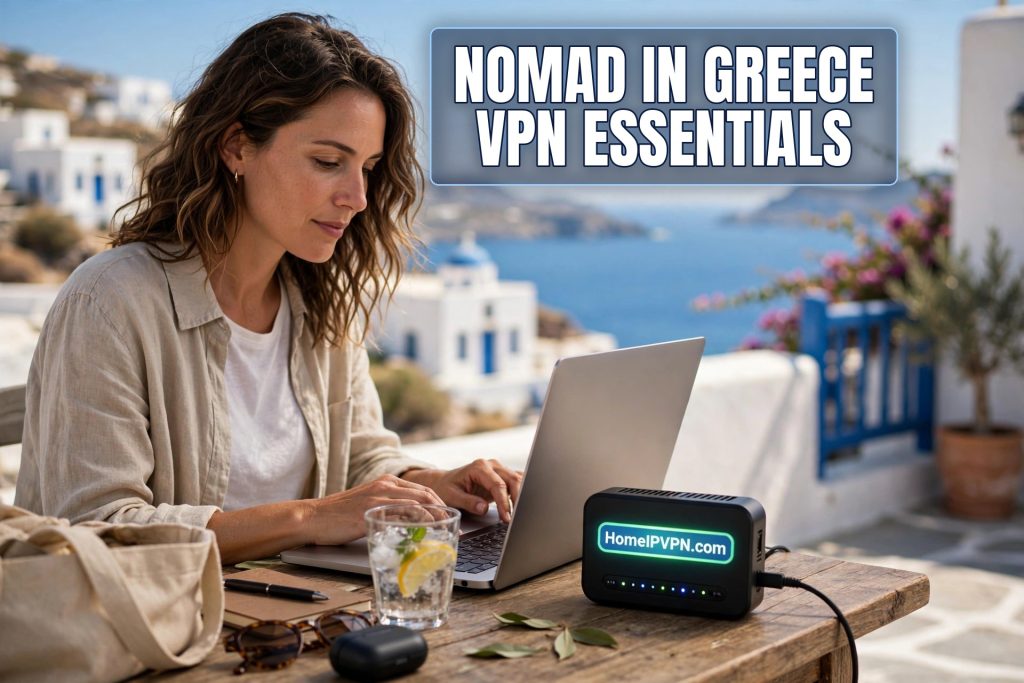
Digital Nomad in Greece: Home IP VPN Essentials
Greece will spoil you and then test you, sometimes in the same afternoon. A digital nomad in Greece learns fast that the internet in an Athens apartment and the internet on a Cycladic island are barely the same technology. And while you're figuring that out, your bank back home wants to verify it's really you, your company's SSO is side-eyeing the foreign IP, and the streaming service has opinions about your catalog. A home IP VPN stops being a nice-to-have and becomes part of the kit, right next to sunscreen.
Athens vs. the Islands: Two Different Internets
Athens and Thessaloniki are easy mode. Fiber and VDSL are common, coworking spaces in Koukaki and Exarchia run proper business connections, 5G coverage is solid. Base yourself in Athens for a month and a travel router on apartment WiFi plus your home IP tunnel will feel close enough to home that you forget you're abroad.
The islands are where plans meet reality. And the reality varies not just island to island but village to village:
- The big names (Santorini, Mykonos, Rhodes, Crete's north coast) mostly have decent 4G/5G and accommodations with usable WiFi. The catch is August: when every tourist is streaming at 9pm, the whole town's network wheezes.
- The smaller islands (Small Cyclades, remote Dodecanese, much of the Sporades) might have one cell tower for the entire island and guesthouse WiFi fed by an ADSL line that's been overloaded since 2019. Out here, your phone's cellular signal is frequently better than the accommodation's WiFi. Plan accordingly.
- Ferries are dead zones. Hours of nothing. Schedule deep work around ferry days, not through them; I've learned this the expensive way.
The strategic takeaway: in Greece your uplink will change completely every few days and occasionally be genuinely bad. Your VPN setup has to be the stable layer above that chaos. One private network, one home IP, regardless of whether today's uplink is fiber, café WiFi, or a single bar of 4G clinging to a distant tower.
A Lightweight Kit for Island Hopping
Ferries, island-hop flights with strict baggage rules, and rooms up steep car-free lanes all punish heavy gear. Everything here fits in a daypack pocket:
- A pocket travel router with WireGuard client support and repeater mode, USB-C powered. This is the heart: it holds your home IP tunnel and broadcasts your private network everywhere you sleep.
- A short USB-C cable and a compact GaN charger. Greek island rooms famously offer one accessible outlet, sometimes in a baffling location. One meter of cable and a small multi-port charger covers router, phone, laptop.
- A 10,000 mAh power bank. Beach days, ferry crossings, the taverna with no outlets near your table. It'll also run the router directly through an outage; these things sip power.
- A Greek or EU eSIM data plan, bought before you start hopping. Coverage on populated islands is generally good, and cellular-as-uplink means you're never fully hostage to guesthouse WiFi.
- A 1-2 meter ethernet cable. You'll rarely need it. The one time an apartment has a free LAN port, you'll feel like a genius. It weighs nothing.
- Your VPN profiles backed up offline, in an encrypted note on the laptop. If the router ever needs a factory reset on some remote island, you rebuild without needing internet to fetch configs. Future you says thanks.
Leave behind: bulky "gaming" routers, anything with its own power brick, single-purpose gadgets. If it doesn't earn its weight on a ferry, it stays home.
Keeping a Stable Home IP While Everything Else Changes
The kit's whole point is that your network identity stays put while the uplink changes daily. Making that real across Greece:
- Let the router auto-recover. Set the WireGuard client to start on boot and retry persistently. Moving from Athens fiber to a Paros café to Naxos 4G should re-establish the tunnel without you opening the admin panel.
- Tune keepalives for flaky uplinks. Island cellular and saturated guesthouse WiFi cull idle connections fast. A keepalive around 25 seconds keeps NAT sessions alive through the quiet gaps between keystrokes.
- Tether over USB when WiFi is garbage. If the guesthouse network is congested, feeding the router from your phone's USB tether skips a wireless hop and usually beats repeating an already-saturated signal.
- Pack a fallback protocol. WireGuard over UDP is the default, but some managed hotel networks mangle UDP. An OpenVPN-over-TCP-443 profile as backup means you're never tunnel-less.
- Verify on arrival, every arrival. New place, thirty seconds: check your visible IP, run a quick DNS leak test, then join the first call. Finding a leak mid-meeting with your manager is a rite of passage you can skip.
One Greece-specific note: Greek bureaucracy lives on portals that can be twitchy about foreign IPs. Tax systems, banking apps, government services sometimes demand extra verification loops when they see you abroad. Routing through your home IP keeps those interactions boring and predictable, which is exactly what you want when you're trying to file something from Milos.
FAQ
Is Greek internet actually good enough for remote work?
Any legal issues with VPNs in Greece?
Do Greek hotel captive portals play nice with travel routers?
How do I handle constant switching between WiFi and 4G?
Coworking or cafés for important calls on the islands?
What if a hotel network blocks my VPN?
Need Help Setting This Up?
Greece is one of those places where the right kit makes the difference between "working from paradise" and "fighting the WiFi in paradise." If you want the whole home-and-travel router setup configured before you fly, our done-for-you service handles it end to end: https://homeipvpn.com.

