REMOTE WORK & DIGITAL NOMAD
Krakow and Warsaw: Poland’s Nomad Boom Explained
The train pulled into Krakow Glowny just after 9 p.m., and the first thing I noticed was the price of the coffee I bought while waiting for my tram. It was…
✓Why Central Europe started winning✓Krakow: the pretty one✓Warsaw: the serious one
Quick Answer
Krakow and Warsaw have become two of Europe’s most popular bases for digital nomads, leading Central Europe’s rise in the 2026 rankings. The appeal is simple math: Western European quality of life at roughly half the cost, with fast internet, strong coworking scenes, and easy train connections across the continent.
- The cost gap: a comfortable one-bedroom in either city runs roughly half of what you would pay in Berlin or Amsterdam, with excellent food and transport included in the bargain.
- Internet that delivers: Poland has some of Europe’s fastest and most reliable broadband, and coworking spaces in both cities are built for people who actually work.
- Krakow versus Warsaw: Krakow is prettier and cheaper with a bigger expat social scene; Warsaw is more businesslike, better connected, and slightly pricier.
- Working from abroad, seamlessly: HomeIPVPN keeps your home IP address with you in Poland, so your company’s systems and your bank see you exactly as they always have.
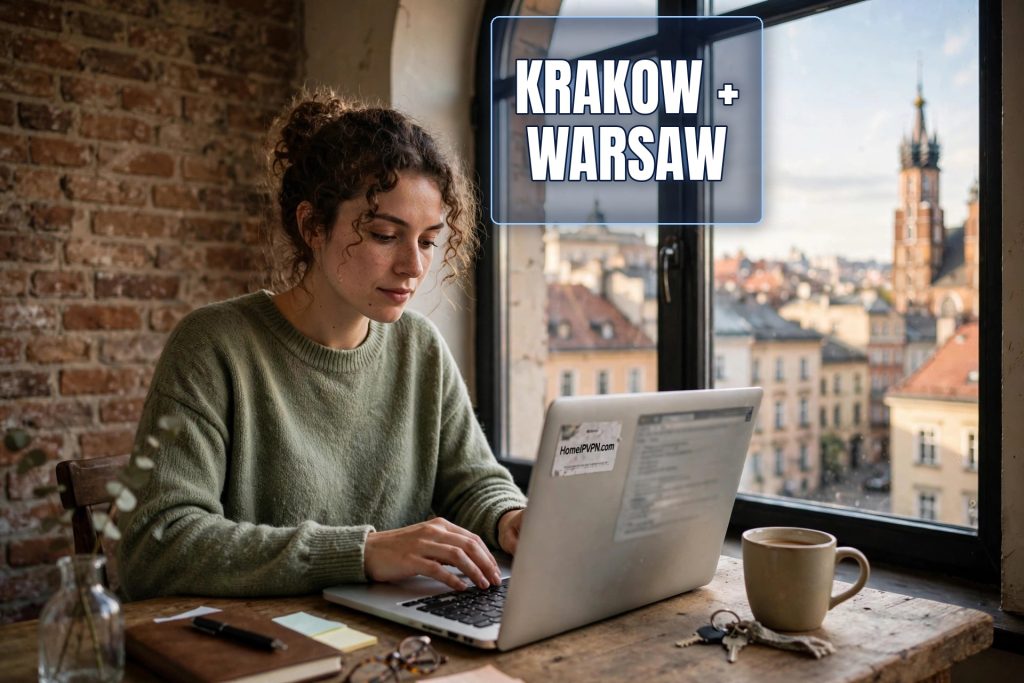
The train pulled into Krakow Glowny just after 9 p.m., and the first thing I noticed was the price of the coffee I bought while waiting for my tram. It was good coffee, the kind with actual latte art, and it cost less than a bottle of water at the airport I had left that morning. By the time I reached my apartment, a bright one-bedroom ten minutes from the old town, I had already done the mental math that every nomad does on arrival in Poland: this costs half of what I was paying, and the internet is faster.
Poland has been climbing the nomad rankings for years, but the 2026 lists made it official. Krakow and Warsaw are no longer “up and coming.” They are arrived, established, and in some rankings sitting above far more famous Western European cities. The reasons are not mysterious. They are the same reasons nomads have always followed: cost, quality, connectivity, and the feeling that a place wants you there.
Why Central Europe started winning
For a long time, the European nomad map had two poles. There was the cheap south, Lisbon and Athens and the Spanish islands, where the weather was perfect and the infrastructure was occasionally held together with hope. And there was the expensive north, Berlin and Amsterdam and Copenhagen, where everything worked and everything cost a fortune. Central Europe sat in the middle, ignored, until people started noticing that the middle was the best part.
Poland is the clearest example of the pattern. The country invested heavily in broadband and transport infrastructure over the last decade, the cities are genuinely beautiful, the food culture is excellent, and prices stayed far below Western Europe even as quality caught up. A nomad in Krakow gets Berlin-tier internet, a Warsaw-tier coworking scene, and a cost of living that lets them actually save money while working remotely. That combination did not exist in Europe ten years ago.
There is also a less tangible factor: Poland feels functional in a way that matters when you are trying to get work done. Trains run on time. Packages arrive. Bureaucracy is annoying but navigable. The basics of daily life do not fight you. After a few months in places where every small task is an adventure, that reliability starts to feel like luxury.
Krakow: the pretty one
Krakow is the city that makes people fall in love first and do the cost math second. The old town survived the war intact, which means you are working from cafes in medieval squares and walking home past a castle. It sounds like a tourism brochure, but when you live there, it is just your Tuesday. The beauty stops being remarkable and starts being the background of your life, which is the best possible outcome.
The nomad scene in Krakow is big, social, and easy to enter. There are regular meetups, a dense cluster of coworking spaces around Kazimierz and the old town, and enough English-speaking expats that you can build a social life in weeks rather than months. If you are traveling solo and worried about loneliness, Krakow is one of the easiest soft landings in Europe.
Costs are the headline. A comfortable one-bedroom in a good neighborhood typically runs well under what you would pay for a room in a shared flat in London. Eating out is genuinely affordable, not “affordable for Europe” but affordable in absolute terms. A proper dinner with drinks costs less than a sad desk salad in Zurich. Your money goes further here than almost anywhere else in Europe at this quality level.
The tradeoff is that Krakow is smaller and less business-oriented than Warsaw. If your work involves in-person meetings with clients or you want the energy of a capital city, it can feel a bit cozy. It is also a major tourist destination, which means the very center gets crowded in summer and prices in the old town creep up. Live slightly outside the center and you get the best of both.
Warsaw: the serious one
Warsaw is what happens when a city gets flattened in a war and rebuilds itself as a business capital. It does not have Krakow’s fairy-tale looks. What it has is scale: more companies, more coworking spaces, more flight connections, and a skyline that actually looks like a place where deals happen. If Krakow is where you go to enjoy nomad life, Warsaw is where you go to build something.
The practical advantages are real. Warsaw Chopin Airport connects to basically everywhere, which matters when you are flying to client meetings or doing visa runs. The metro is fast and modern. The coworking scene is more corporate and more numerous, with spaces designed for teams rather than just solo laptop workers. If you need to rent a proper office for a month, Warsaw has options Krakow does not.
It is slightly more expensive than Krakow, though still cheap by Western European standards. The difference shows up mostly in rent and in the upscale end of restaurants and bars. Day to day, the gap is small enough that the choice between the cities should be about vibe and logistics, not money.
Warsaw’s weakness is atmosphere. Rebuilt cities can feel a bit generic, and Warsaw’s center is a mix of communist-era blocks and glass towers that does not charm everyone. But the neighborhoods have character if you look: Praga across the river is artsy and rough around the edges, and the riverside in summer is genuinely lovely. Give it a month before you judge it.
The numbers: what it actually costs
Let us talk real numbers, because that is why you are reading this. A decent one-bedroom apartment in a good Krakow neighborhood, booked monthly, typically lands around the price of a week in a mid-range hotel in Paris. Warsaw runs a bit higher but not dramatically. Utilities are reasonable, and winter heating is the one cost that surprises people, so budget for it from November to March.
Food is where Poland really shines. A proper lunch at a milk bar, the classic Polish canteen, costs less than a coffee in most Western capitals. Even mid-range restaurants are kind to your wallet. Groceries are cheap and good, especially dairy, bread, and produce. The oft-quoted figure is that daily expenses run about half of Berlin levels, and in my experience that is conservative for careful spenders.
Transport is nearly free by Western standards. Trams and buses are clean, frequent, and cheap, with monthly passes costing less than two taxi rides in London. Between cities, the trains are excellent: Krakow to Warsaw is under three hours on the fast service, and tickets bought in advance are very cheap. You can realistically live in one city and spend weekends in the other.
Coworking memberships are priced for the local market, which means they are a bargain for anyone earning Western wages. A monthly hot desk in a good space costs a fraction of London or Amsterdam prices, and the spaces are genuinely nice: fast internet, good coffee, phone booths, the works.
Internet and the work infrastructure
Poland’s internet is one of its quiet superpowers. The country has invested heavily in fiber, and both Krakow and Warsaw have widespread gigabit-capable connections. In practice, this means your apartment WiFi is fast, cafe WiFi is usable, and coworking spaces have the kind of symmetric connections that make video calls boring in the best way.
Mobile data is cheap and plentiful. Prepaid SIMs with generous data allowances cost very little, and 5G coverage in both cities is good. Most nomads end up with a local SIM as a backup connection within days of arrival. It is the kind of place where connectivity stops being something you think about, which is exactly what you want.
The coworking scenes deserve a paragraph each. Krakow’s spaces cluster around the old town and Kazimierz, with a friendly, community-heavy vibe and lots of events. Warsaw’s are bigger, more numerous, and more corporate, with several international chains operating large floors. Both cities have spaces with 24-hour access, which matters when your team is on another continent and your best working hours are everyone else’s night.
The Polish connection itself is superb. Pair it with HomeIPVPN and your employer’s systems still see your home IP, so the fast local internet never triggers a security flag back home.
Visas and the paperwork reality
Poland is in the Schengen zone, which means the standard 90-days-in-180 rule applies to most non-EU visitors. For many nomads, that is the whole visa strategy: spend up to three months in Poland, then move on. The 90-day limit is the main reason people do not stay longer, not cost or boredom.
Poland does have a digital nomad visa conversation happening, as does most of Europe, but as of now the practical routes are the standard ones: Schengen short stays, EU freedom of movement if you have an EU passport, or a work or business visa if you have a Polish connection. Do not overstay Schengen. The penalties are real and they follow you to every future border in Europe.
One practical tip: Poland is a great Schengen-clock management base. Because it is affordable and pleasant, many nomads use it as the place to spend their Schengen days carefully, then hop to non-Schengen countries like the UK, the Balkans, or Georgia to reset. Krakow’s airport has cheap connections to all of them.
The honest downsides
No city is perfect, and Poland has real drawbacks. Winter is the big one. From November to March, it is cold, dark, and gray, and the famous smog in Krakow is a genuine health concern on bad days. If you are sensitive to air quality or seasonal gloom, plan Poland for the warmer months and winter somewhere else. Many nomads do exactly that.
The language barrier is real but manageable. Younger Poles and anyone in the service industry generally speak English well. Officialdom, landlords, and older neighbors often do not. Google Translate handles most of it, but renting an apartment or dealing with bureaucracy goes much smoother with a Polish-speaking friend or a relocation helper.
And while the nomad scene is big, it is also transient. People come for three months and leave, which means friendships have a built-in expiry date. This is true everywhere in nomad life, but it is worth saying: the social ease of Krakow is real, and so is the good-bye cycle.
Which city should you pick
If this is your first time in Poland, start with Krakow. It is prettier, cheaper, more social, and easier to love quickly. You will know within two weeks whether the nomad life suits you, because Krakow removes most of the friction that makes the first month hard.
Pick Warsaw if you need the capital city infrastructure: more flights, more business contacts, bigger coworking spaces, or a base for frequent travel. It is also the better choice if you find tourist crowds draining, since Warsaw feels like a working city rather than a destination.
Or do what a lot of people do: a month in each. The train between them is fast and cheap, and there is no better way to understand the difference than living it. Poland rewards the curious.
Staying connected to home while you are there
One thing that catches remote workers in Poland is not the Polish internet, which is excellent, but what their employer’s systems think about a login from Warsaw. Company security tools, banks, and streaming services all notice when your location changes, and some of them react badly: locked accounts, verification loops, and IT tickets at midnight.
This is a solved problem. HomeIPVPN gives you your own home IP address that travels with you, so everything on the other end sees the same connection it has always seen. Your work laptop in a Krakow coworking space looks, to your company’s systems, like it never left your house.
If you would rather have someone set that up and verify it works before you fly, the Pre-Travel Audit & Advisory session is 1 hour, costs $79, and that fee comes straight off the $279 Secure Home IP VPN System session if you go ahead. It is one of those things that is much nicer to have sorted before you are standing in a foreign apartment trying to log in to work.
Poland figured out the formula before most of Europe did: make it affordable, make it work, make it beautiful. Go see why everyone is talking about it. Just go in spring.