REMOTE WORK & DIGITAL NOMAD
The Freelancer’s Emergency Fund: How Much Cash to Keep Reachable
The card reader beeped, flashed red, and the cashier in Lisbon looked at me with the patient expression of someone who has seen this before. Declined. I tried…
✓Why freelancers abroad need a✓How much: the one-month rule✓Reachable means hours, not days
Quick Answer
A traveling freelancer should keep at least one month of essential expenses instantly reachable, spread across two or three separate places so no single frozen account or lost card leaves you stranded. Reachable means you can spend it within hours, not money locked in investments or slow transfers. Build it gradually and treat it as untouchable except for real emergencies.
- One month minimum: cover rent, food, transport, and insurance for 30 days without any new income arriving.
- Split it across accounts: two banks or a bank plus a payment app, so one frozen account is an annoyance, not a crisis.
- Keep some physical cash: a few hundred in local currency covers the gaps cards cannot, like markets and taxis.
- Protect your access: frozen logins are a top emergency-fund killer abroad, which is why travelers use HomeIPVPN to keep their banking logins consistent and trusted.
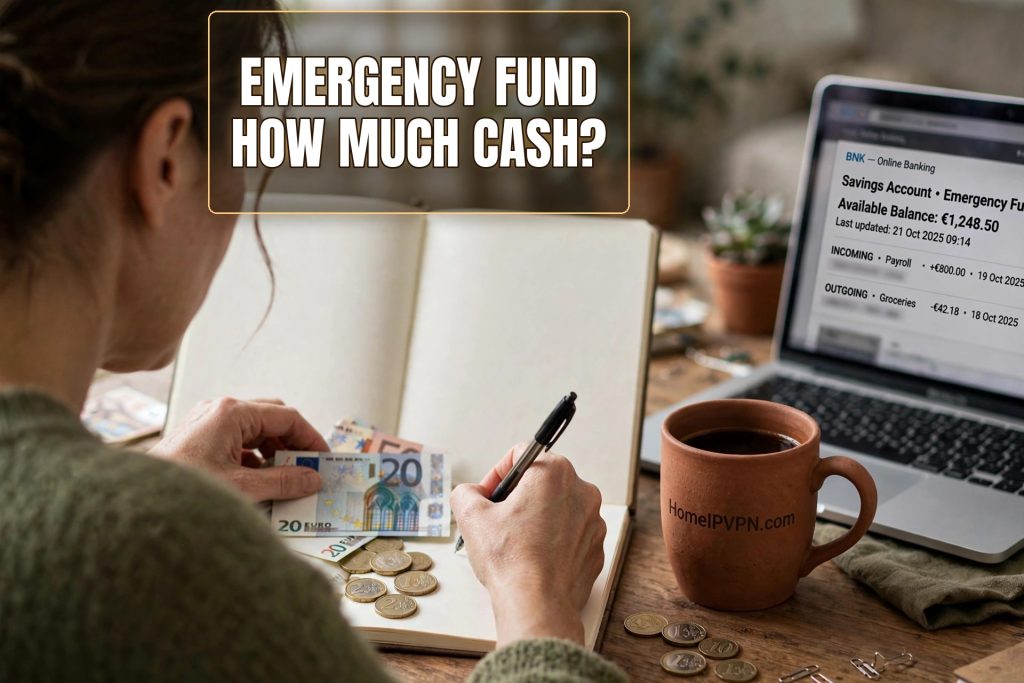
The card reader beeped, flashed red, and the cashier in Lisbon looked at me with the patient expression of someone who has seen this before. Declined. I tried the other card. Declined. Behind me, a small queue was forming, and I was doing mental math about how much cash was in my bag. Forty euros. The groceries came to sixty-three.
Nothing was actually wrong with my money. My bank had decided my login from Portugal looked suspicious and frozen everything “for my protection.” The funds were released two days later, but those two days taught me more about emergency funds than any finance article ever had. When your income is irregular and your location keeps changing, a reachable reserve is not a nice-to-have. It is infrastructure.
Why freelancers abroad need a bigger cushion
The standard advice, three to six months of expenses in savings, assumes a salaried life where the main risk is losing a job. Freelancers face a different risk profile. Your income does not stop all at once; it stutters. A client pays late. A payment platform holds funds for three weeks. A bank freezes your account because you logged in from a new country. Each of these is temporary, and each of them can leave you unable to pay for dinner tonight.
Travel multiplies these risks. You cannot walk into your bank branch when you are six time zones away. Customer service phone lines have hours that do not match your timezone. Replacement cards take weeks to reach a foreign address. Everything that would be a minor hassle at home becomes a logistical project abroad.
So the emergency fund for a traveling freelancer serves a narrower, more urgent purpose than the textbook version. It is not primarily about surviving unemployment. It is about surviving the gaps: the frozen account, the delayed payout, the lost card, the week where everything financial goes sideways at once. That means the money must be reachable fast, not just saved somewhere.
How much: the one-month rule
Start with one month of essential expenses, instantly reachable. Essentials means rent or accommodation, food, local transport, phone and internet, insurance, and any non-negotiable bills. Not restaurants, not the coworking space with the nice view, not the weekend trip. The number that keeps a roof over your head and food on the table.
For most nomads this lands somewhere between $1,500 and $3,000, depending on where you are. In Southeast Asia it might be less; in Western Europe or Australia, more. Calculate it for your current location, not some average. The fund exists to keep you functioning where you actually are.
One month is the minimum, not the target. Once you have it, keep building toward two or three months. But do not let the perfect number stop you from starting. The freelancer with $800 reachable is dramatically safer than the one with zero, even if the textbook says they need $2,500. Start where you are.
A useful way to think about it: your emergency fund should cover the longest realistic disruption. A frozen bank account typically resolves in days to two weeks. A lost card replacement takes one to three weeks internationally. A payment platform hold runs up to 21 days. One month covers all of these with margin. That is why the rule works.
Reachable means hours, not days
This is where many people go wrong. They have savings, but the savings are in the wrong place. Money in an investment account that takes three days to sell and settle is not an emergency fund. Money in a fixed-term deposit with early withdrawal penalties is not an emergency fund. Money that requires a wire transfer from another country is not an emergency fund.
Reachable means you can spend it within hours, ideally minutes. A debit card attached to a checking account. A balance in a payment app you can spend from directly. Physical cash in your bag. These are the tiers that matter when the card reader flashes red.
Think of your reserves in layers. Layer one is cash on hand: enough for a few days of food and transport, in local currency. Layer two is a debit card on an account with a real balance, separate from your main spending account. Layer three is a second account or app you can transfer from within minutes. Each layer backs up the one before it.
Split it: never one account
The Lisbon story has one more detail worth sharing. Both of my declined cards were linked to the same bank. When the bank froze my access, it froze everything at once. Two cards, one point of failure. I might as well have had one card.
Split your reachable money across at least two genuinely separate places. Two different banks is the gold standard. A bank plus a well-funded payment app is a good practical alternative. The point is that a single frozen account, a single lost wallet, or a single bank’s bad day cannot take you to zero.
Test the split before you need it. Once a month, buy a coffee with the backup card or make a small transfer from the backup account. Cards expire, accounts get flagged for inactivity, apps log you out. A backup you have not touched in eight months is a hope, not a plan. The monthly coffee is your drill.
For the same reason, do not keep both cards in the same wallet. One in the wallet, one in the room safe or a separate bag pocket. Losing your wallet abroad is common enough that you should plan for it the way you plan for rain: not if, but when, and with a spare already in place.
Cash still matters
In an increasingly card-based world, it is tempting to go fully digital. Resist that. There are still plenty of places where cash is faster, cheaper, or the only option: street markets, small taxis, beach towns, border crossings, and anywhere the card network is having a bad day.
Keep a working amount of local currency on you, enough for two or three days of basic spending. When you arrive in a new country, getting local cash is one of the first errands, right up there with the SIM card. Airport ATMs have terrible rates, so take only what you need there and find a proper ATM in town.
Also keep a small stash of US dollars or euros separate from your daily cash, somewhere secure. Dollars are the universal backup currency: exchangeable everywhere, accepted in a pinch in many places. This is your layer-zero reserve, the money you touch only when everything else has failed simultaneously.
Building it when money is tight
“Keep a month of expenses reachable” is easy to write and hard to do when every invoice is already allocated. So build it the way you build any habit: automatically and in amounts too small to miss.
Set up an automatic transfer that moves a fixed amount to your reserve account the day after your biggest regular payment usually arrives. Start with $50 or $100. The amount matters less than the automation. Freelance income is lumpy, so tie the transfer to income events rather than calendar dates: every time a payment over a certain size lands, a slice moves to reserves before you can spend it.
Treat windfalls as fund accelerators. A bigger-than-expected project, a tax refund, a client bonus: route a portion straight to the emergency fund before lifestyle inflation notices. Many freelancers build their entire cushion from three or four good months, not from slow grinding.
And define “emergency” in advance, in writing, even if only to yourself. A real emergency: frozen accounts, lost cards, medical costs, a flight you must take. Not an emergency: a cheap flight deal, new gear, a great restaurant. The fund only works if raiding it feels like breaking a rule, because it is one.
Replenish after you use it
Using the emergency fund is not failure; it is the fund doing its job. The failure is using it and then not rebuilding it. After any dip, make replenishment your top financial priority, ahead of discretionary spending and even ahead of extra debt payments in most cases. An empty emergency fund means the next surprise starts from zero.
Keep a simple log: date, amount used, reason, and a target date for full replenishment. This turns a vague intention into a plan. It also gives you data over time about what actually goes wrong in your traveling life, which is genuinely useful intelligence for planning.
Remove the preventable emergencies
Here is the uncomfortable truth about my Lisbon story: the emergency was preventable. My bank froze my account because I logged in from a new country, a trigger I now know how to avoid. A chunk of every traveler’s “emergencies” are really just predictable frictions they have not addressed yet.
Keeping your digital access consistent is one of the highest-leverage fixes. Banks, payment apps, and invoicing tools all get nervous about new countries. When your connection always appears from your home internet, through a setup like HomeIPVPN, those tools see the same familiar login they have always seen. Fewer freezes, fewer verification loops, fewer 40-euro grocery standoffs.
An emergency fund handles the surprises you cannot prevent. A stable setup prevents the ones you can, and that is the problem HomeIPVPN was built to solve: a connection that always appears from your home internet, so your accounts never meet a new country. If you would rather have someone build that stable setup for you and verify it works, the Pre-Travel Audit & Advisory session is 1 hour, costs $79, and that fee comes straight off the $279 Secure Home IP VPN System session if you go ahead.
Build the fund, split it across accounts, keep some cash, and remove the avoidable triggers. Then get back to the part of freelancing that is actually fun. The safety net is there so you rarely have to think about it.

