REMOTE WORK & DIGITAL NOMAD
The Unwritten Rules of Working From Cafes Abroad
You have been in Lisbon for six days, and you have found it: the perfect cafe. Corner table, outlet within reach, WiFi that actually holds a video call,…
✓Rule one: you are a customer first✓Rule two: sound is the real✓Rule three: space and time have
Quick Answer
Working from cafes abroad works beautifully when you follow the unwritten rules: buy something every hour or two, keep calls off speaker and preferably outside, do not camp tables during rush hours, and respect any posted laptop policies. The core principle is that you are a customer first and a worker second. Cafes that feel welcoming are the ones where remote workers behave like good guests.
- Buying: A purchase every 60-90 minutes is the standard exchange rate for your seat.
- Calls: Step outside for anything longer than a quick check-in; never use speakerphone.
- Timing: Avoid camping tables during lunch and weekend rushes; mornings and mid afternoons are yours.
- Connectivity: Cafe WiFi changes daily, but a steady home IP from HomeIPVPN keeps your logins consistent wherever you sit.
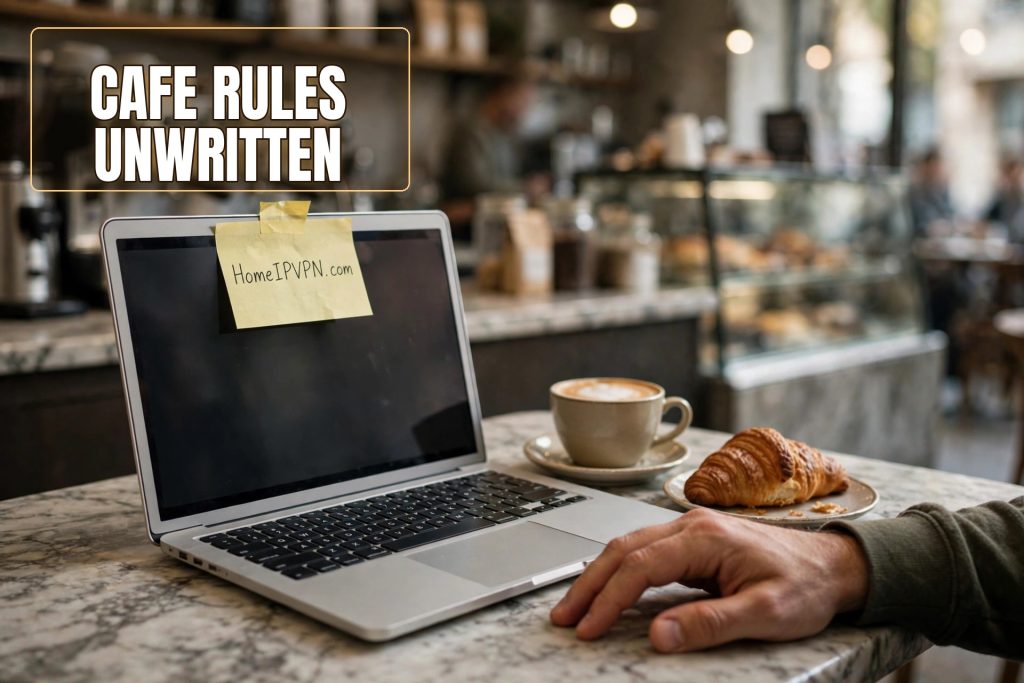
You have been in Lisbon for six days, and you have found it: the perfect cafe. Corner table, outlet within reach, WiFi that actually holds a video call, pastries that should be illegal, and a barista who smiled at your terrible Portuguese and answered in perfect English. You have been here for four hours. You bought one coffee.
The barista is still smiling, but it is a different smile now. You know the one. And somewhere in the back of your mind, a small voice is asking the question every remote worker eventually asks in a foreign cafe: how long am I actually welcome here?
This guide answers that question, and all the ones around it. The unwritten rules of working from cafes abroad: the etiquette that keeps you welcome, the mistakes that get remote workers a bad name, and the small behaviors that turn a cafe into your place.
Rule one: you are a customer first
Everything else follows from this. A cafe is a business that sells food and drink, not a coworking space that sells desks. Your laptop is a guest in their business model, tolerated because you are also buying things. The moment your presence costs them more than you contribute, in lost table turnover, in annoyed other customers, in staff time, the deal is broken, whether anyone says so or not.
The practical exchange rate that works almost everywhere: buy something every sixty to ninety minutes. Coffee, then a pastry, then a sparkling water, then lunch. This is not just politeness; it is the economics of the table. A table that turns four paying customers in an afternoon is profitable. A table occupied for six hours by one coffee is a loss. You do not need to do the math precisely. You just need to keep buying at a pace that would make sense if you were watching yourself from behind the counter.
This rule also answers the “can I just buy one coffee and work all day” question that every new nomad asks. Technically, sometimes, in an empty cafe, nobody will stop you. But it is the behavior that gives laptop workers a bad name, and it is how cafes end up posting “no laptops” signs that punish everyone. Be the customer who makes laptop workers welcome, not the one who gets them banned.
Rule two: sound is the real currency
If buying is the economic rule, sound is the social one. Cafes are shared acoustic spaces, and nothing breaks the spell faster than one person treating it as their personal call center. The rule is absolute: no speakerphone, ever, for any reason. Headphones for all audio, including the video you are “just quickly checking.”
Phone and video calls deserve a stricter standard than most people apply. The ideal is to take no calls in a cafe at all. Step outside, find a quiet corner, call from the street. For a thirty second check-in, a hushed voice at your table is fine. For anything longer, anything with back and forth, anything where the other person might raise their voice, leave the room. Your client cannot hear the cafe, but the cafe can hear your client, and twenty strangers did not consent to attend your standup.
Typing noise counts too. Mechanical keyboards, the beloved clacky ones, are genuinely disruptive in a quiet cafe. If you travel with one, consider a quieter option for cafe days, or at least be aware of the volume. And keep your notifications silent. Nobody wants to hear your Slack pings with their espresso.
Rule three: space and time have limits
Do not spread out. This sounds obvious and is violated constantly. One person gets one table, or one share of a large table. Your bag goes on the floor or on the hook, not on the adjacent chair. Your laptop, notebook, phone, and water bottle fit in front of you. The charger cable runs neatly, not across the walkway. You are renting a seat, not an office.
Time has limits too, and they are set by the cafe’s rhythm, not your to do list. The lunch rush, roughly noon to two in most countries, is sacred. If you are camped at a table when a line forms, you finish your drink and free the table, even if you just bought it. Mornings before eleven and mid afternoons between three and five are the golden hours for long sessions: the cafe is quiet, staff are relaxed, and your presence is genuinely welcome.
Weekends follow the same logic amplified. A Saturday afternoon cafe is a social space, not a workspace, and working through the weekend rush is the fastest way to feel, correctly, that you do not belong there. Save the long weekend sessions for coworking spaces or home. Cafes on weekends are for coffee and people watching, laptop closed.
Rule four: read the room, literally
Posted rules are not suggestions. If a sign says no laptops, or no laptops after a certain hour, or a time limit per table, that is the law of that establishment. Do not ask for exceptions. Do not test the boundary. Do not assume it does not apply to foreigners. The sign exists because someone before you pushed too far, and arguing with it makes you that person retroactively.
Beyond posted rules, read the actual room. Is the cafe full of other people working quietly? You have found a work friendly spot; settle in accordingly. Is it full of friends chatting, couples on dates, families? This is a social space tolerating your laptop, not inviting it; keep your session short or move on. Are the staff giving you meaningful looks? The looks are the feedback. Act on them before they become words.
Cultural calibration matters enormously and varies by country. Tokyo cafes expect near monastic quiet. Italian bars expect you to drink your espresso standing up and leave; lingering with a laptop is simply not a thing in most traditional ones. French cafes are more tolerant of lingering but less tolerant of noise. Latin American cafes are generally relaxed about everything except ingratitude. When in doubt, watch what the locals do and match it. You are the guest. Act like one.
Rule five: the practical setup
Beyond etiquette, a few practical habits separate the smooth cafe workers from the struggling ones. Scout outlets before you commit to a table; the perfect corner is worthless if your battery dies at noon. Carry a compact power strip or a multi plug adapter, and offer the spare socket to a neighbor: it is the fastest friendship accelerator in nomad life.
Have a mobile data backup ready before you need it. Cafe WiFi is a shared resource that degrades as the cafe fills up, and the video call that was fine at 9am may stutter at noon. Knowing you can flip to your phone hotspot in ten seconds removes the anxiety. Test the handoff once, calmly, before the important call, not during it.
Security basics apply with extra force on cafe networks. These are shared, often unencrypted networks in public places, which is exactly the environment where snooping happens. A VPN is not optional here; it is the lock on the door. And keep your screen angled away from foot traffic when working on anything sensitive. Shoulder surfing is low tech and effective.
Rule six: become a regular, properly
The best cafe work life comes from becoming a regular, and becoming a regular is a skill. Pick one or two cafes near your accommodation and go consistently. Learn the staff’s names. Learn a few words of the local language: please, thank you, the usual. Tip where tipping is customary, generously but not performatively.
Regulars get the good table, the outlet spot saved with a nod, the heads up about the WiFi being flaky today, and the honest answer when you ask if it is okay to stay through the afternoon. These small privileges are earned through consistent good behavior: buying well, staying quiet, leaving the table clean, and being pleasant. It takes about two weeks of regular visits. It is one of the highest ROI investments in nomad social life.
And when you leave a city, say goodbye. Thank the staff. It costs nothing and it means something, both to them and to the next remote worker who walks in. Reputations in nomad hubs are collective. Every good guest makes the next guest’s life easier.
The connectivity you cannot see
There is one cafe rule nobody posts on the wall, because it is invisible. Every new cafe is a new network, a new IP address, a new location signal for every automated system watching your accounts. Work from six cafes in a week, and your bank sees six new networks in six days. To a fraud algorithm, that pattern is indistinguishable from a compromised account being tested across a city.
This is the quiet tax on the cafe lifestyle, and it is completely disconnected from how well you follow the etiquette rules. You can be the perfect customer, buy every hour, whisper your calls, and still get your account frozen on Thursday because the fraud system counted networks instead of coffees.
The fix is to separate your digital identity from your physical venue. When your traffic always exits through the same home IP address, the cafe becomes irrelevant to your accounts: the corner spot in Lisbon and the quiet kissaten in Tokyo look identical to your bank. That is what HomeIPVPN provides, a constant home IP routed through your own residential connection, so you can be promiscuous with cafes and monogamous with your digital identity. Follow the etiquette for the humans. Let the infrastructure handle the algorithms.
The spirit of the thing
Strip away the specific rules and the spirit is simple: a cafe is someone’s livelihood and everyone’s shared space, and you are lucky to be allowed to work in it. Act like it. Buy generously, stay quiet, take up little room, leave on time, and be kind to the people whose workplace you are borrowing.
Remote workers who do this find that cafes abroad become one of the great joys of the lifestyle: the morning regular spot, the barista who knows your order, the corner table that feels like yours. Those who do not find that cafes put up signs, and the signs stay up long after they have left. Be the reason a cafe welcomes laptops, not the reason it bans them.
That spirit extends to the invisible layer too. Good guests do not just behave well in the room; they leave no mess in the systems either. A stable, trustworthy digital presence, the kind a constant home IP gives you, is the online equivalent of cleaning up your table. HomeIPVPN was built to make that part automatic, so the only thing you need to think about is being a good guest in person. If you would rather have someone set it up and verify it works before your next cafe day, the Pre-Travel Audit & Advisory session is 1 hour, costs $79, and that fee comes straight off the $279 Secure Home IP VPN System session if you go ahead.
Buy the second coffee before they have to ask. That is the whole secret.