REMOTE WORK & DIGITAL NOMAD
The Philippines for Remote Workers: Internet Reality Check
The photo shows a hammock strung between two palm trees, a laptop balanced on a bamboo table, turquoise water in the background. The caption says something…
✓The honest speed picture✓Why it is like this: a thirty✓Where remote work actually works
Quick Answer
Internet in the Philippines is workable but inconsistent: Manila, Cebu, and Clark have decent fiber and coworking spaces, while islands and provinces vary wildly. Expect slower speeds and more outages than in most of Southeast Asia, and plan redundancy into your setup. Thousands of remote workers make it work, but go in with realistic expectations.
- Best bases: Makati/BGC in Manila, Cebu City, and Clark offer the most reliable connections.
- Reality check: Speeds lag behind neighbors like Thailand and Vietnam; outages and typhoon disruptions happen.
- Redundancy: Dual SIMs on different carriers plus a vetted rental connection is the standard survival kit.
- Banking: Philippine IPs are unfamiliar to most home banks, so a steady home IP via HomeIPVPN prevents fraud lockouts.
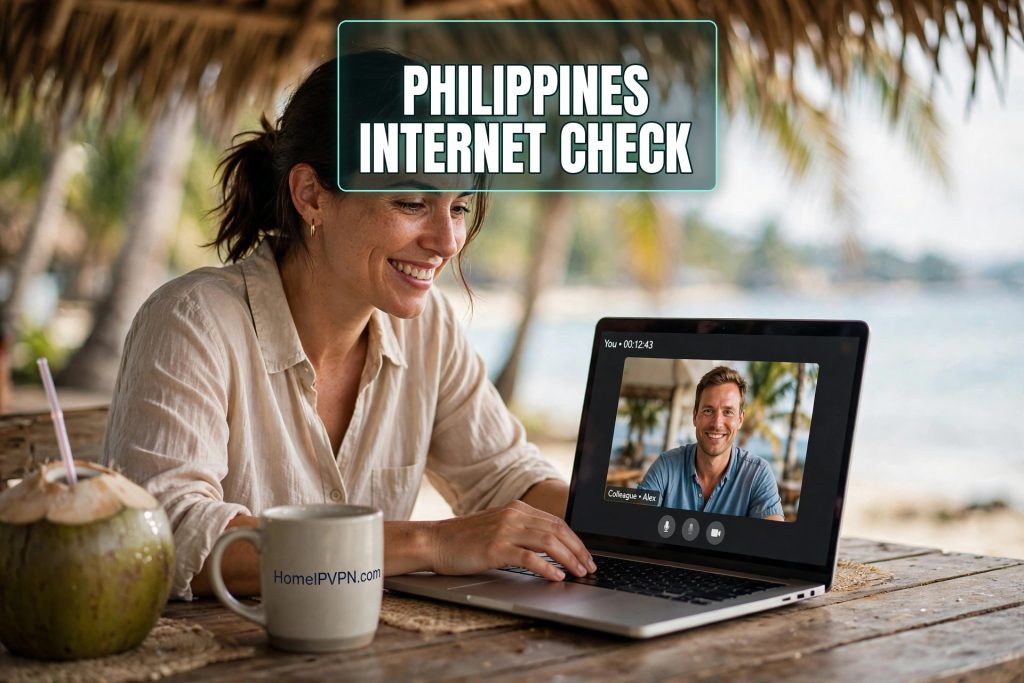
The photo shows a hammock strung between two palm trees, a laptop balanced on a bamboo table, turquoise water in the background. The caption says something about the office for the day. You have seen this photo a hundred times, selling a hundred destinations, and for the Philippines it sells particularly well, because the beaches really do look like that.
What the photo does not show is the video call freezing eleven minutes into a client presentation, or the brownout rolling through the barangay at the worst possible moment, or the host explaining that the “fiber” in the listing is actually a wireless antenna pointed at a mast three hills away. The Philippines can be a wonderful remote work base. It can also humble you. This is the reality check, delivered with affection.
The honest speed picture
Let us start with numbers, or rather, with the shape of the numbers. The Philippines has improved enormously over the past decade, and in the right places you can get perfectly serviceable internet. Business districts in Manila, particularly BGC and Makati, have fiber connections that handle video calls and normal remote work without drama. Cebu City and Clark are solid. These are real, functional work bases.
Outside those pockets, the picture degrades fast. Provincial towns, islands, and beach destinations run on a mix of DSL, wireless relays, and hope. Speeds that would be embarrassing in Bangkok are normal in Siargao. Upload speeds, the number that actually matters for video calls, are often the first casualty. And the variance is the killer: the same island can have a street with decent fiber and a street where the connection drops every afternoon.
Compared to the region, the Philippines lags. Thailand, Vietnam, and Malaysia all offer faster, cheaper, more reliable internet on average. This is not a controversial statement; it shows up in every global speed ranking. The Philippines compensates with other things, English fluency, warmth, natural beauty, affordability, but if raw connectivity is your top priority, you should know where the country sits in the regional table.
Why it is like this: a thirty second history
The short version is geography plus history. The Philippines is an archipelago of over seven thousand islands, which makes building network infrastructure inherently expensive: every island needs its own backhaul, its own masts, its own maintenance crews reachable by boat. Contrast that with Vietnam or Thailand, where you can run fiber along a highway and serve millions.
The market history matters too. For years the country was dominated by two big telecom players with limited competitive pressure to invest aggressively in fixed line infrastructure. Newer entrants have shaken things up considerably, and the competitive picture is better than it was, but decades of underinvestment do not reverse overnight. The fiber rollout is real and ongoing. It is just uneven, and the islands are always last.
Typhoons are the third factor, and they are not a footnote. The Philippines gets hit by major storms every year, and storms break infrastructure. A typhoon can take a provincial area offline for days or weeks. This is a fact of life, not a flaw in planning, and anyone basing themselves outside the big cities needs a typhoon season plan the way beach nomads elsewhere need a rainy season plan.
Where remote work actually works
BGC and Makati in Manila are the professional choice. Dense fiber coverage, coworking spaces with backup power and redundant connections, serviced apartments aimed at business travelers, and the largest community of remote workers in the country. It is not the Philippines of the postcards. It is the Philippines of getting work done, and there is no shame in that.
Cebu City is the second city option: cheaper than Manila, well connected in the business districts, with island getaways a short ferry ride away. The nomad community is smaller but real. Clark, the former US airbase zone turned business hub, has surprisingly good infrastructure and a growing remote worker presence, plus an international airport. It is unglamorous and functional, which is a combination experienced nomads learn to love.
The island destinations require honest segmentation. El Nido and Coron in Palawan are stunning and, for connectivity, a gamble: some resorts and rentals have invested in proper connections, many have not, and the remoteness that makes them beautiful makes infrastructure fragile. Siargao has a real surf nomad scene and improving internet, but it is still island internet, with island variance. Boracay is better connected than its size suggests, thanks to tourism density. Bohol’s Panglao area is mid tier: workable with vetting.
The rule that never fails: the more tourists sleep in a place year round, the better its internet. Tourism density funds infrastructure. A beach town with fifty resorts has fiber. A beach with three resorts has a prayer.
The redundancy stack: non negotiable here
In the Philippines, backup connectivity is not a nice to have. It is the job. The standard kit that experienced remote workers carry has three layers. Layer one is the rental or coworking connection, vetted before commitment with a live speed test and explicit questions about the technology behind it. Layer two is a mobile data plan on the strongest carrier for the area, used as a hotspot when layer one dips. Layer three is a second SIM on the other major carrier, because carriers have different dead zones and the one that works in your rental may not be the one you guessed.
Prepaid SIMs with large data allowances are cheap and available everywhere, so there is no excuse for skipping this. Load both, test both at your accommodation on day one, and know which one to switch to before the important call, not during it. This fifteen minute setup has saved more Philippine workdays than any other single habit.
Power deserves the same redundancy thinking. Brownouts are a fact of life in many areas, and they take your router down with them. A UPS for the router is cheap insurance. A fully charged laptop plus a power bank covers the personal side. And knowing the location of the nearest coworking space with a generator turns a brownout day from a crisis into a change of scenery.
Coworking and cafes: the work infrastructure
Manila’s coworking scene is mature, with spaces offering what you would expect: fast redundant internet, meeting rooms, phone booths, and 24 hour access options for those working US hours. Day passes and monthly memberships are priced well below Western equivalents. For your first weeks in the country, a coworking base removes every variable while you learn the landscape.
Cebu and Clark have smaller but real scenes. The islands have a scattering of coworking spots, usually attached to hostels or resorts, with quality that varies from genuinely good to “a room with a router.” Check reviews from actual remote workers, not tourists, because a tourist’s “great WiFi” means Instagram loads, and your “great WiFi” means eight hours of video calls.
Cafes follow the familiar pattern: fine for light work, risky for critical calls. The Philippines has a strong cafe culture in the cities, with specialty coffee scenes in Manila and Cebu that rival anywhere. The etiquette is relaxed by Asian standards, but the golden rule still applies: buy regularly, do not camp tables at rush hour, and take calls elsewhere.
Banking, visas, and the admin layer
The Philippines is generous with tourist entries: many nationalities get thirty days visa free on arrival, extendable in country through immigration offices, a system the country has operated for years. Long stayers often do the extension dance for months. There is also a long stay visa framework that has evolved over time, so check current options with official sources if you are planning a serious base. The bureaucracy is navigable but slow, and fixers who specialize in immigration paperwork are a well established industry.
Banking as a foreigner follows the regional pattern: your home accounts remain primary, local accounts are hard to open on tourist status, and multi currency services fill the gaps. ATMs are widespread in cities and tourist areas. Fees add up, so a no foreign transaction fee card is basic equipment.
The fraud alert issue is, if anything, sharper here than in more common nomad destinations, precisely because the Philippines is a less common login location for most Western banks. A login from Manila or Cebu is more unusual in your bank’s data than a login from London or Tokyo, which means the anomaly score is higher and the freeze trigger is more sensitive. Add in the IP hopping from your redundancy stack, two carriers plus rental WiFi, and you look like a fraud case study.
This is where a constant home IP earns its keep many times over. When every login appears from the same residential address back home, none of the above matters: not the city, not the carrier, not the island. HomeIPVPN gives remote workers that constant address, routed through their own home connection, so the Philippine internet chaos stays on the connectivity layer where it belongs and never touches the banking layer. It is the single highest leverage setup item for this country.
Who the Philippines is actually for
The Philippines is for the remote worker who values English fluency, genuine warmth, absurd natural beauty, and low costs, and who is willing to engineer around the connectivity. It is for the async worker, the writer, the developer with flexible hours, the person whose worst case internet day is an inconvenience rather than a lost client. It is for people who find the engineering challenge part of the adventure rather than a dealbreaker.
It is a harder sell for the person whose job is back to back video calls with no tolerance for drops, or who wants infrastructure to be invisible. That person will be happier in Vietnam or Thailand, and there is no shame in choosing the tool that fits the job. Destinations are not moral choices. They are practical ones.
Go in with the redundancy stack, base yourself where the infrastructure is real, keep your expectations calibrated, and the Philippines will give you some of the best months of your nomad life. The beaches really do look like the photo. Just make sure your backup SIM is loaded before you take it.
The throughline of this whole guide is that the Philippines asks more infrastructure thinking than its neighbors, and rewards it with an experience its neighbors cannot match. Most of that thinking is about connectivity you can see. The part people forget is the connectivity they cannot: the IP address their bank sees, quietly determining whether their money stays accessible. That is the piece HomeIPVPN was built to hold steady, in the Philippines and everywhere else. If you would rather have someone set it up and verify it works before you fly, the Pre-Travel Audit & Advisory session is 1 hour, costs $79, and that fee comes straight off the $279 Secure Home IP VPN System session if you go ahead.
Pack the second SIM. The hammock photo will still be there when your calls are done.