REMOTE WORK & DIGITAL NOMAD
What Happens to Your Money If a Payment Platform Closes Your Account
I woke up in Canggu to an email with the subject line nobody wants: “Your account has been limited.” No warning, no explanation beyond vague…
✓Why platforms close accounts✓What “frozen” actually✓The first 24 hours: do not panic,
Quick Answer
If a payment platform closes your account, your money is usually frozen, not gone. Most platforms must eventually return your balance, but the process can take weeks or months and often requires an appeal or identity verification. The best defense is prevention: keep your account verified, avoid sudden pattern changes like new-country logins, and never keep all your income in one platform.
- Frozen is not lost: in most cases the balance is held during review and eventually released or returned to you.
- Appeal promptly and calmly: use the platform’s official appeal process with clear documentation of your legitimate activity.
- Timelines vary widely: simple reviews take days; full closures with fund release can take 30 to 180 days depending on the platform.
- Reduce the risk: sudden new-country logins are a classic closure trigger for travelers; HomeIPVPN keeps your account seeing one consistent home location.
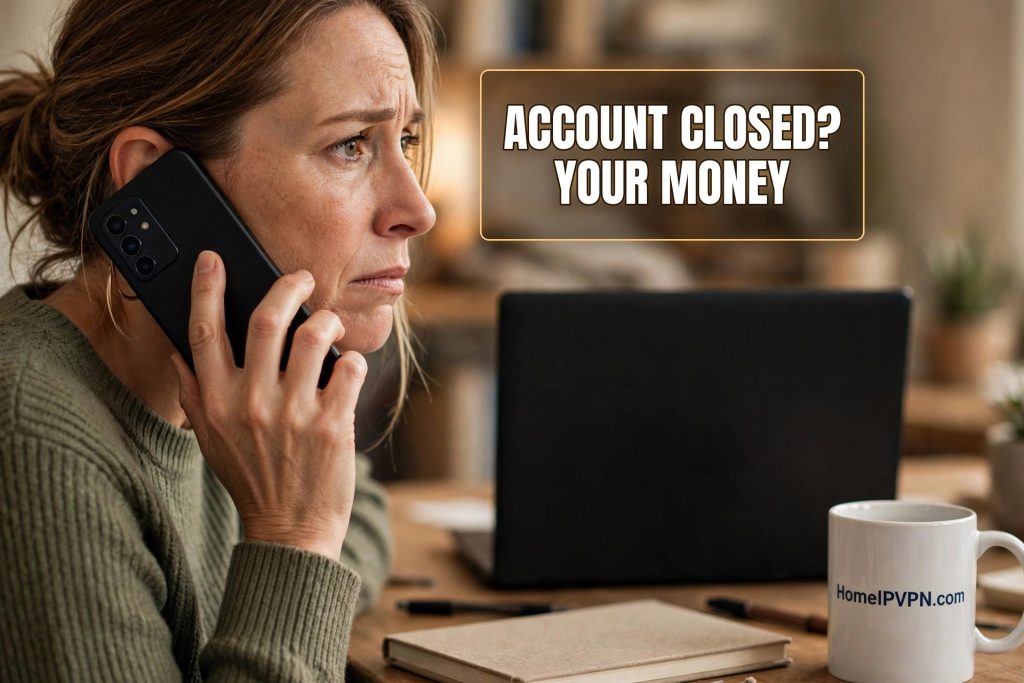
I woke up in Canggu to an email with the subject line nobody wants: “Your account has been limited.” No warning, no explanation beyond vague language about unusual activity. My balance, several thousand dollars of client payments, was suddenly untouchable. My first thought was that the money was gone. My second thought was considerably less printable.
It took three weeks, two appeals, and one very long video call to get everything back. What I learned in the process is worth sharing, because account closures happen to legitimate freelancers more often than anyone admits, and travelers get hit hardest. Here is what actually happens, step by step, and what you can do at each stage.
Why platforms close accounts
Payment platforms close accounts for one reason: risk. They are legally responsible for the money moving through them, and regulators fine them heavily when they get it wrong. So they build automated systems that look for patterns associated with fraud, money laundering, and policy violations, and those systems act first and ask questions later.
The patterns that trigger closures are well known: logging in from many different countries in a short period, sudden large transactions that do not match your history, receiving money from high-risk regions, disputes or chargebacks piling up, and incomplete identity verification. Notice how many of these describe an ordinary traveling freelancer. You are not suspicious. Your lifestyle just rhymes with suspicious from the algorithm’s point of view.
Sometimes the trigger is even more mundane. A client pays you from an account that later turns out to be compromised. A transaction gets flagged two steps removed from anything you did. A routine compliance review sweeps up accounts that share some trait with actual bad actors. The system does not know you are innocent; it knows you match a pattern.
What “frozen” actually means
When an account is limited or closed, the platform freezes the balance. Frozen means you cannot withdraw it, spend it, or send it. It does not mean the platform keeps it. This distinction matters enormously for your stress levels, even though it does not help you pay rent this week.
In most jurisdictions, payment platforms and banks cannot simply confiscate your money. They are holding it pending review. If the review clears you, the funds are released back to your control. If the account is permanently closed, the platform typically must return the balance to you after a holding period, often by check or to a verified bank account. The timelines are the painful part, not the outcome.
There are exceptions. If funds are tied to actual fraud, a court order, or a government seizure, recovery gets complicated and may require legal help. But for the ordinary freelancer caught by an automated risk system, the money comes back. It is a question of when, not if.
The first 24 hours: do not panic, document
Your actions in the first day matter. First, read the platform’s notice carefully. It usually states the reason category, even if vaguely, and tells you what steps are available: appeal, verify identity, provide documentation. Screenshot everything, including your balance, recent transactions, and the notice itself.
Second, do not try to dodge the limitation. Do not open a second account, do not ask a friend to receive money for you through their account, do not try to withdraw through loopholes. Platforms link accounts through devices, bank details, and personal information, and evasion attempts turn a temporary limitation into a permanent ban. Work through the official process.
Third, secure your income. Notify any clients with pending payments to pause and use your backup payment method instead. If you do not have a backup payment method, this is the expensive lesson that teaches you to get one. More on that below.
The appeal process, demystified
Every major platform has an appeal or review process, usually through a Resolution Center or a dedicated form. The appeal is your chance to show a human reviewer that you are a legitimate user. Treat it like a job application: organized, factual, complete.
What reviewers want to see: who you are (government ID, proof of address), what your business is (contracts, invoices, a portfolio or website), and that your transactions are legitimate (message threads with clients, delivery confirmations, explanations for anything unusual). If the trigger was travel, say so plainly: “I am a freelance designer traveling for work; here are my bookings and my client contracts.”
Write in calm, simple language. Do not rant about the unfairness, do not threaten legal action in the first message, do not write a novel. State the facts, attach the evidence, ask for the review. If the first appeal is denied, you can usually escalate or submit additional documentation. Persistence with new information works better than repeating the same appeal.
Keep records of every interaction: dates, reference numbers, names of agents you speak with. If the process drags on, this log becomes useful for complaints to regulators or ombudsmen, which is a real and effective escalation path in many countries.
Timelines: how long this actually takes
Honest answer: it varies wildly. A simple limitation resolved by uploading an ID can clear in a few days. A review of flagged transactions typically takes one to three weeks. A full account closure with fund release can take 30 to 180 days, because the platform holds the money through the window in which buyers could file disputes.
That 180-day figure scares people, and it should motivate preparation, not despair. It is the maximum, not the typical. Most legitimate freelancers I know who went through this had access restored or funds released within a month. But “most” is not “all,” which is why the emergency fund and backup payment methods matter so much. The timeline is survivable if you planned for a gap; it is a crisis if you did not.
During the wait, check the case status regularly but do not spam support with daily messages. Weekly polite follow-ups are reasonable. If a stated deadline passes with no update, that is the moment to escalate firmly.
Getting your money out afterward
When the review clears you, funds are usually released back to the account and you can withdraw normally. When the account is permanently closed, the platform will typically send the balance to your verified bank account or issue a check after the holding period. Make sure your verified withdrawal details are current before the release happens; a release to a closed bank account creates a whole new delay.
If the platform is unresponsive past its own stated timelines, escalate outside the platform. Financial regulators and consumer protection agencies in most countries accept complaints about payment platforms, and platforms respond to regulator inquiries much faster than to customer emails. This is not a first resort, but it is a real one.
Prevention: the boring stuff that works
Everything above is damage control. Prevention is better, and it is mostly unglamorous. Complete all identity verification before you need it: ID, address, tax information, linked bank account. Verified accounts face fewer reviews and get faster resolutions when reviews happen.
Keep your patterns stable. Do not change your bank account, phone number, and business name in the same month you start traveling. Introduce changes gradually. And keep your login location consistent. Logging in from a new country every few weeks is one of the most common triggers for traveling freelancers, and it is entirely avoidable: when your connection always appears from your home internet via HomeIPVPN, the platform sees the same familiar location it has always seen.
Keep disputes near zero. Communicate with clients, deliver what was agreed, refund promptly when something goes wrong. A clean dispute history is armor; each dispute is a small crack in it.
Never one platform: the real lesson
The deepest fix has nothing to do with any single platform’s policies. It is structural: never let one company control all your income. Maintain at least two independent ways to receive money, a bank account that can take transfers plus a payment platform, or two platforms, and test the backup route before you need it.
Spread your balances too. Do not let months of income accumulate in one platform’s wallet. Regular withdrawals to your bank keep your exposure to any single freeze manageable. The goal is that no single email subject line can ever again make your stomach drop the way mine did in Canggu.
Account closures feel personal, but they are procedural. Stay calm, document everything, appeal properly, and build a setup where no one platform can strand you. That location trigger is the problem HomeIPVPN was built to solve, and if you want it removed from the equation entirely, the Pre-Travel Audit & Advisory session is 1 hour, costs $79, and that fee comes straight off the $279 Secure Home IP VPN System session if you go ahead.
You will probably never need most of this. But the freelancers who sail through a frozen account are the ones who prepared before it happened. Be one of those.

