REMOTE WORK & DIGITAL NOMAD
“Where Are You Right Now?” How Freelancers Answer Client Location Questions
“So where are you right now?” The client asked it casually, mid-call, with the tone of someone making small talk. I was in a coworking space in Da…
✓What they are really asking✓The casual version: honest, brief,✓When they press: the confidence
Quick Answer
When clients ask where you are, answer honestly but briefly, then redirect to the work. Most clients care about availability and reliability, not geography; the ones with real location requirements usually put them in the contract, so check there first.
- Honesty is the policy: lying about your location can void contracts and destroy trust; a short truthful answer protects you legally and professionally.
- Keep it brief and boring: “I am based in Lisbon this month” answers the question without inviting a travelogue or raising concerns.
- Redirect to what matters: follow the location with your hours and responsiveness, which is what the client is actually worried about.
- Make location a non-issue technically: clients notice when logins and file access behave oddly abroad; a home IP address from HomeIPVPN keeps everything working like you never left.
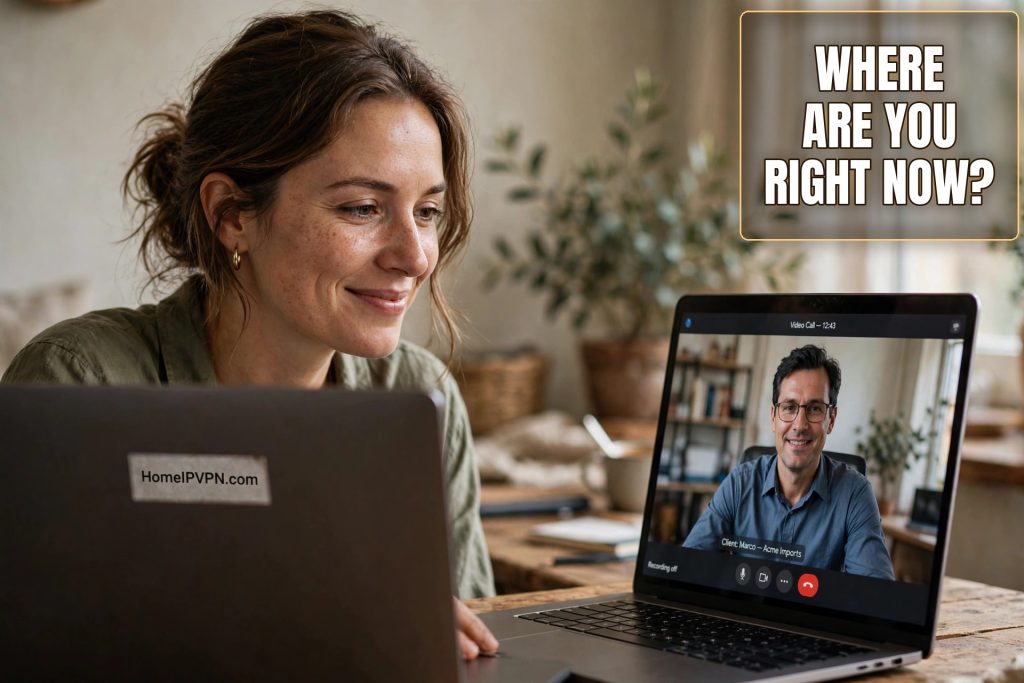
“So where are you right now?” The client asked it casually, mid-call, with the tone of someone making small talk. I was in a coworking space in Da Nang, it was 9 p.m. my time, and I had exactly two seconds to decide how to answer. Too vague and I sounded evasive. Too detailed and I sounded like I was on vacation. I said, “I am in Vietnam this month, working your hours,” and we moved on. The project continued for another year.
Every freelancer who works from different countries gets this question, and it always carries a weight beyond curiosity. Underneath it are real concerns: Will you be available when I need you? Is my data safe? Are you actually working or backpacking? Here is how to answer at every level, from casual to contractual.
What they are really asking
Almost nobody asks about your location because they care about geography. They ask because location is a proxy for their actual worries. The most common one is availability: if I need you urgently at 3 p.m., will you be awake? Next is reliability: is this person settled enough to deliver, or will they disappear into a jungle with no wifi? Then there is a quieter concern about professionalism: am I hiring a serious contractor or funding someone’s holiday?
Understanding this changes your answer completely. The question is not “where are you,” it is “can I count on you.” Every good response to the location question is really an answer to the trust question, with the location as a brief, honest preface. “I am in Lisbon this month, online 9 to 6 your time, and I respond within the hour during the workday” addresses every underlying worry in one sentence.
There is also a category of client who asks for compliance reasons: data protection rules, tax requirements, or company policies about where contractors may be. That is a different conversation, covered below, and it deserves a straight answer rather than a charming deflection.
The casual version: honest, brief, boring
For the small-talk version of the question, you want an answer that is truthful, short, and deliberately undramatic. “I am based in Mexico City right now.” “I am working from Portugal this quarter.” “I am in Bangkok for the next few weeks.” Then stop. Do not narrate the beach, the street food, or the scooter adventure. Every exotic detail feeds the suspicion that you are on holiday with a laptop.
The word “based” does useful work here. It sounds settled and intentional, which is exactly the impression you want. “I am traveling around” sounds transient. “I am based in Lisbon” sounds like someone with an apartment, a routine, and a reliable internet connection, even if the apartment is an Airbnb and you arrived Tuesday.
Follow immediately with the practical details that matter to them: your working hours in their timezone, your response time, your next availability. This redirect is the whole technique. You answer the question they asked in five words and the question they meant in fifteen, and the conversation moves back to the work, which is where you want it.
When they press: the confidence conversation
Sometimes the casual answer does not land, and the client probes: “But are you able to work properly from there?” or “What is your internet like?” This is the trust question surfacing directly, and it deserves a direct, confident answer, not defensiveness.
Be specific about your setup, because specifics are convincing. “I work from a coworking space with fiber internet, I have a backup mobile connection, and I have delivered every milestone on time for six months” is an answer that ends the conversation. Vague reassurances like “it is totally fine” invite more questions. Concrete details close them.
It helps enormously to have a track record to point at. If you have been delivering reliably, say so: the work speaks. New clients without that history need more reassurance, which is why many nomads front-load reliability signals early in a relationship: fast responses, early deliveries, proactive updates. Trust is built from evidence, and evidence accumulates fast when you are deliberate about it.
One more practical point: make sure your tools back up your claims. If you say your setup is professional, your video calls should not freeze and your file sharing should just work. Clients notice when shared drives, logins, and collaboration tools behave oddly from foreign connections. Many freelancers keep everything running smoothly with a home IP address from a service like HomeIPVPN, so the client’s systems see a normal, consistent connection. Your words say reliable; your connection should agree.
The contractual version: when location actually matters
Some clients have genuine location requirements, and you need to know where you stand. Data protection regulations may restrict where personal data can be accessed from. Financial and healthcare clients often have strict rules about contractor locations. Government work may require it explicitly. US federal contractors, for example, frequently face citizenship and location requirements that are not negotiable.
Read your contract before you travel, not after. Look for clauses about work location, data handling, and governing law. If the contract says work must be performed in a specific country or region, that is binding regardless of how good your wifi is in Bali. Violating it can void the contract, kill your insurance coverage, and in regulated industries create real legal exposure.
If a client raises a location requirement mid-relationship, do not lie and do not panic. Ask what the actual requirement is: sometimes “you must be in the EU” is satisfiable, sometimes “data must not leave the country” is not. If you cannot meet it, say so promptly and help with the transition. Losing one client honestly beats losing your reputation creatively.
For future contracts, consider addressing location upfront. A simple clause stating that you work remotely from various locations, with guaranteed availability during specified hours, prevents most of these conversations. Clients who truly need location restrictions will say so during negotiation, when you can still decide whether the engagement fits your life.
Scripts for the common situations
Keep a few polished answers ready so you never improvise under pressure. For the casual ask: “I am based in [city] this month, working [their] business hours.” For the concerned follow-up: “I have a dedicated workspace with fiber plus a backup connection; here is my availability this week.” For the timezone question: “I am [X] hours ahead, which means I am online when your day starts and I deliver overnight.”
Turn the timezone difference into an asset whenever you can. Being ahead means work delivered overnight, questions answered before their morning coffee, drafts waiting when they wake up. Many clients come to love this once they experience it. “I will have it for you by your morning” is a sentence that sells itself.
For the client who seems skeptical about the whole lifestyle, do not evangelize nomadism. Nobody hired you to convert them. Keep the focus relentlessly on deliverables, deadlines, and communication. Your lifestyle is your business; their results are theirs. The freelancers who thrive long-term are the ones whose clients eventually forget to ask where they are, because it so clearly does not matter.
What never to do
Do not lie about your location. Ever. Beyond the ethics, the practical risks are severe: IP addresses, timezones, background details on calls, and payment records all leak the truth eventually. A discovered lie destroys trust instantly and can void contracts. The short-term comfort of “I am in London” is never worth the long-term catastrophe of being caught.
Do not over-explain or apologize for your lifestyle. Lengthy justifications signal that you think there is something to justify, which plants the very doubt you are trying to remove. Brief, confident, and boring is the tone. You are a professional who happens to work from different places, not a traveler asking permission to have a job.
And do not badmouth the question itself. Clients who ask are usually just doing diligence, and reacting with irritation confirms their worry. Treat it as the routine professional question it is, answer it well, and move on.
The bigger picture
The reason this question feels loaded is that remote work is still new enough that “where are you” reads as a proxy for “are you real.” Every awkward pause on a call, every frozen screen share, every login hiccup feeds the doubt. The freelancers who never get the question twice are the ones whose entire operation, connection included, behaves as if they never left home. That seamlessness is the problem HomeIPVPN was built to solve: a home IP address that keeps your digital presence consistent and professional from anywhere. If you would rather have someone set that up and verify it works, the Pre-Travel Audit & Advisory session is 1 hour, costs $79, and that fee comes straight off the $279 Secure Home IP VPN System session if you go ahead.
Answer honestly, keep it boring, redirect to the work. Your location is the least interesting thing about you, and your answers should make sure it stays that way.