PRIVACY & SECURITY
Why Banks Freeze Accounts When You Travel Overseas
If you have ever been locked out of your bank account ten minutes after landing in another country, you probably asked the obvious question: why? You are a…
✓Your bank does not know it is you✓The risk score you never see✓Why a travel notice helps, but
Quick Answer
Banks freeze accounts abroad because automated fraud systems score every login for risk, and a foreign country is one of the heaviest risk signals. It is not personal: the same system protects you from real theft. Travel notices, consistent devices, and logging in from your home IP address all lower your risk score.
- The trigger: A login from a new country looks identical to a stolen-password login, so the system freezes first.
- What raises risk: New country plus new device, odd hours, large transfers, and commercial VPN addresses.
- What lowers risk: A travel notice on file, your usual phone or laptop, and small normal transactions.
- The cleanest signal: Your own home internet address is the most trusted login signal there is, which is what HomeIPVPN lets you carry with you.
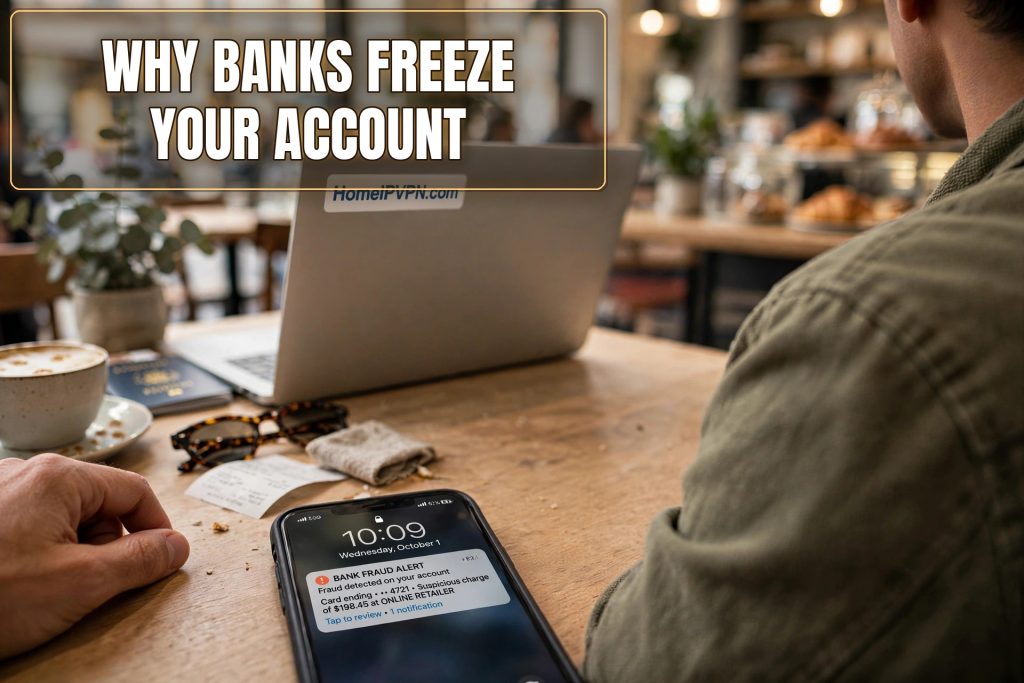
If you have ever been locked out of your bank account ten minutes after landing in another country, you probably asked the obvious question: why? You are a legitimate customer. You have had the account for years. Why does your bank treat you like a criminal the moment you cross a border?
Fair question. Here is what is actually happening, in plain English, with no computer science degree required.
Your bank does not know it is you
Think about it from the bank’s side. Every day, criminals buy stolen usernames and passwords and try them from all over the world. One of the oldest tricks is logging into someone’s account from a country the real customer has never visited.
Now think about what your login looks like when you travel. Yesterday you logged in from your couch in Denver. Today you are logging in from a hostel in Lisbon. To the bank’s computer, those two logins look exactly the same as the criminal scenario. It has no way to know you bought a plane ticket. It just sees: same account, wildly different location, minutes or hours apart. That is the single most classic pattern of account theft there is.
So it freezes the account. Not because it thinks you are guilty, but because freezing is cheap and being wrong about a real theft is catastrophically expensive.
The risk score you never see
Behind the scenes, banks run what is basically a scoring system for every login. Imagine a scoreboard that starts at zero and adds points for anything unusual:
- New country: big points. This is the heaviest single signal.
- New device: did you buy a new phone for the trip, or log in from a hotel business center computer? More points.
- Odd hour: logging in at 3 a.m. home time because of the time difference? A few more points.
- Unusual transaction: first thing you do is wire two months of rent to a foreign landlord? Points.
- Commercial VPN: your login comes from an address the bank knows belongs to a VPN company? Extra points, because stolen-account crews use those constantly.
Cross a threshold and the account locks automatically. No human reviews it first. That is why it feels so sudden and so unfair: a machine added up points and pulled the lever.
Why a travel notice helps, but only partly
Setting a travel notice in your banking app tells the bank’s system to expect foreign logins. It is genuinely useful and takes a minute. But it is not a force field. The notice mainly covers card purchases in the countries you listed. Online banking logins are scored by a different part of the system, and a travel notice only lowers your score, it does not zero it out.
It also expires. Most banks cap travel notices at 30 to 90 days. If you are traveling long term, working remotely from abroad for months, the notice quietly lapses and you are back to looking like a stranger to your own bank.
What actually makes you look like yourself
Here is the part most travelers miss. The strongest trust signal is not your password, your phone, or even the travel notice. It is your home internet address: the digital address your home WiFi has. Banks keep quiet histories of which internet addresses you normally log in from. Your home address, used for years, is the most boring and therefore the most trusted login in your entire history.
Everything about traveling breaks that signal. Hotel WiFi, cafe WiFi, your phone’s data roaming: all of them announce a foreign location the moment you connect. You can have the right password, the right phone, and a travel notice on file, and still trip the system, because the address itself is unfamiliar.
This is also why logging in through a random commercial VPN usually backfires. Those services route you through addresses shared by thousands of strangers, and banks maintain lists of them. A login from a known VPN address can score worse than a plain foreign hotel login.
Why some banks are stricter than others
Not all banks freeze with equal enthusiasm. Travelers consistently report that large banks with big fraud losses tend to be the most aggressive. In the US, that means names like Chase, Bank of America, and Wells Fargo come up constantly in traveler forums. In the UK, Barclays and the Lloyds group have a reputation for strictness that goes beyond freezing: they have actually closed accounts of British expats living in certain EU countries. Australian travelers talk about CommBank and ANZ flagging foreign logins, and about MyGov, the government services portal, blocking access from abroad entirely.
Smaller banks and credit unions are often calmer about travel, partly because their fraud systems are simpler and partly because a human is more likely to review the flag before it becomes a lock. Online-first banks vary wildly: some were built for travelers and barely blink at foreign logins, while others are notoriously twitchy.
None of this is official policy you can look up. Banks do not publish their fraud thresholds. Everything here comes from thousands of travelers comparing notes. The practical takeaway: if you bank with one of the strict ones and you travel often, you need a better strategy than hoping. Which brings us to…
The device piece nobody mentions
Location is the heaviest signal, but it is not the only one. Your device matters more than most travelers realize.
Did you buy a new phone for the trip? Log in from a hotel business center computer? Borrow a friend’s laptop because yours died? Each of those is a “new device” flag stacked on top of the “new country” flag, and the combination scores much worse than either alone. The fraud system cannot tell “I bought a new phone in Bangkok” from “a criminal bought a new phone and is trying my password from Bangkok.”
Even subtler: clearing your browser cookies or using incognito mode before logging into your bank wipes the little markers the bank uses to recognize your usual browser. To you it is tidiness. To the fraud system it is one more way you do not look like yourself. When you are abroad, log into your bank the boring way: your own phone, your own laptop, your normal browser, no privacy mode. Boring is trustworthy.
Joint accounts add a wrinkle
Here is a scenario that catches couples and families. You are in Thailand. Your partner is back home, paying bills from your shared account. The bank sees logins from two continents within hours of each other. That is the textbook pattern of a compromised account being used by two people, and it can trigger a freeze even though both logins are completely legitimate.
If you share accounts with someone who is not traveling with you, warn them before you leave, and consider telling the bank too. “My wife will be logging in from Chicago while I am in Chiang Mai” is a perfectly normal thing to put on the record, and it prevents one of the most confusing lockouts there is: the one where nobody did anything wrong at all.
So what is the real fix?
The travelers who never get frozen are the ones whose logins look utterly ordinary. Same device, same patterns, and critically, the same home internet address the bank has trusted for years. You cannot pack your home router in your suitcase, but you can carry its address with you.
That is what HomeIPVPN sets up: a private, secure connection that routes your banking (and everything else) through your own home internet, so your bank sees the same trusted address whether you are in Ohio or Osaka. No shared VPN addresses, no foreign flags, no explaining yourself to a fraud department at 2 a.m.
If the technical side sounds intimidating, that is exactly why we do it as a done-for-you service. Our Pre-Travel Audit & Advisory session is $79, done over a screen share in 1 hour, and the fee counts toward the Secure Home IP VPN System session. You watch it get built and tested on your own devices. Zero technical skill required on your end.
Your bank is not your enemy here. It is a nervous guard dog that cannot recognize you in a new coat. The trick is showing up in the coat it already knows.