RESIDENTIAL IP SOLUTIONS
Do I Need a VPN for Online Shopping Abroad?
Quick Answer Shopping from abroad triggers two annoyances: prices that change by country and payment systems that flag foreign transactions. A VPN helps with the location side, showing stores your hom
Quick Answer
Shopping from abroad triggers two annoyances: prices that change by country and payment systems that flag foreign transactions. A VPN helps with the location side, showing stores your home country so prices and availability look normal. It cannot change your card’s issuing country, so pair it with a travel-friendly card and always pay in the local currency to avoid bad conversion rates.
- Prices vary by country: many stores show different prices and even different products based on your location.
- Payments get flagged: a purchase from an unexpected country can trigger your card’s fraud protection and decline the transaction.
- Always pay in local currency: when a checkout offers to convert to your home currency, decline; your own bank’s rate is almost always better.
- Shop like you are home: with HomeIPVPN your connection appears from your home internet, so stores and payment checks see a normal domestic shopper.
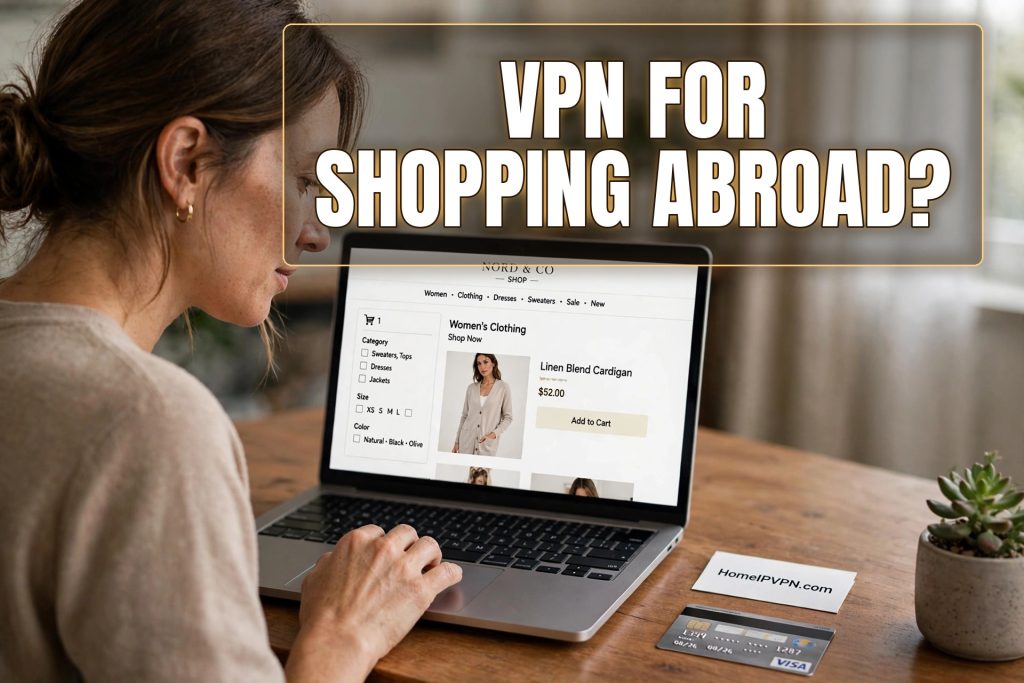
I was trying to buy a domestic flight in Colombia, on a Colombian airline’s website, priced in pesos, and the site kept flipping the price every time I refreshed. Then my card got declined. Then the airline’s fraud check locked my booking attempt for 24 hours. I ended up paying more the next day, through a different device, feeling like I had been punished for the crime of shopping while traveling.
Online shopping from abroad is full of these small humiliations. The prices move, the payments fail, the accounts lock. Most of it traces back to one thing: the internet cannot tell the difference between you on a trip and a thief with your card. Here is what is happening and what actually helps.
Why prices change when you cross borders
Many online stores practice regional pricing: the same product costs different amounts in different countries. Sometimes this reflects taxes, shipping, or local market conditions. Sometimes it is simply what the market will bear. Airlines and booking sites are the most dramatic example; the same seat can vary by double-digit percentages depending on the country the site thinks you are in.
Stores determine your country from your IP address, the same mechanism behind streaming catalogs. Change countries and the store may show you different prices, different currency, different availability, or a different version of the site entirely. Some travelers have saved real money by checking prices through different locations, though this is a gray area and stores are not obligated to honor cross-border pricing.
There is also the currency display trap. A store detects you are American and helpfully shows prices in dollars, converted at their own rate, which includes a comfortable margin for them. You think you are seeing the price; you are seeing the price plus their conversion profit. Whenever possible, view and pay in the store’s local currency and let your own bank handle the conversion.
Why your card gets declined abroad
Card fraud systems work like bank login systems: they learn your normal pattern and flag deviations. A purchase from a new country, especially a large one, especially from a merchant category you do not usually buy from, is a textbook fraud signal. The system declines first and asks questions later.
This is genuinely protective; card fraud is rampant and travelers are prime targets. But the false positives are maddening. Your own purchase, on your own card, for a flight you need tomorrow, declined because the fraud model cannot distinguish your trip from a theft.
What helps: notifying your card issuer of travel plans still works with many banks, though some have moved to automatic detection. Keeping your phone number current matters, because the verification text has to reach you. And having a second card from a different issuer means one decline is an inconvenience rather than a crisis. The travelers who sail through are the ones with redundancy.
What a VPN changes about shopping
A VPN changes the location the store sees, which addresses the price-display and availability side. Appearing from your home country means the store shows you the home version: home prices, home currency, the full catalog. For digital purchases, subscriptions, and region-specific stores, this alone resolves most of the weirdness.
It also helps with the account-security side. Many stores run their own fraud checks on login location, separate from your card issuer. A login from an unexpected country can trigger extra verification or lock the account. Appearing from your consistent home location keeps these checks quiet.
But here is the honest limit: a VPN cannot change your card’s issuing country, and it cannot change your billing address. When the payment processor checks whether the card’s country matches the purchase country, the VPN is irrelevant. The card is American, the billing address is American, and no tunnel changes that. For the payment itself, the card’s own travel-friendliness matters more than your IP address.
The home IP advantage for shoppers
Where a home IP setup shines for shopping is making everything look boringly normal. The store sees a domestic visitor. Your accounts see a domestic login. The fraud checks, both the store’s and your bank’s, see the pattern they expect. It is the same principle as with banking: not a disguise, just the absence of anomalies.
Regular VPNs are weaker here for the familiar reason: stores and payment processors increasingly recognize data-center addresses. A purchase routed through a known VPN server can itself look suspicious, which is the opposite of what you want at checkout. A home IP address, your own residential connection via HomeIPVPN, carries none of that baggage. It looks like you, shopping from home, because at the network level that is what is happening.
Pay in local currency, every time
This deserves its own section because it costs travelers more money than almost anything else in this guide. When you check out on a foreign site, you will often be offered a choice: pay in the local currency or pay in your home currency. The home-currency option sounds convenient. It is a markup in disguise.
This is dynamic currency conversion, and the merchant’s exchange rate is consistently worse than your bank’s, often by three to five percent. On a $1,000 purchase, that is $30 to $50 vanishing into the convenience. Always choose the local currency and let your card issuer convert. The only exception is if you hold a balance in that currency already, in which case paying from that balance avoids conversion entirely.
The same rule applies at foreign ATMs and card readers in physical stores. “Pay in dollars?” No. Local currency, always. Make it a reflex and stop thinking about it.
Cards that travel well
Not all cards are equal abroad. The two features that matter: no foreign transaction fees, and a fair exchange rate. Many travel-focused cards waive the typical 1 to 3 percent foreign transaction fee, which is an instant saving on every purchase. The exchange rate itself is usually set by the card network and is consistently fair, far better than any “pay in your currency” offer.
Consider keeping one card specifically for travel purchases, separate from your everyday card. It simplifies tracking, limits exposure if the number is compromised, and gives you the redundancy mentioned earlier. Two cards, two issuers, one for daily use and one as backup: this is the standard kit.
For larger purchases, check whether your card offers any purchase protection or extended warranty. These benefits apply abroad too, and they are genuinely useful when buying electronics or gear on the road. Read the fine print once; it takes ten minutes.
Account locks at checkout
One more frustration worth naming: store accounts that lock when accessed from abroad. You go to reorder something from a favorite shop, the site demands verification, the verification goes to an old email or phone number, and the purchase dies. This is the retail version of the bank problem, with the same root cause and the same fix.
Keeping your login location consistent prevents most of it. And for the accounts themselves, do a pre-trip audit: make sure the email and phone number on your most-used shopping accounts are current and reachable abroad. Update recovery options before you need them. The five minutes this takes saves the exact kind of checkout meltdown described at the top of this article.
Shop calmly
Do you need a VPN for online shopping abroad? For the location side, prices, availability, account checks, yes, it smooths nearly everything. For the payment itself, what matters more is a travel-friendly card and the discipline to always pay in local currency. The VPN handles where you appear to be; the card handles the money.
The pattern underneath is the one this whole series keeps returning to: the internet treats travel as suspicious, and “I am just on a trip” is never an accepted explanation. Appearing from home resolves the suspicion at its root. That is the problem HomeIPVPN was built to solve. If you would rather have someone set it up and verify it works, the Pre-Travel Audit & Advisory session is 1 hour, costs $79, and that fee comes straight off the $279 Secure Home IP VPN System session if you go ahead.
Buy the flight, pay in pesos, and get on with the trip. The checkout page should be the least interesting part of your journey.