TROUBLESHOOTING
German Banks Abroad: Why Deutsche Bank and Sparkasse Flag Foreign Logins
The email from Deutsche Bank arrived on a Tuesday morning in Lisbon, written in the particular German blend of politeness and finality that I have learned to…
✓Why German banks are stricter than✓What “restricted”✓Before you leave Germany: the
Quick Answer
German banks flag foreign logins aggressively because EU banking rules require strong fraud monitoring, and a login from an unexpected country looks exactly like account takeover. Deutsche Bank, Sparkasse, Commerzbank, and others may freeze online access until you verify, so plan for it before you travel.
- Expect verification, not just a warning: many German banks respond to foreign logins by restricting online banking until you confirm by phone, app, or branch visit.
- photoTAN and pushTAN need your registered phone: if the bank texts codes to a German number you canceled, the unblocking process gets much harder from abroad.
- Long absences raise bigger flags: travelers report that extended time abroad can trigger reviews of the account relationship itself, not just single logins.
- Log in like you never left: accessing your accounts over a home IP address with HomeIPVPN keeps your sessions looking domestic and avoids tripping location-based fraud filters.
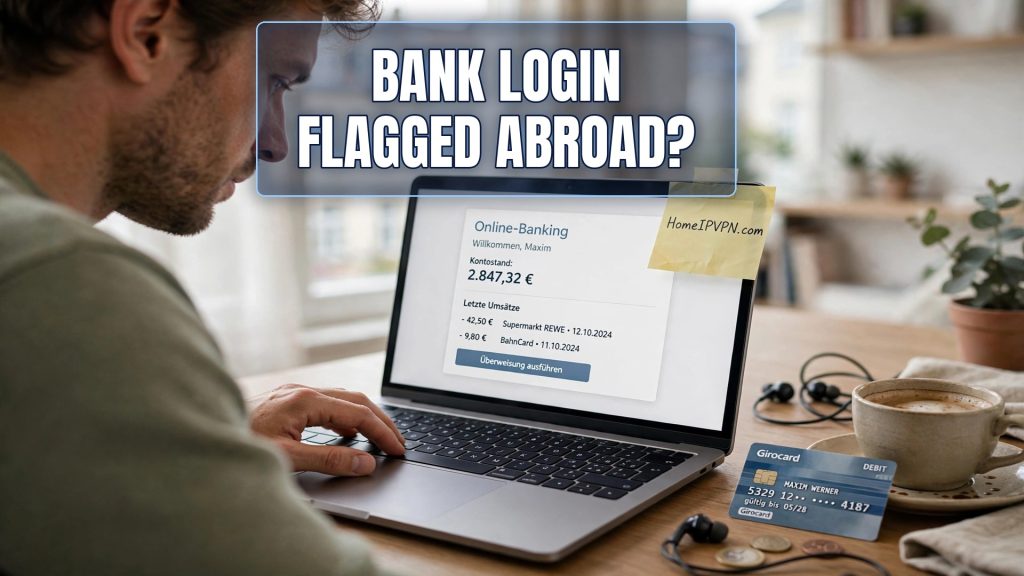
The email from Deutsche Bank arrived on a Tuesday morning in Lisbon, written in the particular German blend of politeness and finality that I have learned to dread. “Aus Sicherheitsgruenden,” it began. For security reasons. My online banking access had been restricted following logins from an unrecognized location. To restore it, I could call a Frankfurt number during German business hours, or visit a branch in person. I was 2,800 kilometers from the nearest branch.
If you are German, or bank in Germany, and you live abroad, this story will sound familiar. German banks are among the most cautious in Europe about foreign access, and their caution has a specific shape. Here is what to expect and how to prepare, in plain language.
Why German banks are stricter than most
German banking operates under some of the tightest consumer protection and fraud rules in Europe. The EU’s payment services directive requires strong customer authentication, which in practice means German banks built elaborate verification systems: photoTAN, pushTAN, chipTAN, each a method of confirming it is really you approving a login or transfer. These systems are excellent at stopping fraud and equally excellent at stopping you, when you show up from the wrong country.
The Sparkassen, Germany’s network of local savings banks, add another layer. They are regional institutions by design; your account belongs to a specific local Sparkasse, and their systems and support are oriented around local customers. A Sparkasse in Bavaria seeing daily logins from Thailand is not seeing a valued international client. It is seeing an anomaly, and anomalies get restricted first and investigated later.
Commerzbank, Deutsche Bank, and the online banks like N26 and DKB each have their own thresholds, but the pattern is consistent across all of them: foreign logins trigger stepped-up verification, repeated foreign logins trigger restrictions, and long unexplained absences can trigger reviews of whether the account relationship should continue at all. None of this is personal. It is automated risk management doing exactly what it was built to do.
What “restricted” actually looks like
It usually starts small. You log in from abroad and everything works, but a transfer requires extra confirmation. Then one day the login itself is blocked, or the app demands verification you cannot complete. The restriction levels escalate: first individual transactions need approval, then online banking is limited to viewing, then access is suspended entirely pending verification.
The verification paths are where the real pain lives. Many German banks verify by calling or texting the phone number on file, which is often a German mobile number. If you canceled that number when you moved, the bank’s recovery path leads to a dead end, and the alternative is usually a phone call to Germany or a branch visit. Some banks accept verification through their app, but only if the app was set up and paired while you were still in Germany.
Timing makes everything worse. German bank phone support runs on German business hours, which might be the middle of your night. Document requests go by post to your registered address, which might be an old apartment. Each round trip of “we sent a letter, please respond” adds weeks. A problem that would take one branch visit at home becomes a month-long correspondence saga from abroad.
Before you leave Germany: the checklist
If you are still in Germany and planning to go, you have a window to make all of this dramatically easier. First, switch your TAN method to the app-based option and make sure it is fully activated and working. photoTAN and pushTAN through the bank’s app work over the internet from anywhere; SMS-based codes depend on keeping your German number alive.
Second, decide about that phone number deliberately. Keeping a cheap German prepaid SIM active, even just for receiving texts, preserves the bank’s primary verification channel. Many travelers keep the SIM in a drawer at home, topped up once a year, purely as a bank-code receiver. It is the cheapest insurance in this whole story.
Third, update your address to somewhere reliable. If you have family in Germany, use their address with their permission. Banks send important notices by post, including the ones about account reviews, and “I never got the letter” is not a defense. A reliable German mailing address is worth more than most people realize.
Fourth, tell the bank you are going. This sounds obvious and almost nobody does it. A travel notice or a simple message to customer service, noting that you will be logging in from abroad for an extended period, goes into your file. It does not guarantee smooth sailing, but an annotated account fares better with automated systems than an unexplained one. While you are at it, ask directly: what happens to my online access if I log in from outside the EU for six months? Write down the answer.
Living abroad with German accounts: the ongoing routine
Once you are out, consistency is your friend. Log in on a regular schedule rather than in panicked bursts; steady, predictable usage looks human to monitoring systems, while six months of silence followed by a flurry of transfers looks like a takeover. Keep the app updated, keep your phone number current in their records, and respond to any verification request the same day.
Watch for the long-absence review. Travelers report that after extended periods abroad, some German banks initiate a review of the account relationship, asking for proof of continued ties to Germany or warning of eventual closure. This is not universal, and policies differ between institutions, but it happens often enough to plan for. Maintaining a German address, keeping some account activity, and responding promptly to bank correspondence all help.
Consider keeping a second German banking relationship as a backup. If one bank restricts you, having another account at a different institution means you are inconvenienced, not stranded. The online banks with more international orientation can complement a traditional Sparkasse or Deutsche Bank account nicely.
The login-location problem
Here is the technical thread running under all of this: every login carries a location signal, derived from your internet connection’s IP address. When your IP says Bangkok and your account history says Munich, the fraud system notices. One such login is a curiosity. A pattern of them is a case file.
German banks are particularly sensitive to this signal because their fraud models are tuned for a customer base that historically stayed put. The systems were built for people who live in Germany and occasionally vacation, not for people who live everywhere. You are an edge case in their model, and edge cases get restricted.
The practical fix is to remove the anomaly: access your accounts over a connection that appears to come from Germany. A home IP address from a service like HomeIPVPN makes your logins look domestic, which keeps them below the fraud filters’ radar. It does not change who you are or what you are doing; it simply stops your location from being the thing that triggers every alarm. For German accounts specifically, this one change prevents more problems than any other.
If you are already locked out
First, do not panic and do not try logging in twenty more times; repeated failed attempts make automated systems more suspicious, not less. One careful attempt, then stop and switch to the recovery channel.
Call the bank’s international or English-language line if one exists, during German business hours, with your account details and identification ready. Be calm, be specific: “My online access was restricted after logins from abroad, I am the account holder, how do we verify me?” If phone verification fails because of the dead-number problem, ask about alternatives: video identification, verification through the app, or a written request with certified ID copies.
VideoIdent, the video-call identity verification widely used in Germany, can sometimes be completed from abroad and may satisfy the bank’s requirements. Ask explicitly whether it is accepted for your situation. And if the bank insists on a branch visit, ask whether any partner or correspondent arrangement exists, or whether a German consulate can certify the documents they need. There is almost always a path; it is just rarely the obvious one.
The bigger picture
The deeper issue is that German banking was engineered for residents, down to the TAN apps, the branch networks, and the fraud models. Living abroad with these accounts means constantly proving you are still you, to systems that equate “abroad” with “suspicious.” Removing the location anomaly from your logins is the problem HomeIPVPN was built to solve: a home IP address so your sessions look like they come from home, and the bank’s attention stays where it belongs. If you would rather have someone set that up and verify it works, the Pre-Travel Audit & Advisory session is 1 hour, costs $79, and that fee comes straight off the $279 Secure Home IP VPN System session if you go ahead.
Keep the German number, tell the bank you are going, log in like you never left. Aus Sicherheitsgruenden does not have to ruin your Tuesday.

