PRIVACY & SECURITY
Fake eSIM Sellers: The Travel Scam Targeting Arriving Tourists
Quick Answer Fake eSIM sellers target newly arrived travelers with too-good-to-be-true data plans sold at airports, in chat groups, and through ads. The “eSIM” is often a worthless QR code
Quick Answer
Fake eSIM sellers target newly arrived travelers with too-good-to-be-true data plans sold at airports, in chat groups, and through ads. The “eSIM” is often a worthless QR code, a hijacked account, or a lure to harvest your payment details and identity documents. Buy eSIMs only from established providers with real reviews and real support.
- How it works: friendly sellers approach tired arrivals, or ads promise unlimited data for a few dollars, and the product never works or never existed.
- Red flags: prices far below market, pressure to decide now, payment by crypto or transfer only, and requests for your passport “for registration.”
- The deeper risk: some scams harvest payment and identity details, which feeds larger fraud like SIM swaps.
- Stay connected safely: sort your connectivity before you fly when you can, and keep your important accounts on your trusted home connection with HomeIPVPN no matter which SIM you use.
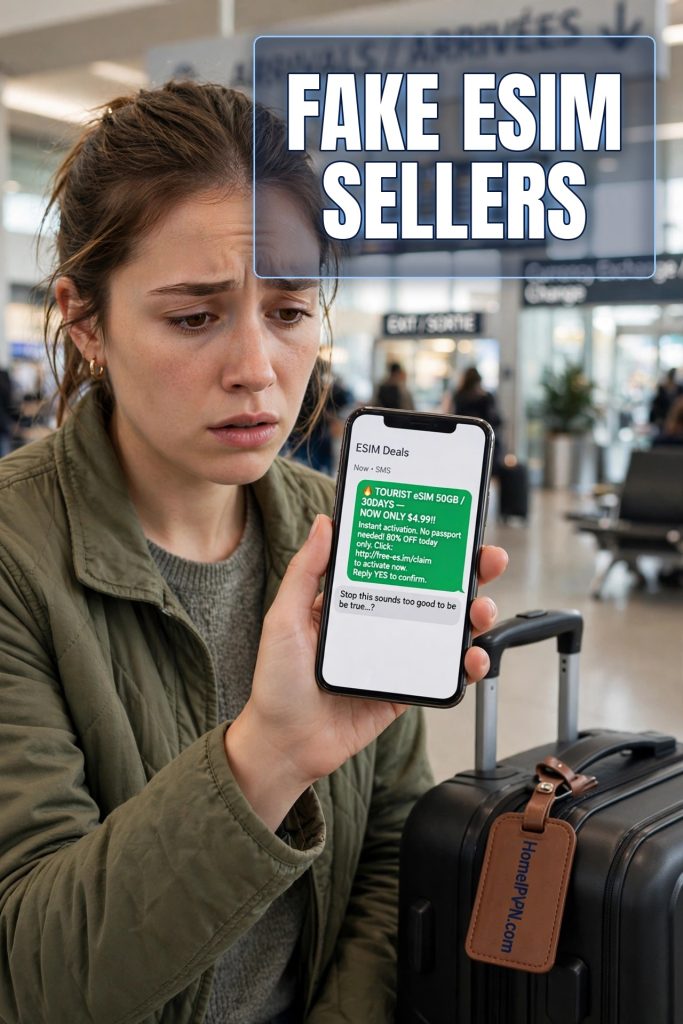
You have just landed after fourteen hours in the air. You are dehydrated, disoriented, and your phone shows no service. You need data, now, for the taxi app, the hotel address, the message to your family that you arrived alive. And right there in the arrivals hall is a smiling person with a sign: “Tourist eSIM, unlimited data, cheapest price.”
It feels like a rescue. Sometimes it is. Sometimes it is the start of a scam that costs you far more than the twenty dollars you hand over.
Fake eSIM sellers have become one of the most common arrival scams in tourist-heavy countries. The scam exploits a perfect moment: you are tired, you are disconnected, you need connectivity urgently, and your normal skepticism is still somewhere over the ocean. Here is how it works and how to walk past it.
Why eSIMs created the perfect scam product
First, some context for anyone who has not used one. An eSIM is a digital SIM card: instead of a physical chip, your phone downloads a mobile plan as software, usually by scanning a QR code. For travelers, they are wonderful. You can buy data for a country before you land, activate it in minutes, and skip the airport SIM counter entirely.
But the same features that make eSIMs convenient make them perfect for scammers. The product is invisible. There is no physical card to inspect, no shop to return to, no packaging to examine. A scammer can “sell” you a QR code printed on a slip of paper, and you will not know it is worthless until you try to activate it, by which time the seller is gone.
The market is also genuinely confusing. Dozens of legitimate eSIM providers, hundreds of plans, prices that vary wildly by country. A newcomer cannot tell a fair price from a scam price. When everything is unfamiliar, the cheapest option looks like a bargain instead of a warning.
And the moment of purchase is the moment of maximum vulnerability. You have no data, so you cannot look up reviews. You are in a hurry. Everyone around you seems to be buying one. The scam does not need to be sophisticated. It just needs to be standing where you land.
The airport seller version
The classic version happens right in the arrivals hall or just outside the terminal. A friendly person, sometimes with an official-looking vest or a printed banner, offers tourist eSIMs at unbeatable prices. They are helpful. They will even “activate” it for you on the spot, handling your phone, scanning the code, tapping through the setup.
What you actually get varies. Sometimes it is a QR code that does nothing: no plan behind it, just a dead code. Sometimes it is a real eSIM but with a tiny fraction of the promised data: “unlimited” turns out to be a few hundred megabytes that vanish by evening. Sometimes it works for a day and then dies, because it was a trial account or a shared login that got deactivated.
The “let me set it up for you” part deserves special attention. Handing your unlocked phone to a stranger is risky in any context. While “activating” your eSIM, a dishonest seller can install a profile that routes your traffic through their servers, note down your details, or in the worst cases, initiate changes to your accounts. The helpfulness is the technique. The phone in their hands is the opportunity.
Legitimate airport sellers exist, of course. Official carrier stores and authorized resellers operate in many airports. The difference is verifiability: a real store has signage you can photograph, receipts with company details, and a brand you can look up later. A person with a laminated sign and a stack of QR codes has none of these.
The online version: ads, groups, and DMs
The scam is not limited to airports. Online versions target you before you even fly, through ads and travel groups.
The ads are easy to spot once you know the pattern: “Unlimited 5G data, 30 countries, $4.99” with stock photos and a countdown timer. The price is the tell. Real eSIM data costs real money because providers buy it from real carriers. Anyone selling far below market price is either losing money on every sale, which no business does, or selling something that is not what it claims to be.
Travel Facebook groups and forums get infiltrated with “recommendations” from fake accounts: “I used this eSIM seller, amazing service, so cheap!” The accounts are new, the enthusiasm is suspicious, and the link goes to a site registered last month. Real recommendations come from established community members with post histories. Treat eSIM tips from strangers the way you would treat a stranger offering you a drink.
Direct messages are the boldest version. Someone messages you after you post in a travel group, offering a “special deal” on eSIMs. No legitimate business operates this way. Real eSIM providers have websites, apps, and support desks. They do not need to slide into your DMs.
What they are really after (it is not always the twenty dollars)
The twenty dollars stings, but for the more sophisticated operations, your money is the least of it. The real harvest is your data.
Many fake sellers ask for your passport “for registration.” Real carriers in some countries do require ID for SIM registration, which makes this request sound plausible. But a scammer with a photo of your passport has the core of your identity: full name, date of birth, document number, photo. That is the homework kit for a SIM swap scam, for account takeovers, for fraud in your name. A passport photo is worth far more than the eSIM price to the right buyer.
Payment details are the other harvest. Sellers who insist on card payments through their own links or apps, rather than cash or standard processors, may be skimming card numbers. Sellers who demand crypto or wire transfers are telling you the payment cannot be reversed, which is exactly what a scammer wants.
And the configuration profiles some “helpers” install can be the most dangerous of all. A malicious profile on your phone can route traffic, install certificates, or maintain access long after the seller is gone. This is rare, but it is the reason you should never let a stranger configure your phone, no matter how helpful they seem.
Red flags: the sixty-second check
You will be tired when you encounter these sellers, so make the check simple enough to run on no sleep.
Price far below market is the biggest flag. If the established providers charge fifteen dollars for 5GB and someone offers unlimited for five, the math does not work. It is not a bargain. It is bait.
Pressure and urgency are next. “Special price only right now,” “last one at this price,” “the shop closes in five minutes.” Legitimate sellers do not need to rush you. Scammers do, because a customer with time looks things up.
Payment method tells you a lot. Cash is normal at airports. Card through a proper terminal is fine. Demands for crypto, wire transfers, or payment through unfamiliar apps mean the seller needs the transaction to be irreversible. Ask yourself why.
Identity document requests should make you pause. If local law genuinely requires ID for SIM registration, buy from the official carrier store where the process is formal and receipted. A random seller photographing your passport on their personal phone is not compliance. It is collection.
And the setup offer, “let me do it for you,” is a hard no. Your phone, your hands. Anyone who insists on handling your device is telling you their business requires access you should not grant.
How to actually buy an eSIM safely
The safe path is boring, which is exactly why it works. Buy from established providers with real track records: companies that have been around for years, have apps in the official stores with long review histories, and offer customer support that answers.
Buy before you fly, from home, on wifi you trust. This is the single best defense. When you land with a working eSIM already installed, the arrivals-hall sellers become irrelevant. You walk past them the way you walk past every other airport hustle: with the calm of someone who does not need what they are selling.
Check the provider’s reputation the way you would check a hotel: recent reviews, real support channels, a company you can name. The established eSIM marketplaces are well reviewed and widely discussed in nomad communities. A provider nobody has heard of, with a website registered last month, is not worth the gamble to save five dollars.
Keep your purchase confirmation. Screenshot the plan details, the order email, the support contact. If something goes wrong, you want proof of what you bought and from whom. With a legitimate provider, support will fix it. That sentence is the whole difference: legitimate sellers have support desks, scammers have exit routes.
If you already bought a dud
If you are reading this after the fact, do not feel foolish. This scam works on experienced travelers. Here is the cleanup.
First, check what got installed. On your phone, look at the installed eSIMs and configuration profiles. Remove anything from the suspicious seller. If someone handled your phone, consider what else they might have touched: check for unknown apps, unknown profiles, and changed settings.
Second, if you shared your passport or ID, treat it as compromised for fraud purposes. Monitor your accounts, consider the identity-theft protections available in your country, and be extra alert for the follow-up scams that use those details, including SIM swap attempts. This connects directly: the eSIM scam’s data harvest feeds the SIM swap scam’s homework phase.
Third, if you paid by card through their link, watch that card closely and consider replacing it. If you paid cash, the loss is limited to the cash, which is the small mercy of the airport version.
Fourth, report it. Airport authorities, tourist police, the platform where you saw the ad. Reports rarely get your money back, but they build the record that gets repeat offenders shut down.
Connectivity is infrastructure, not an impulse buy
Step back and notice the pattern. The eSIM scam works because connectivity feels urgent on arrival, and urgency destroys judgment. The defense is to remove the urgency: land already connected, with a plan bought calmly from home.
Treat connectivity the way you treat accommodation and insurance: arranged in advance, from providers you chose with a clear head. The arrivals hall is for finding your driver, not for making purchasing decisions. Every scam in that hall, eSIMs included, depends on you deciding under pressure. Decide beforehand and the pressure vanishes.
And once you are connected, keep the important stuff on infrastructure you trust. Public wifi, hotel networks, brand-new local SIMs: all fine for maps and messages, but your banking and client work deserve your own trusted connection. Routing through your home setup with HomeIPVPN means your important accounts see the same familiar home address no matter which SIM is in your phone or which airport you just left.
If setting that up before your next trip sounds better than figuring it out from an airport floor, that is exactly the problem HomeIPVPN was built to solve. And if you would rather have someone configure it and verify it works, the Pre-Travel Audit & Advisory session is 1 hour, costs $79, and that fee comes straight off the $279 Secure Home IP VPN System session if you go ahead.
Land connected. Walk past the laminated signs. Your tired future self will thank your prepared present self.