REMOTE WORK & DIGITAL NOMAD
Berlin for Remote Workers: Internet, Coworking, and Costs in 2026
The U-Bahn doors close, and you are wedged between a DJ heading home at 8am and a startup founder heading to work at the same hour, which tells you most of…
✓Internet in Berlin: the 2026✓Coworking: depth and variety✓Costs in 2026: honest numbers shape
Quick Answer
Berlin remains one of Europe’s strongest remote work bases in 2026: fast internet widely available, a deep coworking scene, and costs below London or Amsterdam. EU citizens can base here freely; non EU remote workers typically use Schengen tourist entries or Germany’s freelance visa options. The main challenges are housing competition and bureaucracy, both manageable with preparation.
- Internet: Fiber and fast cable widely available; always verify the specific apartment’s connection.
- Coworking: One of Europe’s deepest scenes, with options from budget to premium across all districts.
- Costs: Cheaper than London, Paris, or Amsterdam, but rising; budget carefully for housing.
- Working online: German IPs are fine for most services, but your home bank still notices; a home IP from HomeIPVPN keeps things boring.
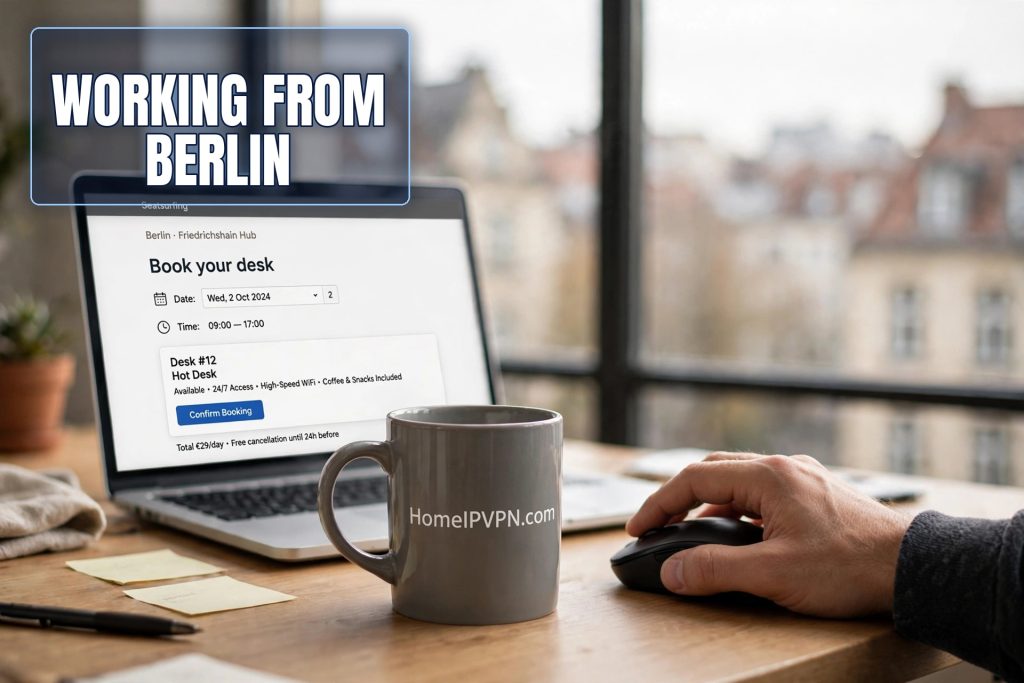
The U-Bahn doors close, and you are wedged between a DJ heading home at 8am and a startup founder heading to work at the same hour, which tells you most of what you need to know about Berlin. By nine you are at a coworking space in Kreuzberg, flat white in hand, on a fiber connection that does not flinch at your four person video call. By seven you are at a Spätkauf with a two euro beer, watching the city do its thing.
Berlin has been a remote work magnet for over a decade, and unlike some nomad darlings, it earned the status on infrastructure rather than Instagram. In 2026 it remains one of the most practical European bases: real internet, real coworking, real culture, at prices that undercut its Western rivals. Here is the current picture.
Internet in Berlin: the 2026 reality
Berlin’s internet is good and getting better. Fiber rollout has expanded significantly across the city, fast cable connections are widespread, and the days when Berlin lagged behind on connectivity are largely over. In central districts, Prenzlauer Berg, Mitte, Kreuzberg, Neukölln, Charlottenburg, you can expect fast, reliable connections in most modernized buildings.
The caveat is the building, not the district. Berlin’s housing stock includes many beautiful old Altbau buildings where the in building wiring is the bottleneck, not the street infrastructure. Two apartments on the same street can have wildly different connections. This makes the rental vetting ritual essential: ask for the technology (fiber, cable, DSL), the contracted speed, and a live speed test screenshot from inside the apartment. For a work base, never skip this.
Mobile data in Germany is famously pricier and stingier than in much of Europe, a long running national quirk. Prepaid data plans exist and work fine as backup, but the generous cheap data culture of the Balkans or Asia does not apply here. Treat mobile as your backup, not your plan A, and make sure your primary connection is solid before you sign anything.
Coworking: depth and variety
Berlin’s coworking scene is one of the deepest in Europe, which means choice paralysis is the main risk. International operators run multiple locations with the full package: fast redundant internet, phone booths, meeting rooms, 24 hour access. Independent spaces offer more character and often better communities, from Kreuzberg creative hubs to Mitte startup factories to quiet Neukölln writing rooms.
Day passes are widely available and reasonably priced, which makes the first week easy: tour three or four spaces, work a day in each, and commit to a month where you fit. Monthly memberships vary by district and polish level, but the market is competitive enough that you can find good value without much hunting.
What to prioritize: reliable fast internet with backup, bookable call rooms, and hours that match your timezone reality. Berlin’s spaces generally keep long hours, and several run around the clock, which matters if you work with the Americas. Location matters too, but less than newcomers think: pick the space near your apartment, not the famous one across the city. A ten minute commute you actually do beats a forty minute commute you dread.
Costs in 2026: honest numbers shape
Berlin is no longer the absurd bargain it was a decade ago, and anyone telling you otherwise is working from old data. Rents have risen substantially, the housing market is competitive, and the famous cheap Berlin is now merely affordable Berlin. But affordable compared to what: still meaningfully cheaper than London, Paris, Amsterdam, or Zurich, for a comparable quality of life.
Housing is the budget line that matters most. The rental market is tight, furnished short term apartments carry a premium, and the infamous apartment hunt, with its mass viewings and document folders, is real. For nomads, the practical paths are furnished temporary rentals, which cost more but skip the bureaucracy, or sublets, which require local networks to find. Budget for housing generously and start searching before you arrive.
Everything else is reasonable. Eating out spans from two euro street food to proper restaurants at moderate prices. Groceries are affordable, especially at discount supermarkets. Public transport is excellent and the monthly pass is good value. The total monthly cost for a comfortable remote work life sits well below Western Europe’s big three of London, Paris, and Amsterdam, which is the comparison that matters.
Visas and the right to be here
EU citizens can live and work in Berlin freely, which makes it the default serious base for European remote workers. No visa, no paperwork beyond the local registration, just show up and build a life. This is a massive structural advantage that non EU nomads should factor into their Europe planning.
For non EU remote workers, the standard path is the Schengen tourist entry: ninety days in any rolling one hundred eighty day period. Berlin works beautifully as a ninety day base, long enough to get the apartment, the coworking routine, and the favorite Spätkauf, short enough to avoid the deeper bureaucracy.
Germany also has freelance visa frameworks that some remote workers use for longer stays, with requirements around proving freelance income, local clients or economic interest, health insurance, and financial stability. These are real options but they involve real German bureaucracy, which is thorough, slow, and conducted substantially in German. Get professional advice before pursuing this path. It is achievable and many have done it, but it is a project, not a formality.
Whatever your status, do the Anmeldung, the local address registration, if you are staying long enough to need it. It unlocks everything from bank accounts to library cards, and skipping it creates cascading annoyances. It is also, characteristically, a bureaucratic appointment you book weeks in advance. Welcome to Germany.
Neighborhoods for remote workers
Kreuzberg remains the classic choice: central, lively, diverse, with great cafes and coworking options, though no longer cheap. Neukölln is the younger sibling: more affordable, creative, excellent food, and a growing remote worker presence. Prenzlauer Berg is the polished family friendly option: beautiful streets, good infrastructure, higher prices, quieter nights.
Mitte is central and businesslike, convenient but pricey and a bit soulless after hours. Charlottenburg and Wilmersdorf in the west offer elegant old buildings and calmer streets, popular with longer term residents. Friedrichshain has the east side energy, good value pockets, and the famous nightlife that you will hear whether you participate or not. Wedding is the up and comer: affordable, diverse, increasingly interesting.
The practical advice: prioritize your coworking space and your U-Bahn line over the neighborhood’s reputation. Berlin is a city of villages connected by excellent transit, and a good apartment ten minutes from your workspace beats a fashionable address with a bad commute. Visit neighborhoods at different times of day before committing. The street that charms at noon can deafen at midnight.
Banking, bureaucracy, and daily friction
Germany’s banking system is modernizing but retains quirks. Online banks and fintech options work well for daily life. Traditional banks can be slow and paper loving. As a non resident, opening an account ranges from easy with fintech options to difficult with traditional ones; research current options for your situation before arrival.
Cash still matters more in Germany than visitors expect. The famous German cash preference is fading but not gone, especially in smaller shops, bars, and bakeries. Carry euros alongside your cards. Card acceptance is broad in chains and restaurants but patchy in the places with the most character, which is a very Berlin tradeoff.
Bureaucracy is the city’s love language. Appointments for everything, forms in triplicate, offices with specific hours and specific requirements. It is all navigable, and it all works eventually, but it operates on its own timeline. Bring patience, bring documents, bring a German speaking friend for the important appointments. The system rewards preparation and punishes improvisation.
The digital layer: why your IP still matters in Berlin
Berlin’s internet is fast and German IPs are respectable worldwide, so the connectivity story here is mostly solved. But the administrative story is the same as everywhere: your home bank, your employer’s security systems, and your various accounts notice that you are logging in from Germany now, on new networks, at new patterns.
For EU based workers this is milder than for intercontinental movers, but it is not zero. Banks still flag, systems still challenge, and the verification dance still happens at inconvenient moments. The nomad who moves between Berlin and other bases, which describes most Berlin nomads eventually, generates the familiar pattern of changing locations that fraud systems are built to question.
The permanent answer is the same one that works on every continent: a home IP address that does not change when you do. HomeIPVPN routes your traffic through your own residential connection, giving your accounts one stable familiar address whether you are on Kreuzberg fiber, a Neukölln cafe, or your next base entirely. In a city where you have already solved the visible infrastructure, this solves the invisible kind. Set it once, and Berlin’s excellent internet carries traffic your bank never questions.
Who Berlin is for in 2026
Berlin is for the remote worker who wants a real city, not a resort with WiFi: depth of culture, serious infrastructure, an international community that is actually international, and costs that, while risen, still undercut the Western European alternatives. It suits EU citizens building a genuine base, non EU nomads doing a productive ninety day season, and anyone whose work benefits from being around other ambitious people.
It is less suited to the sun seeker, the beach worker, or anyone whose primary criterion is cheap. Berlin’s winters are long, gray, and dark by four in the afternoon. If you need sunshine to function, winter here is a test. Many nomads solve this the classic way: Berlin for spring through autumn, somewhere warm for winter. The city will be here when you get back. It always is.
The throughline of Berlin as a work base is seriousness: serious internet, serious coworking, serious culture, serious bureaucracy. It rewards people who approach it as a place to do good work, not just a place to be. Bring your A game, sort your housing early, register your address, and the city gives back enormously.
And beneath all of it, the same invisible foundation as every base in this series: work that flows and accounts that stay calm. Fast Berlin fiber handles the first. A constant home IP handles the second, which is exactly what HomeIPVPN was built to provide, quietly, under everything else. If you would rather have someone set it up and verify it works before you settle in, the Pre-Travel Audit & Advisory session is 1 hour, costs $79, and that fee comes straight off the $279 Secure Home IP VPN System session if you go ahead.
Learn the U-Bahn map. Find your Spätkauf. Berlin rewards those who stay a while.