REMOTE WORK & DIGITAL NOMAD
Greece Digital Nomad Visa: What Remote Workers Need to Know
You land in Athens on a Tuesday afternoon in late spring. The light is the kind of white-gold you only get in the Mediterranean, the taxi driver is already…
✓What the Greece digital nomad visa✓The income requirement, explained✓The documents you will actually
Quick Answer
Greece offers a digital nomad visa that lets remote workers live in the country while working for employers or clients based abroad. You need to prove steady remote income above the official threshold and carry health insurance, and the permit is typically issued for up to a year. Requirements shift over time, so always confirm the current figures with a Greek consulate before you apply.
- Income proof: You must show regular remote earnings above the monthly threshold set by the Greek authorities, usually through bank statements or contracts.
- Paperwork: Expect a passport, proof of remote employment or freelance clients, health insurance, and a clean criminal record check.
- Timeline: Applications go through a Greek consulate in your home country and can take several weeks, so start early.
- Banking from Greece: Your home bank may flag logins from a Greek IP address, which is one reason remote workers route their connection through HomeIPVPN so their accounts see a familiar home connection.
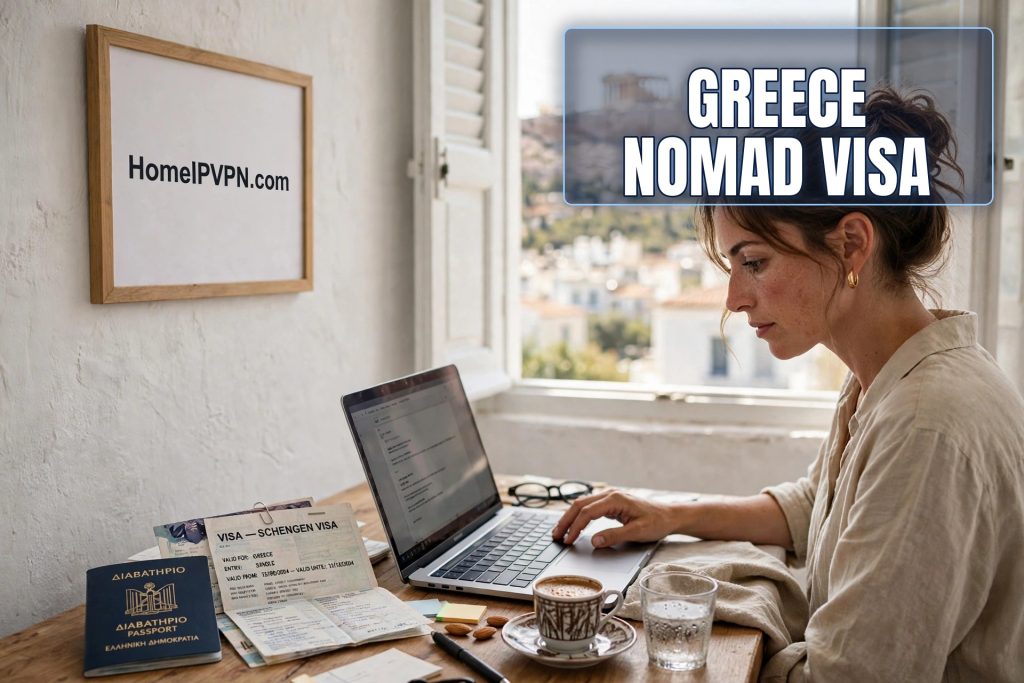
You land in Athens on a Tuesday afternoon in late spring. The light is the kind of white-gold you only get in the Mediterranean, the taxi driver is already telling you his cousin lives in Chicago, and by evening you are on a rooftop in Koukaki with a cold drink, watching the Acropolis turn pink. Your laptop is in your bag. Tomorrow you will open it and do a full workday from a country where lunch costs less than your old parking spot.
That is the dream that pulls remote workers toward Greece, and the digital nomad visa is the paperwork that makes it legal for longer than a tourist stamp allows. But between the dream and the residence permit sits a stack of forms, an income threshold, and a handful of realities nobody puts in the Instagram captions. Let us walk through all of it in plain language.
What the Greece digital nomad visa actually is
Greece created a dedicated visa for remote workers a few years back, and the idea is simple. If you earn your living from clients or an employer outside Greece, and you can do that work from a laptop, Greece will let you live there legally for an extended stay. You are not taking a Greek job. You are bringing your foreign paycheck and spending it in the Greek economy, which is exactly why the government wants you.
The permit is generally issued for up to twelve months, and in many cases it can be renewed if you still qualify. That is the headline. The details, as always, live in the paperwork, and the paperwork lives at the Greek consulate that covers wherever you currently live. You apply before you move, not after you arrive on a tourist entry and decide to stay. People who skip that step end up in the worst kind of limbo, legally present as tourists but working in a gray zone they cannot fix without leaving.
One thing worth knowing upfront: this visa is for people whose work is genuinely location independent. If your job requires you to be physically present somewhere, or your clients are all Greek companies paying into the Greek system, this is not the right permit and a consulate officer will tell you so. The whole design assumes your money comes from outside Greece.
The income requirement, explained without the jargon
Every digital nomad visa has a money bar, and Greece is no exception. The authorities want proof that you earn enough to support yourself without working locally, and the threshold has historically sat at a level meant to filter for established remote workers rather than people hoping to figure it out after arrival. The figure most widely reported in recent years is around three and a half thousand euros per month, with higher amounts if a spouse or family members are coming with you.
Here is the part that matters more than the number itself: the number changes. Governments adjust these thresholds, and what was true eighteen months ago may not be true when you apply. Do not plan your move around a figure you read in a blog post, including this one. Check the current requirement on the website of the Greek consulate that handles your application, or ask an immigration lawyer who files these routinely. A thirty minute check now beats a rejected application later.
What counts as proof is usually straightforward: recent bank statements showing regular incoming payments, an employment contract stating you work remotely, or client contracts if you freelance. The pattern they want to see is stability. Three months of steady deposits tells a better story than one big invoice and silence. If your income is lumpy, as freelance income often is, gather six months of statements so the average is obvious at a glance.
The documents you will actually need to gather
Beyond income proof, the standard file looks like this. A passport valid well beyond your planned stay. Proof of health insurance that covers you in Greece for the full permit period, which is non negotiable and checked carefully. A criminal record check from your home country, which in some places takes weeks to issue, so request it early. Proof of where you will live, which can be a rental agreement, and some consulates ask for this before they will finalize anything.
The criminal record check deserves its own warning. In the United States, for example, an FBI background check can take a couple of months if you do it by mail, and then it may need an apostille, which is an international authentication stamp, before a Greek consulate accepts it. Start that process the day you decide to apply, not the week before your appointment. This single document causes more delays than every other requirement combined.
You will also fill out the national visa application form, provide passport photos in the specified size, and pay the visa fee. None of this is difficult. All of it is slow. Treat the application like a project with a six to eight week runway and you will be fine. Treat it like something you can knock out in a weekend and you will be rebooking flights.
The realities nobody puts in the brochure
Now the honest part. Greek bureaucracy has a reputation, and the reputation is earned. Offices keep idiosyncratic hours, requirements vary slightly between consulates, and a document that was accepted in one city gets questioned in another. Bring originals plus copies of everything. Bring patience as well. The people processing your file are not your adversaries, but the system rewards those who arrive over prepared.
Tax is the second reality. Spending a year in Greece on a nomad visa can create tax obligations depending on how long you stay and how the local rules treat your situation. This is not a reason to panic, and many nomads sort it cleanly with an accountant, but it is absolutely a reason to get professional advice before you go rather than after a letter arrives. A one hour consultation with a cross border tax advisor is some of the best money you will spend on this move.
The third reality is housing. The neighborhoods remote workers love, Koukaki and Pangrati in Athens, the old towns of Chania or Rhodes, price very differently in July than in February. If you are signing a lease sight unseen for the visa application, use a reputable platform, video call the landlord, and never wire a deposit to someone who will not get on camera. Rental scams targeting incoming foreigners are a known problem in every popular nomad city, and Greece is not exempt.
Internet, banking, and the practical side of working from Greece
The good news first: Greece has perfectly workable internet in the places nomads actually live. Athens, Thessaloniki, and the bigger islands have fiber in most central neighborhoods, and coworking spaces in Athens are genuinely good, with fast connections, proper desks, and communities that make the first lonely month much easier. Ask any landlord for a speed test screenshot before you sign a lease, and confirm whether the quoted speed is fiber or just optimistic advertising.
Banking is where the friction hides. Your home bank’s fraud system does not know you moved to Greece. It sees logins from an unfamiliar country, sometimes on unfamiliar networks, and it reacts the way it was programmed to react: with locked accounts, blocked transfers, and verification codes sent to a phone number you may not be able to receive abroad. This is the single most common administrative headache nomads report in their first month anywhere, and it is entirely predictable.
There are two ways to handle it. The manual way is to notify your bank before you travel, keep your home phone number active for two factor codes, and cross your fingers that the fraud algorithm stays calm. The structural way is to make your connection look like home no matter where you are. A home IP setup routes your traffic through your own residential connection back home, so your bank, your employer VPN, and your streaming accounts all see the same familiar home IP address they have always seen. That is the core of what HomeIPVPN sets up for remote workers: your internet presence stays anchored at home while your body is on a Greek island.
Is the visa worth it, or should you just visit?
An honest question deserves an honest answer. If you want to spend two or three months working from Greece, you may not need this visa at all, depending on your nationality and the entry rules that apply to you. Many nationalities can enter the Schengen area for up to ninety days in any rolling one hundred eighty day period without any special permit. For a season in Crete or a winter in Athens, that is often enough, and it involves zero paperwork.
The nomad visa earns its keep when you want to stay longer, when you want legal certainty for a full year, or when you are building a life rather than taking an extended trip. It also matters if you want to sign a proper long term lease, since landlords prefer tenants with residence permits, and it simplifies things like getting a local tax number if you need one. Think of it as the difference between an extended visit and an actual base.
There is also a middle path people overlook: spend your ninety days, leave the Schengen zone for a while, perhaps to a non Schengen Balkan country or back home, and return later. Plenty of nomads structure their year this way and never touch a visa application. It requires calendar discipline, because overstaying a Schengen entry stamp creates real problems for future travel, but for the flexible it works well.
Before you book the flight
If you decide to apply, sequence it like this. First, confirm the current income threshold and document list with your consulate. Second, start the criminal record check immediately. Third, line up health insurance that explicitly covers Greece. Fourth, gather six months of financial proof, not three. Fifth, book your consulate appointment, because slots can be weeks out. Then, and only then, start looking at flights and neighborhoods with a clear conscience.
The visa process is the unglamorous part of the Greek dream, but it is also the part that makes everything after it relaxed. Once the permit is in your passport, the rooftop evenings and slow island weekends are just your life, not a countdown. Do the paperwork right and Greece stops being a trip you are squeezing in and becomes the place you happen to work from.
The root cause of most nomad admin pain is simple: your digital life still thinks you live where you used to, while your body is somewhere new, and every bank, employer system, and streaming service notices the mismatch. That mismatch is exactly the problem HomeIPVPN was built to solve, by keeping your connection anchored to your home IP wherever you roam. If you would rather have someone set it up and verify it works before you fly, the Pre-Travel Audit & Advisory session is 1 hour, costs $79, and that fee comes straight off the $279 Secure Home IP VPN System session if you go ahead.
Yassas, and may your paperwork be boring and your sunsets spectacular.