REMOTE WORK & DIGITAL NOMAD
Opening a Spanish Bank Account as a Nomad: What It Takes
You have found the apartment. The NIE appointment is booked. Your laptop is set up on a table that wobbles slightly but has character. And then the landlord…
✓Why you even need one✓Resident versus non resident:✓The paperwork stack
Quick Answer
As a non resident, you can open a Spanish bank account, but you will need your passport, a foreigner identity number (the NIE), and a certificate confirming you do not live in Spain. The process usually takes one or two in person branch visits, and non resident accounts typically carry a monthly fee, so compare a few banks before you commit.
- Get the NIE first: almost everything in Spain, including bank accounts, runs on this foreigner identity number, so start the appointment process as early as you can.
- Bring the paperwork stack: passport, NIE document, proof of address back home, and sometimes proof of income or employment, with sworn translations if anything is not in Spanish.
- Expect a monthly fee: travelers report non resident accounts typically cost around 10 to 15 euros a month, unlike many free resident accounts.
- Keep home banking calm too: while you sort out Spanish banking, your home bank may flag logins from Spain, which is why some nomads use HomeIPVPN to reach their home connection from abroad.
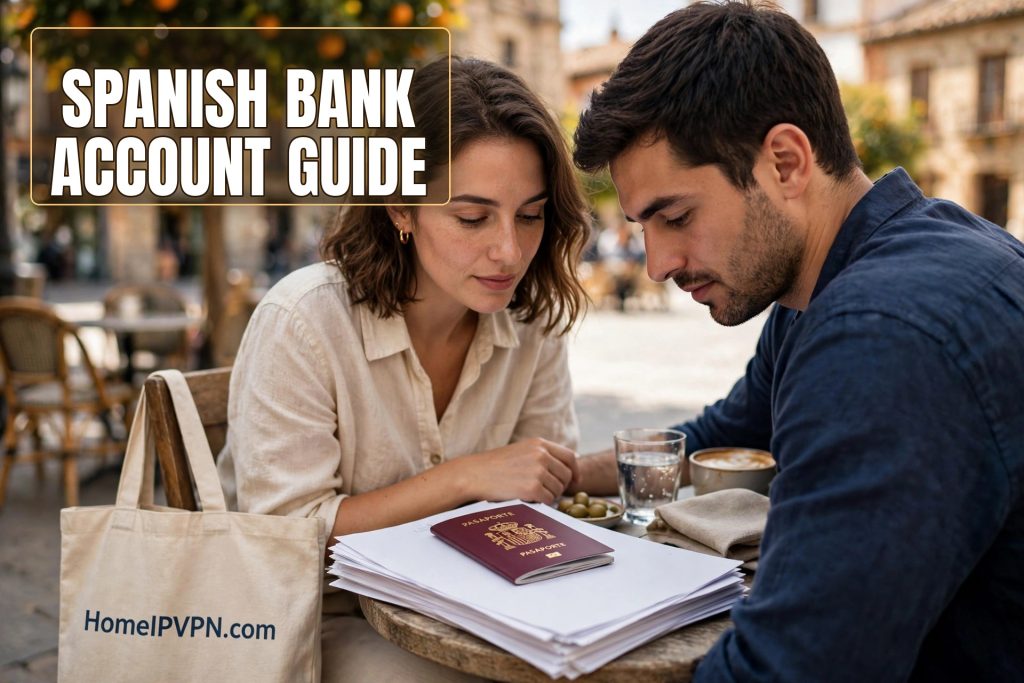
You have found the apartment. The NIE appointment is booked. Your laptop is set up on a table that wobbles slightly but has character. And then the landlord says the words every nomad in Spain eventually hears: the rent needs to come from a Spanish account. Or the coworking space wants a local IBAN for the monthly membership. Or you just want to stop paying foreign transaction fees on every grocery run. Welcome to the Spanish bank account quest.
Opening a bank account in Spain as a non resident is one of those tasks that sounds like it should take twenty minutes and somehow consumes a week. Not because it is impossible, far from it, but because it runs on paperwork, appointments, and a particular Spanish rhythm that you cannot rush. Here is how it actually works, what you need, and how to avoid the classic mistakes.
Why you even need one
Let us start with whether you actually do, because not every nomad does. If you are in Spain for a month or two, you can absolutely survive on your home bank cards and a travel friendly account from a digital bank. Plenty of nomads do exactly that and never set foot in a Spanish branch.
But the longer you stay, the more a local account earns its keep. Landlords strongly prefer rent from a Spanish IBAN, and some will not accept anything else. Local direct debits, the domiciliacion system that pays your phone bill, your gym, your utilities automatically, basically require one. And the small daily frictions add up: foreign transaction fees on every tap to pay, ATM fees, the mental math on every purchase. A Spanish account with a local debit card turns all of that into background noise.
There is also a less obvious reason. Having a Spanish account makes the rest of the bureaucracy easier. Deposits, visa related financial proofs, the general sense that you are a real person with a real footprint in the country: a local bank account quietly supports all of it. It is one of the first dominoes that makes the others fall.
Resident versus non resident: which one are you?
Spanish banks draw a hard line between resident and non resident accounts, and you need to know which side you are on before you walk in. If you are on the digital nomad visa or otherwise legally resident, you open a resident account, which is the simpler, cheaper path. If you are staying long term without residency, or you are still in the application process, you are looking at a non resident account.
Non resident accounts work fine for daily life: you get an IBAN, a debit card, online banking, direct debits, all of it. The differences are the paperwork, which is heavier, and the fees, which are real. Travelers report non resident accounts typically running around 10 to 15 euros a month in maintenance fees, where a resident account at the same bank might be free. It is not a punishment. It is just how the banks price the extra compliance work.
One thing to get straight early: you cannot just open a resident account by saying you live here now. The bank will ask for proof, usually the residency card or the relevant visa documentation. Be honest about your status and open the account type that matches it. Trying to shortcut this creates problems later, usually at the worst moment.
The paperwork stack
Here is what you will typically need for a non resident account. Requirements vary a bit by bank and even by branch, because Spain, but this is the standard stack that covers most cases.
First, your passport, valid and with you in person. Most banks still want to see your actual face for a non resident account, though a few have started offering online openings. Second, the NIE, the foreigner identity number. This is the magic number of Spanish bureaucracy, and the bank will want the document that proves you have one. If you do not have it yet, some banks will start the process with just the passport and add the NIE later, but do not count on it.
Third, the certificado de no residencia, the certificate confirming you are not a resident of Spain. You get this from the national police, and yes, it is as fun as it sounds. In practice, many branches will accept your word plus your passport stamps at first and ask for the certificate within a set period. Ask the specific branch what they require before you go, because this is the document that varies most.
Fourth, proof of address from your home country: a utility bill, a bank statement, something official with your name and address. Fifth, proof of income or employment: a work contract, recent payslips, or freelance invoices. Banks ask for this to satisfy their own compliance rules, not because they are nosy. And sixth, if any of this is not in Spanish, budget for sworn translations. A translator’s stamp turns a maybe into a yes.
Choosing a bank without losing your mind
Spain’s big banks all offer non resident accounts: the names you will see everywhere are Santander, BBVA, CaixaBank, and Sabadell. They are all competent, all have English speaking staff in the major cities at least some of the time, and all have functional apps. The differences that matter to a nomad are fees, branch experience, and how painful the non resident process is at that particular bank.
The honest advice from nomads who have done this: do not just walk into the nearest branch. Ask in the local nomad groups which bank and which branch people had a good experience with recently. Branch staff have real discretion in how they handle non resident applications, and the difference between a helpful branch manager and one who has never done it before is the difference between one visit and four. A specific recommendation for a specific branch is worth more than any comparison of interest rates you will never earn anyway.
Also compare the fee schedules before you commit. Non resident accounts vary: monthly maintenance, card fees, transfer fees, the cost of doing things that are free on resident accounts. Ask for the full fee sheet, in writing if you can, and do the math on a year. The cheapest advertised account is not always the cheapest account you will actually have.
The branch visit: what actually happens
Set your expectations correctly and the branch visit is fine. Book an appointment if the bank offers it, because walk in waits in Spanish banks can be long and philosophical. Bring every document you have, plus photocopies, plus the translations. Dress like someone opening a bank account, not like someone who just came from the beach, because first impressions still count with branch managers.
The appointment itself is usually straightforward: they check your documents, fill in forms, explain the fees, and set up your online banking. What surprises nomads is the timeline. The account might be open the same day, but the debit card often takes a week or two to arrive, and full online banking access sometimes needs a second visit or a mailed code. Plan for the account to be truly usable about two weeks after you walk in, not two hours.
The classic mistakes are all avoidable. Do not assume the branch speaks English; bring a Spanish speaking friend or your best phrasebook Spanish for the important parts. Do not leave without asking exactly what happens next and when. And get the direct contact details of the person who helped you, because when something needs a follow up, having a name beats having a general helpline number.
The digital alternatives, honestly assessed
You will hear nomads say to skip the Spanish banks entirely and just use a digital bank or fintech account with a European IBAN. For some people, that is genuinely the right call. These accounts open from your phone, often have low fees, and handle multi currency life elegantly. If your needs are simple, receiving freelance payments and spending with a card, they can cover you without a single branch visit.
But know the limits. Some Spanish landlords and institutions specifically want a Spanish IBAN, not just any European one, and while this is technically not supposed to matter within the eurozone, in practice it sometimes does. Some local direct debits can be fussy with non Spanish IBANs. And if you ever need to prove financial roots in Spain for a visa renewal or similar, a real Spanish bank account carries weight that a phone app does not.
The pragmatic middle path that many long stay nomads take: a Spanish non resident account for rent, direct debits, and local life, plus a digital multi currency account for everything else. Two accounts sounds like more hassle, but each one doing what it is good at is less hassle than one account doing everything badly.
Keeping your home banking alive while you are at it
Here is the wrinkle nobody puts on the checklist. While you are busy opening a Spanish account, your home bank back home is watching your logins arrive from Spain and, in some cases, deciding that looks like fraud. An IP address is basically your internet’s return address, and when yours suddenly says Madrid instead of Manchester, automated security systems do what they were built to do.
The timing could not be worse: you need your home accounts working smoothly precisely when you are moving money around for deposits, setup costs, and the general expense of landing in a new country. A frozen home account during your first month in Spain is a special kind of stress. The nomads who avoid it usually kept a way to reach their home internet from abroad. Some run a HomeIPVPN setup on their home connection, so their logins look like they are coming from home even while they are queueing at a bank in Barcelona. One less fire to fight during the move.
The unglamorous truth about Spanish bureaucracy
A word about the overall experience, because the bank account does not exist in isolation. The NIE, the empadronamiento, the bank account, the phone contract: they form a circle where each one wants proof of the others. Everyone who has done it describes the same feeling of going in loops for the first few weeks. This is normal. This is just how it works.
The way through is patience plus preparation. Keep a folder, physical and digital, with every document, every photocopy, every translation. Write down names, dates, and reference numbers from every appointment. Assume everything takes twice as long as you hope and half as long as you fear. And when a branch asks for one more document, smile and bring it, because arguing with Spanish bureaucracy is a game you cannot win and should not play.
Months later, when your rent goes out automatically, your card just works, and the whole system hums along in the background, you will barely remember the quest. That is the reward: not the account itself, but the moment it becomes invisible.
One setup project that covers the whole move
Step back and the pattern is clear. Moving your working life to Spain means rebuilding your financial footprint from scratch: new account, new IBAN, new direct debits, all while your home accounts eye your Spanish logins with suspicion. The paperwork is unavoidable, but the digital friction on top of it is optional.
That friction, your home bank and home services treating you like a stranger the moment your IP address changes, is exactly the problem HomeIPVPN was built to solve. It gives you your own home internet connection to work through, wherever you are. If you would rather have someone set it up and verify it works, the Pre-Travel Audit & Advisory session is 1 hour, costs $79, and that fee comes straight off the $279 Secure Home IP VPN System session if you go ahead.
Get the NIE early, pick your branch on a recommendation, bring every document twice, and keep your home base reachable. The bureaucracy is a rite of passage. You will have a great story at the end of it.