REMOTE WORK & DIGITAL NOMAD
How to Get Sleep Before a Big Call in a Noisy Hostel
It was 2:17 a.m. in a twelve-bed dorm in Lisbon, and I had a client presentation at 9 a.m. The guy in the bunk below me was snoring like a chainsaw with…
✓Start with the room, not the✓The sleep kit: three items, no✓The wind-down: boring is the goal
Quick Answer
Sleeping well in a noisy hostel before an important call comes down to three things: the right bed in the right room, a small kit of earplugs plus a sleep mask plus white noise, and a wind-down routine that starts an hour before bed. Pick top bunks away from the door, and never rely on willpower against a dorm full of night owls.
- Choose your bed strategically: top bunks sway less from other people’s movement, and beds farthest from the door get the least hallway noise and light.
- Build a sleep kit: foam or wax earplugs, a contoured sleep mask, and a white noise app with your phone face-down will beat most dorm noise.
- Wind down on purpose: stop screens an hour before bed, do something boring and physical like stretching, and set two alarms in case the first one does not wake you.
- Protect the call itself too: HomeIPVPN keeps your connection on your home IP, so your work tools and logins behave normally even on hostel WiFi the morning of a big meeting.
It was 2:17 a.m. in a twelve-bed dorm in Lisbon, and I had a client presentation at 9 a.m. The guy in the bunk below me was snoring like a chainsaw with feelings. Someone’s phone alarm, not mine, went off at 2:30 and nobody turned it off for a full minute. At 3 a.m. a group came back from the bars and spent twenty minutes saying goodbye to each other at full volume in the hallway, which in a hostel might as well be inside your bunk. I lay there doing the math: if I fell asleep right now, I would get five hours. I did not fall asleep right now.
Every remote worker who stays in hostels has a version of this night. The dorm is cheap, the location is perfect, the people are lovely, and the sleep is a disaster exactly when you need it most. A big call the next morning, a presentation, an interview, the kind of day where you need to sound sharp and think fast. Sleep stops being a comfort issue and becomes a work tool, as essential as your laptop charger.
The good news is that sleeping in hostels is a skill, and it is learnable. Here is the full system.
Start with the room, not the earplugs
Most people try to solve hostel sleep with gear. Gear matters, but the biggest variable is which bed you are in. When you check in, and especially when you book, you have more control over this than you think.
Smaller dorms beat bigger ones, every time. A four-bed dorm has a quarter of the snorers, phone alarms, and midnight arrivals of a twelve-bed one. The price difference is usually small, a few dollars a night, and on the night before a big call it is the best money you will spend on your trip. If the hostel offers female-only or male-only dorms, those tend to be slightly quieter than mixed ones, though the real factor is size.
Within the room, pick a top bunk far from the door. Top bunks transmit less movement: when the person below you rolls over or climbs in at 3 a.m., you feel it less up top. Distance from the door matters because the door is where all the noise enters, the hallway light spills in, and the late arrivals fumble with their bags. The corner bunk farthest from the door is the best real estate in any dorm. Claim it early.
Ask at the front desk. This is the move beginners miss. “I have an important work call at 9 a.m., could I have the quietest bed you have?” Hostel staff hear this constantly and they know which rooms are above the bar, which face the street, and which dorms tend to fill with party groups. They will help you if you ask. The people who suffer in silence chose to suffer.
The sleep kit: three items, no excuses
There are three items that separate people who sleep in hostels from people who do not. Together they cost less than one night in a private room, they weigh almost nothing, and they live in your bag permanently.
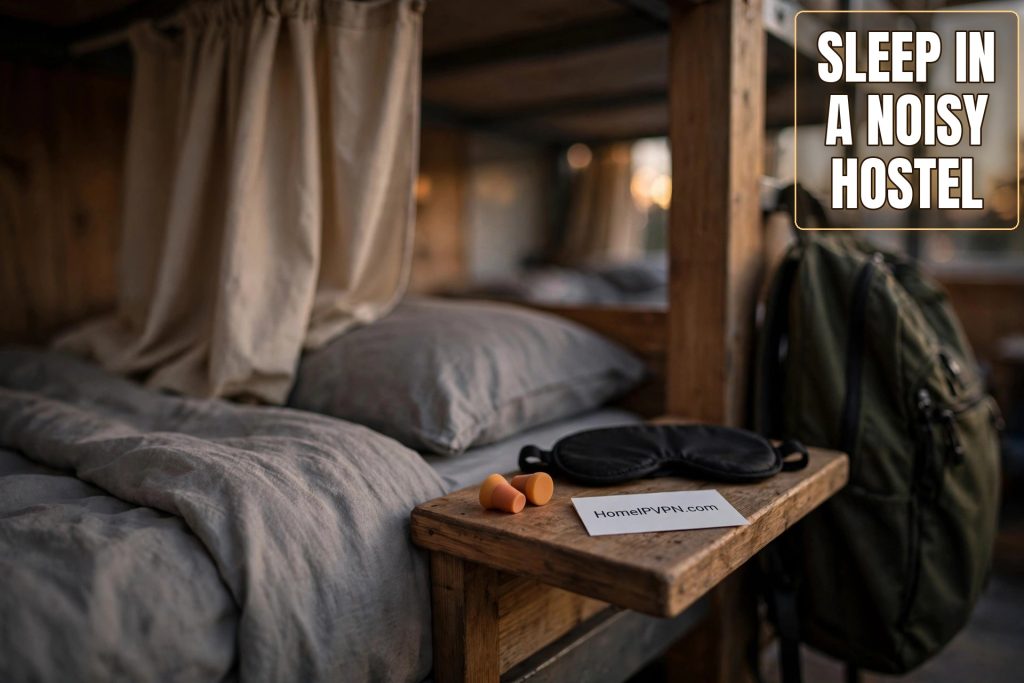
Earplugs first. Not the cheap foam ones from the airplane, though those are better than nothing. Get proper moldable wax or silicone earplugs, the kind swimmers use, or high-quality foam plugs with a high noise reduction rating. The difference between drugstore plugs and good ones is the difference between hearing the snorer and not. Practice putting them in before the trip. There is a technique, rolling foam plugs thin and inserting them deep, and it is worth learning from a video rather than discovering at 2 a.m.
A sleep mask second, and not a flat one. Contoured masks that cup around your eyes block light completely without pressing on your eyelids, which means you can actually blink and move your eyes in REM sleep. A flat mask that lets light leak in around your nose is barely better than nothing. This matters because dorm lights go on and off all night, and hallway light under the door is relentless.
White noise third. A phone app playing brown noise or steady rain, with the phone face-down on your pillow or tucked beside it, masks the irregular sounds that earplugs miss: the door clicks, the whispered conversations, the bag zippers. The key is consistency. Your brain tunes out steady noise beautifully and gets yanked awake by irregular noise. White noise turns a chaotic dorm into a steady hum, and a steady hum is sleepable.
One warning about the phone: set it to Do Not Disturb with only your alarm allowed through, and plug it in. A dead phone means no alarm, no white noise, and a very bad morning. I also set a backup alarm on my watch for big-call days. Paranoia is a reasonable sleep aid.
The wind-down: boring is the goal
You cannot go from a hostel common room, all conversation and music and screens, straight into sleep. Your nervous system does not work that way. You need a wind-down routine, and on big-call nights it needs to start a full hour before bed.
Screens are the main enemy. The blue light story is overblown, but the content story is not: scrolling keeps your brain in reactive mode, processing novelty, when it should be powering down. Put the phone away an hour before bed. Not on the bunk next to you. Away, in your bag, on Do Not Disturb. The urge to check “one more thing” is the urge that keeps you up until 1 a.m.
Replace the scroll with something deliberately boring and physical. Stretching is ideal: ten minutes of slow stretches on the dorm floor signals to your body that the day is over. A warm shower does the same thing, and the temperature drop afterward mimics the body’s natural sleep onset. Reading a physical book, the duller the better, works for the same reason your high school textbook did.
Caffeine and alcohol both deserve honest mention. Caffeine has a half-life of about six hours, which means the coffee you had at 4 p.m. is still a quarter present at midnight. On big-call days, set a caffeine cutoff at noon and hold it. Alcohol is the sneakier trap: a few drinks feel like they help you sleep, and they do help you fall asleep, but they wreck the second half of the night. You wake up at 3 a.m. dehydrated and alert, which in a dorm is the worst possible combination. Skip it the night before the call.
Managing the dorm itself
You share the room, so the room is partly yours to manage. Most dorm conflicts come from unspoken expectations, not bad people. Speak early and kindly.
When you arrive, mention the call. “Hey everyone, I have a big work call at 9 a.m. tomorrow, so I will be crashing early. I have earplugs, so do not worry about being quiet on my account, just giving you a heads up.” This does three things: it makes people slightly more considerate, it removes any awkwardness about you being the boring one, and the earplug mention gives them permission to live normally. Almost everyone responds well to this. The rare person who does not was going to be loud regardless.
Pack your bag the night before. The 7 a.m. version of you, fumbling with zippers and rustling plastic bags in the dark, is everyone’s enemy. Lay out your call clothes, set up your laptop area if the hostel has a workspace, and put everything you need for the morning in one grab-and-go pile. Your dorm mates will thank you, and your half-awake self will thank you more.
If someone is genuinely disruptive, snoring at industrial volume or taking calls on speaker at midnight, talk to the front desk rather than starting a confrontation. Moving rooms at 1 a.m. feels dramatic, but staff do it all the time, and an hour of lost sleep beats a night of none. Know where your valuables are so a middle-of-the-night move takes two minutes.
The morning of the call
Sleep is half the battle. The morning routine is the other half, because you need to go from dorm bunk to professional presence in under an hour, on a hostel’s schedule.
Get up with time to spare. Ninety minutes before the call is the minimum. This gives you time for a shower, which is non-negotiable: hot water resets your face, your voice, and your brain. Eat something real, not just coffee. Your brain runs on glucose, and presenting on an empty stomach after a short night is asking for the 10 a.m. crash mid-sentence.
Scout your call location the night before. Hostel WiFi in the dorm is usually the worst option: bad signal, no privacy, and someone will walk behind you mid-sentence. Better options, in order: a coworking space nearby, a quiet cafe with good WiFi, the hostel’s common room at an off hour, or a private room booked just for the morning. Test the WiFi the night before with a speed check. Discovering at 8:55 a.m. that the upload speed cannot handle video is a preventable disaster.
If the hostel network blocks your company VPN or flags your login location, HomeIPVPN sidesteps the whole issue by giving you your home IP on any network.
Do a tech check thirty minutes early: camera, microphone, lighting, background. Sit facing a window or a lamp, never with a bright window behind you. Close every app you do not need. And have a backup plan: phone hotspot ready, dial-in number saved, a message drafted to the attendees in case you need two minutes. Professionals have backup plans. Amateurs have excuses.
When the hostel just will not work
Sometimes the honest answer is that a particular night needs a private room. If the call is a job interview, a major client pitch, or anything where your income is directly on the line, the forty dollars for a private room or a budget hotel is not an expense. It is insurance. The best sleep system in the world cannot fix a dorm next to a nightclub on a Saturday.
Learn to recognize these nights in advance. Check the hostel’s location on a map: above a bar, on a main nightlife street, near construction. Read recent reviews for noise mentions. If three recent reviews say “loud,” believe them. Book the private room for that one night and enjoy the dorm the rest of the week. This is not failure. This is strategy.
The same logic applies to longer patterns. If you are in a phase of your work with calls every morning, a month in hostels might be the wrong housing choice entirely. A private room in a shared apartment often costs only slightly more than a dorm bed over a month, and the sleep quality difference compounds daily. Match your housing to your work calendar, not the other way around.
The connection deserves the same care as the sleep
Here is the part people forget: you can sleep perfectly and still blow the call if the hostel WiFi betrays you. Shared networks are congested in the morning when everyone is online, and some hostel networks block the ports that video calls and company VPNs need. Worse, logging in to your work systems from yet another new country can trigger security flags that lock you out at the worst moment.
This is why HomeIPVPN belongs in the same conversation as earplugs and sleep masks. It routes your connection through your own home internet, so your company’s systems see the same home IP they always see, no matter which hostel you woke up in. Stable, familiar, boring. Boring is exactly what you want on the morning of a big call.
If you would rather have someone set that up and verify it works, the Pre-Travel Audit & Advisory session is 1 hour, costs $79, and that fee comes straight off the $279 Secure Home IP VPN System session if you go ahead. Do it once, and every future big-call morning has one less thing that can go wrong.
Pick the corner bunk, pack the earplugs, put the phone away, and give yourself the sleep the call deserves. You will sound like the professional you are, and nobody on the other end will ever know you did it from a twelve-bed dorm in Lisbon.