REMOTE WORK & DIGITAL NOMAD
Keeping a US Phone Number While Living Abroad: Your Options
The text arrived at 2 a.m., Lisbon time. “We noticed a sign-in from a new device,” my bank wrote. “Reply YES to confirm it was you.” I…
✓Why that number is harder to✓What actually happens when you✓Option 1: Park it on a cheap
Quick Answer
Keeping your US phone number abroad is mostly about protecting your access to banks, two-factor codes, and old contacts. Canceling the number outright is the one move you cannot undo, so park it somewhere cheap instead of letting it go.
- Banks still text that number: login codes, fraud alerts, and password resets all go to the number on file, so losing it can lock you out of your own accounts.
- Canceling means losing it for good: carriers recycle disconnected numbers within weeks, and getting yours back later is close to impossible.
- Short codes are the catch: some bank verification texts refuse to deliver to internet-based numbers, so test yours before you rely on it.
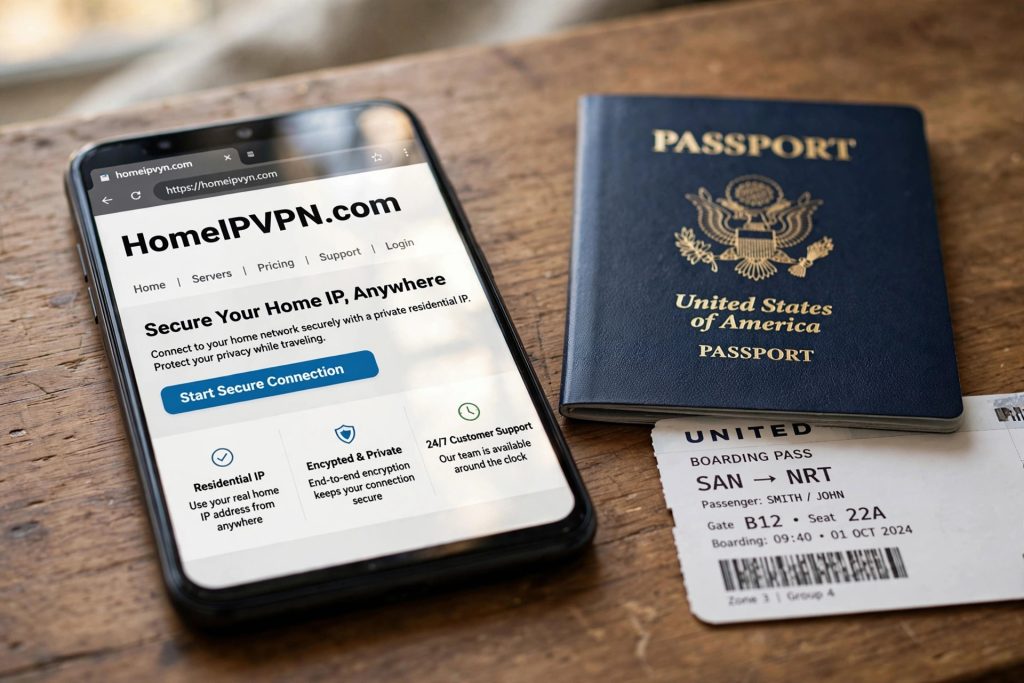
- Keep your whole home identity intact: just as your accounts trust your US number, they trust logins from your home internet connection, which is why travelers pair a kept number with HomeIPVPN.
The text arrived at 2 a.m., Lisbon time. “We noticed a sign-in from a new device,” my bank wrote. “Reply YES to confirm it was you.” I stared at my phone in the dark, wide awake now. The message had gone to my old US number. The one I had canceled three weeks before flying out, because why keep paying seventy dollars a month for a number I would never call anyone from?
I sat there doing the math nobody warns you about. Without that number, I could not confirm the login. Without confirming the login, I could not move money to pay my rent. And the bank’s phone line, the one I was supposed to call instead, wanted to verify me by texting a code to the same dead number. It was a perfect circle, and I was locked outside of it.
If you are planning to live abroad for a while, your phone number deserves the same careful thought you give to your passport and your bank accounts. Here is the full picture, in plain language.
Why that number is harder to replace than you think
Your phone number is not just a way for people to reach you. Over the years it has quietly become the master key to your digital life. Your bank has it. Your email provider has it as a recovery option. Your investment account, your tax software, your password manager, and probably a dozen services you have forgotten about all point back to those ten digits.
When something looks suspicious, and everything looks suspicious when you log in from a new country, the default response from almost every company is the same: we will text a code to the number we have on file. If that number is dead, you are stuck in the slow lane of account recovery, which usually means a phone call during US business hours, a pile of identity questions, and in some cases mailing physical documents to a US address you may not have anymore.
There is also the human side. Old friends, former colleagues, family members, and professional contacts have that number saved. Job recruiters, landlords running background checks, and anyone Googling you will find it. Keeping it alive costs very little. Losing it can cost you a surprising amount of hassle.
What actually happens when you cancel it
This is the part people misunderstand. Canceling a number does not put it in a vault with your name on it. Carriers recycle disconnected numbers, usually within thirty to ninety days. Your old number goes back into the pool and gets handed to a stranger, possibly within weeks.
That stranger will then start receiving your two-factor codes, your appointment reminders, and your “your package arrived” texts. Some of them will be harmless. Some of them will be the keys to your accounts, arriving on someone else’s phone. You can change your number on every service you remember, but you will not remember all of them, and the ones you forget are exactly the ones that matter in an emergency.
Could you get the number back later? In theory, if it has not been reassigned, a carrier might help, but in practice it is close to impossible. Porting rules, new owners, and carrier bureaucracy all work against you. Treat canceling as permanent, because for all practical purposes it is.
Option 1: Park it on a cheap internet-based service
The most popular move among long-term travelers is to move the number off the expensive carrier and onto a cheap internet-based phone service. These services, often called VoIP (voice over internet protocol, which just means phone calls carried over the internet instead of cell towers), can hold your number for a few dollars a month or sometimes nothing at all.
The big name most people start with is Google Voice. It is free for US numbers, it gives you calling and texting through an app, and it works over wifi anywhere in the world. Porting your number to it takes a few days and costs a small one-time fee. Once it is there, your number lives in the cloud, independent of any carrier, and you can keep it for years at no monthly cost.
There are paid alternatives too, usually in the range of five to fifteen dollars a month, that offer better support or extra features. The details matter less than the principle: get the number off the seventy-dollar plan and onto something that costs pocket change, before you cancel anything.
One warning, and it is an important one. Some banks and financial services refuse to send verification codes to internet-based numbers. Their systems can tell the difference, and a few of them block these numbers as a fraud prevention measure. This does not affect every bank, and policies change, but you should test it while you still have options. Log into each important account, trigger a test code, and confirm it arrives on the parked number before you leave.
Option 2: Keep your carrier’s cheapest plan
If the verification-code problem worries you, the safest option is also the simplest: keep the number with a real mobile carrier on the cheapest plan they offer. Many carriers have basic plans in the ten to twenty dollar range, and some offer a “suspended with number hold” option for travelers.
The advantage is that nothing changes from your bank’s point of view. Your number stays a real mobile number, short codes arrive normally, and every service that worked before keeps working. The disadvantage is the monthly cost, which adds up over a year abroad, and the fact that you are paying for service you barely use.
There is a middle path worth asking about. Call your carrier and ask specifically about seasonal suspension, military or extended travel holds, or their cheapest talk-and-text plan. The retention department often knows options that are not advertised on the website. Be direct: tell them you are moving abroad for a year and ask what the cheapest way to keep your number is. You might be surprised.
Option 3: The eSIM shuffle
Most modern phones can hold multiple phone plans at once using eSIM, which is just a digital version of the physical SIM card, no tiny plastic chip to lose. This opens up a practical setup many nomads swear by: keep your US number on a cheap eSIM plan for incoming codes and important calls, and buy a local eSIM with cheap data in each country you visit.
Your phone rings for both numbers. You use local data for maps, browsing, and everything else, while the US line sits quietly in the background, sipping almost no data, ready to receive that bank code at 2 a.m. When someone calls your US number, it still rings. When you need to call the bank back, you can do it over wifi calling without paying international rates.
The cost of a US eSIM plan with minimal service can be quite low, and local data eSIMs are usually far cheaper than any roaming plan. This setup takes about an hour to arrange and gives you the best of both worlds: a real mobile number for the banks, and cheap local data everywhere else.
The two-factor trap nobody warns you about
Let us talk about the thing that actually ruins people’s months: two-factor authentication, or 2FA. That is the system where a site texts or emails you a code after you enter your password. It is the reason your number matters so much, and it has quirks that bite travelers specifically.
First, some 2FA systems will not send codes to foreign numbers at all, which is why keeping a US number matters in the first place. Second, as mentioned, some will not send to internet-based numbers either. Third, a few services only offer SMS as a backup and push you toward an authenticator app, which is actually great news, because authenticator apps work anywhere with no phone number involved.
Before you leave, go through your important accounts and switch whatever you can to an authenticator app. It removes the phone number from the equation entirely for those services. For the ones that insist on SMS, make sure the number they have is the one you are keeping, and test it. Send yourself a code while you are still home, where fixing problems is easy.
And here is a related trap: some banking apps and websites also check where your internet connection appears to come from. A login from a US number paired with an internet connection in another country can look inconsistent to a fraud system. Travelers who keep their number often pair it with a home IP address service like HomeIPVPN, so their connection looks like it is coming from home too. One less mismatch for the fraud filters to trip over.
What I would actually do
If a friend were leaving next month and asked me for the simple version, here it is. First, do not cancel the number. Second, port it to a free or cheap internet-based service if your banks accept codes there, which you will verify by testing each one before you go. Third, if any important bank refuses internet numbers, keep a cheap carrier eSIM for that number instead. Fourth, move everything you can to an authenticator app. Fifth, update the number on every account while you still can, and write down which accounts use SMS codes so you are not guessing later.
Do all of this at least two weeks before departure. Porting a number can take several days, and you do not want to discover a problem the night before your flight. Future you, staring at a bank alert at 2 a.m. in a foreign timezone, will be very grateful.
The bigger picture
The deeper issue here is that your whole digital life still thinks you live in the United States: your number, your bank, your accounts, all of it anchored to a home you are not currently in. That mismatch between where you are and where the internet thinks you should be is the problem HomeIPVPN was built to solve, by giving your devices a home IP address so the services you left behind keep working as if you never left. If you would rather have someone set that up and verify it works, the Pre-Travel Audit & Advisory session is 1 hour, costs $79, and that fee comes straight off the $279 Secure Home IP VPN System session if you go ahead.
Keep the number. It is ten digits, it costs almost nothing to park, and one day at 2 a.m. in some faraway timezone, you will be very glad it still rings.