REMOTE WORK & DIGITAL NOMAD
Keeping US Bank Accounts While Living in Mexico: The Rules
The text message arrives while you are standing in line at a taco stand in Oaxaca. It is from your bank: “We detected unusual activity on your account….
✓Rule One: Keep a US Address on✓Rule Two: Tell Your Banks Before✓Rule Three: Keep Your Accounts
Quick Answer
You can absolutely keep your US bank accounts while living in Mexico, but the system is designed for people who stay put. Keep a US address on file, notify your banks before you go, keep your accounts active with regular transactions, and expect extra identity verification on foreign logins.
- Keep a US address: banks require a US residential address; use a family address or a mail forwarding service, never a foreign address.
- Stay active: regular logins, transactions, and direct deposits signal a normal account; dormant accounts draw reviews.
- Plan for verification: foreign logins trigger extra checks, so keep your US phone number working for two-factor codes.
- Look local, stay home: connecting through your own US home network via HomeIPVPN keeps your logins looking like they come from your house.
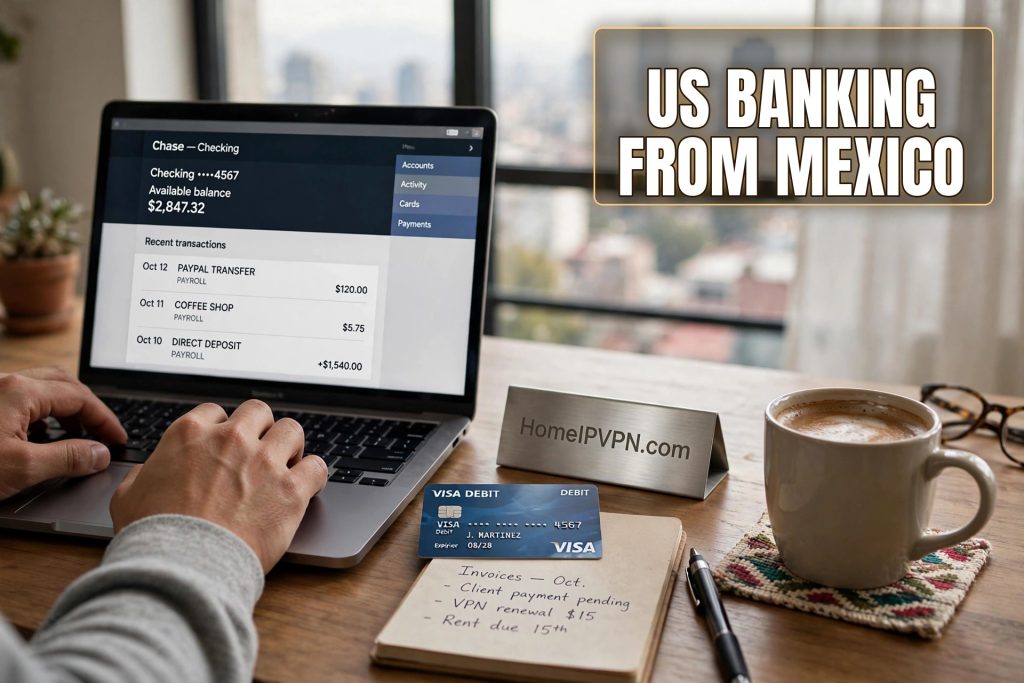
The text message arrives while you are standing in line at a taco stand in Oaxaca. It is from your bank: “We detected unusual activity on your account. Please call us immediately.” Your stomach drops. You are three thousand miles from the nearest branch, your rent is due in two days, and the customer service line has a forty-minute wait.
Nothing is actually wrong. You just logged into your checking account from Mexico, and your bank’s security system did exactly what it was designed to do. But in that moment, staring at your phone with carnitas getting cold in your hand, it feels like your entire financial life is one wrong click away from freezing.
This scenario plays out constantly among Americans living in Mexico, and almost all of it is preventable. Banks do not hate expats. They are just built for customers who never leave. Here are the rules for keeping your US accounts healthy while you live south of the border.
Rule One: Keep a US Address on File, No Exceptions
This is the single most important rule, so let us get it out of the way first. US banks are required to have a US residential address on file for you. This is not a suggestion or a preference. It is a compliance requirement, and it is the tripwire that catches the most nomads.
What happens if you change your address to a Mexican one, or if the bank figures out you have moved abroad without telling them? At best, you get a letter asking you to update your information. At worst, the bank decides it cannot serve customers with foreign addresses and starts the process of closing your accounts. Some banks are more tolerant than others, but none of them are happy about it.
Your options are straightforward. Use a family member’s address, a trusted friend’s address, or a professional mail forwarding service that provides a real US street address. Many nomads use mail forwarding services designed for travelers, which scan your mail and forward the important pieces. Whatever you choose, set it up before you leave, update every bank and financial institution at once, and make sure the address is consistent across all of them.
And here is the part people miss: do not just set it and forget it. If your bank sends a verification letter to that address, someone needs to be able to tell you about it. Coordinate with whoever receives your mail, or use a service with online scanning, so nothing important sits unopened for months.
Rule Two: Tell Your Banks Before You Go
Before you fly, call every bank and credit card company and tell them you will be traveling in Mexico. Give them dates, even approximate ones. This goes into your file as a travel notice, and it meaningfully reduces the number of times your card gets declined at a restaurant in Tulum.
But be honest with yourself about what a travel notice does and does not do. It helps with card transactions. It does not stop the online banking security system from noticing that your logins now come from Mexico every single day for months. Travel notices are designed for two-week vacations, not six-month stays. After a while, the system recalibrates, and you are back to getting extra verification steps.
The travel notice is still worth doing. It is just not a permanent solution, which is why the rest of these rules matter more.
Rule Three: Keep Your Accounts Visibly Alive
Banks get nervous about accounts that go quiet, and they get nervous about accounts whose patterns change dramatically. Living in Mexico changes your patterns by definition, so you want to keep the signals of normalcy as strong as possible.
Keep your direct deposits flowing into the same accounts. Keep paying your US bills from those accounts: credit cards, subscriptions, student loans, whatever you still owe back home. Log in regularly, not just when something is wrong. Use your debit card for at least occasional transactions. An account with steady deposits, regular bill payments, and normal login activity looks like a healthy account, because it is one.
What you want to avoid is the account that sits untouched for four months and then suddenly wires a large sum internationally. That is the pattern that fraud systems are built to catch, and an innocent nomad can trigger it without trying. If you need to move significant money, do it in the open: call the bank first, explain what you are doing, and let them note it.
Rule Four: Protect Your Phone Number Like It Is Your Wallet
Here is the rule nobody thinks about until it burns them. Your US phone number is the key to your entire financial life. Password resets, two-factor codes, fraud alerts, account verification, they all flow through that number. The moment you lose access to it, recovering any locked account becomes ten times harder.
Do not cancel your US phone plan and assume you will figure it out later. Before you leave, move your number to a service that works over Wi-Fi from anywhere in the world. There are several well-known options that let you receive calls and texts over the internet, and they cost a few dollars a month. Set it up while you are still in the US, test it thoroughly, and make sure every bank has that number as your primary contact.
Also, update your contact information everywhere while you still have easy access. Once you are in Mexico and locked out of an account, every verification step is harder. Do the boring admin work before the flight, when customer service hold times do not cost you a beach day.
Rule Five: Understand What Foreign Logins Do to You
Every time you log into your bank from Mexico, the bank sees an IP address, which is basically your internet’s return address, that says you are in Mexico. One login is fine. Daily logins for months create a pattern, and patterns get reviewed.
What does a review look like in practice? Usually it is just friction: extra verification codes, security questions about your childhood pet, a temporary hold while you confirm a transaction. Occasionally it escalates: a fraud department call, a request for documents, or in rare cases a decision that your account activity does not fit their customer profile.
You cannot stop logging in from Mexico. You live there. But you can control what the bank sees. This is where experienced nomads get strategic: instead of logging in from a Mexican connection, they route their traffic through their own US home network first. The bank sees a login from the same home IP address it has always seen. Nothing changes. No flags, no reviews, no forty-minute hold times from a taco stand.
A home IP VPN setup does exactly this. Your connection goes from your laptop in Mexico to your house in the US, then out to the bank. As far as any website can tell, you never left home. It is the single most effective way to keep your digital life boring, and boring is exactly what you want your bank to think you are. HomeIPVPN builds these setups specifically for Americans living and working abroad.
Rule Six: Have a Backup for Everything
Do not keep all your money in one bank. This is good advice generally and critical advice for nomads. Maintain accounts at two different banks, plus at least one credit card from a different issuer than your primary debit card. If one account gets frozen while a fraud review plays out, you need to be able to eat and pay rent from the other one.
Similarly, carry two debit cards from different banks when you go out. Mexican ATMs occasionally eat cards, networks go down, and a card that worked yesterday can be declined today for reasons nobody can explain. Redundancy is not paranoia. It is the cost of doing business from abroad.
And keep some emergency cash in US dollars, separate from your daily pesos. Not a fortune, just enough to cover a week if every electronic system decided to hate you simultaneously. It has happened to people. It will happen again. The ones who shrug it off are the ones with a backup plan.
Rule Seven: Know Which Banks Are Nomad-Friendly
Not all banks treat foreign living equally. Some are known for being relatively tolerant of customers who live abroad, with good international support and reasonable policies. Others are notorious for closing accounts at the first hint of a foreign address. The landscape changes, so get current opinions from nomad communities before choosing where to keep your money.
What to look for: no foreign transaction fees on cards you will use daily, ATM fee reimbursements, responsive customer service with reasonable hours for your time zone, and a track record of not panicking about foreign logins. An account designed for travelers is worth more than a slightly higher interest rate on a savings account you cannot reliably access.
Whatever banks you choose, open any new accounts before you leave the US. Opening a US bank account from abroad is possible but painful, often requiring documents and verification steps that assume you are physically present. Future you will be grateful that present you handled this at home.
The Root Problem Is Not the Rules
These rules work. Thousands of Americans live in Mexico for months or years with their US banking fully intact. But notice what all the rules have in common: they are about performing normalcy for systems that assume you never left. Keep the address. Keep the number. Keep the patterns. Log in like you are home, because the moment the system notices you are not, everything gets harder.
That performance is exhausting over time, and it is fragile. One missed verification letter, one expired travel notice, one fraud algorithm update, and you are back on hold from the taco stand. The deeper fix is to stop performing and simply be home, digitally speaking: route your connection through your own US house so every login looks exactly like it always did. That quiet, boring, invisible stability is the problem HomeIPVPN was built to solve. If you would rather have someone set it up and verify it works, the Pre-Travel Audit & Advisory session is 1 hour, costs $79, and that fee comes straight off the $279 Secure Home IP VPN System session if you go ahead.
Handle the admin before you fly, keep your backups current, and enjoy the tacos. Your money will be right where you left it.