REMOTE WORK & DIGITAL NOMAD
Is Portugal’s Internet Fast Enough for Video Calls? 2026 Reality Check
You are sitting in a sunlit Airbnb in Alfama, Lisbon’s oldest neighborhood. The tiles are gorgeous, the view over the rooftops is exactly what the…
✓Lisbon and Porto: The Good News✓The Apartment Problem: Your Wi-Fi✓Outside the Big Cities: Where
Quick Answer
Portugal’s internet is genuinely fast in the cities, with Lisbon and Porto commonly seeing fiber speeds that handle video calls with ease. The trouble starts in older apartment buildings, rural towns, and shared Airbnb Wi-Fi, where the connection can be fine for browsing but shaky for a full workday of Zoom or Teams.
- City fiber is excellent: Lisbon and Porto apartments with fiber typically report 200 to 500 Mbps down, more than enough for HD video calls.
- The weak spots: old buildings on ADSL, rural Alentejo villages, and crowded coworking or hostel Wi-Fi at peak hours.
- Test before you commit: run a video call from your rental on day one, before you sign a month lease or promise your team a schedule.
- Your connection, sorted: many nomads keep their US home internet running and reach it remotely through HomeIPVPN, so calls work the same no matter where in Portugal they land.
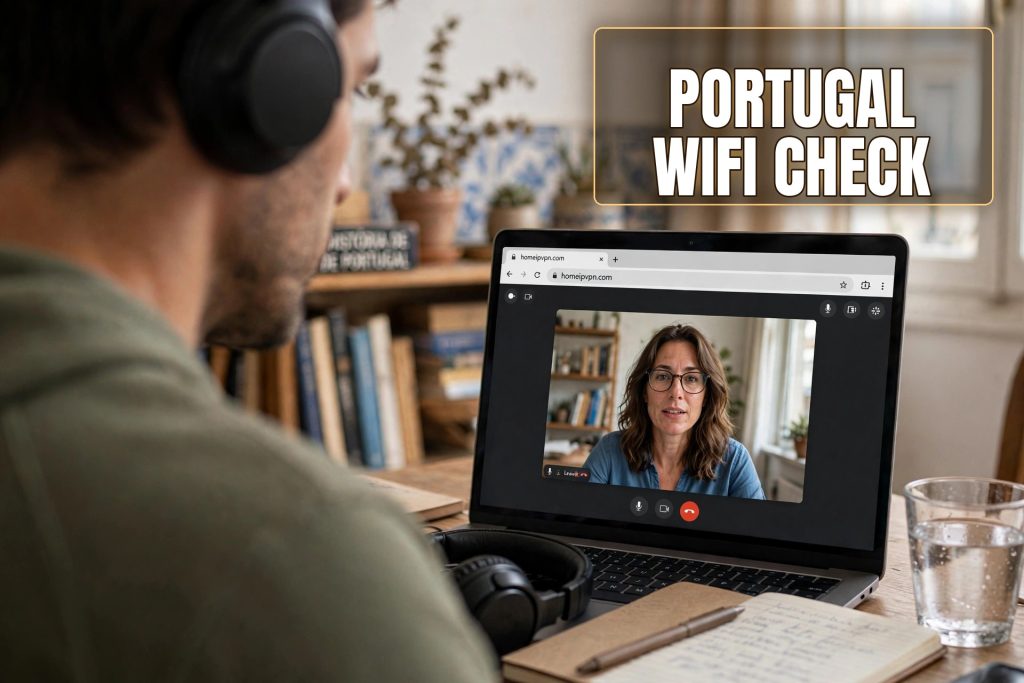
You are sitting in a sunlit Airbnb in Alfama, Lisbon’s oldest neighborhood. The tiles are gorgeous, the view over the rooftops is exactly what the listing promised, and your first team standup starts in ten minutes. You join the call, smile at the camera, and mid-sentence your voice turns into a robot. Then the screen freezes. Then you are staring at your own frozen grin while everyone types “can you hear us?” in the chat.
Portugal is one of the most beloved destinations in the remote work world. The weather, the food, the cost of living, the visa options, it all adds up to a place that feels made for laptops and long lunches. But every nomad who has spent real time here has a story about the internet letting them down at exactly the wrong moment.
So is Portugal’s internet fast enough for video calls in 2026? The honest answer is: it depends entirely on where you are sitting. This is the reality check I wish someone had handed me before my first Lisbon rental.
Lisbon and Porto: The Good News First
Let us start with the part that surprises people. Portugal’s fiber infrastructure in the major cities is genuinely excellent. Fiber optic connections are widespread in Lisbon and Porto, and the speeds are the kind that make you forget you ever worried. Travelers routinely report download speeds between 200 and 500 Mbps in modern apartments, and upload speeds that are usually more than adequate for video calls.
To put that in plain terms: a smooth HD video call on Zoom or Teams needs roughly 3 to 5 Mbps of steady upload speed. A city fiber line gives you twenty to fifty times that. When you are on a proper fiber line in Lisbon, your calls will feel identical to sitting at home in the US. The quality is simply not an issue.
The catch is the word “proper.” Not every Lisbon rental has fiber, even in 2026. Older buildings in the historic center, the beautiful ones with the crooked staircases and the tiled facades, sometimes still run on older DSL lines. DSL is the older technology that runs over phone lines, and it is much slower and much less stable. An Alfama apartment from 1903 with original wiring is charming right up until you need to present slides to your team.
The Apartment Problem: Your Wi-Fi Is Not Your Building’s Wi-Fi
Here is the thing most nomads learn the hard way. When you book an Airbnb or a month-long rental, the “fast Wi-Fi” promise in the listing refers to the router in the corner of the living room. That router is connected to whatever line the building has, and you have no idea what that is until you arrive.
Shared Wi-Fi is another quiet killer. In buildings where the connection is split across multiple units, or in hostels and coliving spaces with thirty people on one network, your speed at 3 PM can be a tenth of what it is at midnight. Coworking spaces are generally better because they invest in business-grade lines, but even there, a packed room of remote workers all on calls at once can strain the network.
My rule is simple and it has saved me more than once: run a real test call on day one. Not a speed test page, an actual video call with a friend. Speed test numbers can look fine while real-time video still stutters, because video calls are sensitive to tiny interruptions that a speed test smooths over. A two-minute call tells you everything. If the landlord’s internet cannot handle it, you want to know in the first 24 hours, while you can still change plans.
Outside the Big Cities: Where Things Get Patchy
Portugal is not just Lisbon and Porto, and remote workers are increasingly settling in places like Ericeira, Lagos, the Douro Valley, and smaller Alentejo towns. This is where the reality check matters most.
In coastal surf towns, the internet is often surprisingly decent, because tourism brought demand and providers followed. In genuinely rural areas, it is a different story. Some villages still rely on DSL or fixed wireless connections that slow to a crawl in the evenings. If you are dreaming of a farmhouse in the Alentejo with a view of the cork oaks, check the internet situation before you check the view. Ask the host for a screenshot of a speed test, and ask what time of day it was taken.
Mobile data is your backup plan, and it is a good one. Portugal’s mobile networks are strong, and a local SIM with a generous data plan can run a hotspot that carries you through a shaky apartment connection. The main providers all offer prepaid plans that are cheap by US standards. A 4G or 5G hotspot will not replace fiber for a full day of calls, but it will absolutely save a meeting when the apartment Wi-Fi drops.
What Actually Breaks on Video Calls (It Is Not Always Speed)
This part confuses a lot of people, so let me explain it in plain English. Video calls need two things: enough bandwidth (the total size of the pipe) and low, steady latency (how quickly data travels back and forth, without hiccups). Most people only think about bandwidth, because that is the number the speed test shows.
Latency is the delay between you speaking and the other person hearing it. High latency makes conversations feel awkward, with everyone talking over each other. Jitter is variation in that delay, and it is what turns your voice into a robot. Packet loss is when chunks of data simply vanish, which is what freezes your video. All three can wreck a call even when the speed test says you have 100 Mbps.
What causes them? Old wiring, overloaded routers, distance from the router, too many devices on the network, and peak-hour congestion. The practical fixes are boring but effective: plug in with an ethernet cable if you can, sit close to the router, ask everyone else in the house to pause their streaming during your important calls, and restart the router once a week. I know it sounds like a cliche. It works anyway.
The Upload Speed Trap
Here is the number that actually matters for video calls, and the one nobody advertises. Download speed is what you get from the internet, upload speed is what you send. Video calls are mostly upload: your camera and microphone constantly sending data out. Many connections in Portugal have wildly asymmetric speeds, meaning the download looks impressive while the upload is a fraction of it.
A 500 Mbps fiber line might have 100 Mbps upload, which is plenty. But an older DSL line might have 20 Mbps down and 1 Mbps up, and that 1 Mbps is where your calls die. When you are evaluating a rental, ask specifically about upload speed. Hosts who only quote the download number either do not know or do not want to tell you.
This is also why your connection can feel fine for Netflix but terrible for Zoom. Streaming video is almost all download. Video calls are a constant two-way stream. A connection built for watching can still fail at working.
Coworking Spaces: Portugal’s Secret Weapon
If your rental internet is unreliable, Portugal has one of the best coworking scenes in Europe, and this is worth knowing before you arrive. Lisbon alone has dozens of coworking spaces, many of them designed specifically for remote workers, with fiber lines, backup connections, phone booths for calls, and coffee that justifies the membership on its own.
A coworking membership in Lisbon typically costs a fraction of what it would in the US, and many offer day passes so you can test the vibe before committing. Porto has a smaller but excellent scene. Even mid-size cities and surf towns usually have at least one good option. If you are planning a month in Portugal, budgeting for a coworking membership is some of the best insurance you can buy for your work life.
The phone booths deserve a special mention. In an open coworking room, a call booth is the difference between a professional call and an embarrassing one. When you are touring spaces, check that the booths exist, that they are actually bookable, and that the Wi-Fi reaches inside them. Some booths are basically Faraday cages with a chair.
What About the Rest of Your Online Life?
Video calls are the stress test, but they are not the only thing that matters. Many US remote workers in Portugal discover a second problem once the calls are sorted: half their online life thinks they are a different person. Your bank wants to verify a login from an unfamiliar location. Streaming services show you the Portuguese catalog instead of your US one. Work tools with security policies flag the new IP address, which is basically your internet’s return address, and lock you out until you prove it is really you.
An IP address tells every website where in the world you are connecting from. When yours suddenly says Lisbon instead of Chicago, automated security systems notice. Most of the time it is just friction, a texted code here, a security question there. But it can escalate. Some banks get nervous about sustained foreign logins. Some company VPNs, the secure tunnels employers use, are configured to block connections from outside the US entirely.
This is the part of the Portugal internet conversation that goes beyond raw speed. Your connection can be blazing fast and still cause you professional headaches, because the problem is not how fast the data moves, it is where the internet thinks you are.
How Nomads Actually Solve This
Talk to enough long-term nomads in Portugal and you start hearing the same setup described over and over. They keep their home internet connection running back in the US, and they reach it from abroad through a home IP VPN. In plain English, that means their laptop connects to their own house first, and then out to the internet from there. Every website, every bank, every work tool sees their familiar home address, no matter which Lisbon cafe they are sitting in.
The setup involves a small travel router, a slim device about the size of a deck of cards that fits in a laptop bag. You connect it to the local Wi-Fi, and it builds an encrypted tunnel back to your home network. It is not complicated to use day to day, but getting it configured correctly the first time takes some know-how. The people I know who did it right had it set up before they flew, tested from a coffee shop at home, and landed in Portugal with one less thing to worry about.
This does not fix a bad local connection, to be clear. If the Airbnb Wi-Fi is genuinely broken, a tunnel back home cannot invent bandwidth that is not there. But it solves the entire second layer of problems: the bank flags, the locked accounts, the streaming catalogs, the work tools that panic at a foreign IP. For a lot of remote workers, that second layer causes more stress than the speed ever did. If you want to understand the full picture, HomeIPVPN specializes in exactly this kind of home network setup for travelers.
The Root Problem Is Not the Speed
Portugal’s internet is fast enough for video calls in 2026, as long as you are on fiber in a city and you have verified it yourself instead of trusting the listing. That is the honest bottom line. The speeds are real, the infrastructure is real, and thousands of remote workers do their full workdays from Lisbon and Porto without issues.
But the deeper issue most nomads hit is not speed at all. It is that moving countries scrambles your digital identity: your location, your logins, your access. The fragmented feeling of being fast but foreign, connected but constantly proving you are who you say you are, is the problem HomeIPVPN was built to solve. If you would rather have someone set it up and verify it works, the Pre-Travel Audit & Advisory session is 1 hour, costs $79, and that fee comes straight off the $279 Secure Home IP VPN System session if you go ahead.
Book the place with the tiles and the view. Test the call on day one. And land with your digital life already sorted, so the only thing you have to figure out in Alfama is where to get the best custard tart.