REMOTE WORK & DIGITAL NOMAD
Working Remotely From Mexico: Internet, Banking, and What to Know
The plane banks over the Gulf, and through the window you can see the coastline curving away in both directions. You have a one-way ticket, a carry-on, a…
✓Getting In: The Visa Basics✓Internet: Better Than You Fear,✓The Money Part: Banking Across the
Quick Answer
Working remotely from Mexico is very doable: internet is solid in the main nomad hubs, living costs run well below most US cities, and US citizens can enter easily for extended stays. The real work is in the details: banking logins that flag foreign access, taxes you still owe back home, and keeping your professional setup reliable.
- Entry is simple: US citizens typically receive up to 180 days on a tourist permit (FMM) at the border or airport, though the exact length is at the officer’s discretion.
- Internet holds up: Mexico City, Playa del Carmen, and Puerto Vallarta have fiber and fast mobile data; always test a rental’s connection on day one.
- Banking needs planning: notify your banks, keep a US address on file, and expect extra verification steps on foreign logins.
- Keep your digital home base: many remote workers route their connection through their US home network using HomeIPVPN, so banks and work tools see a familiar US address.
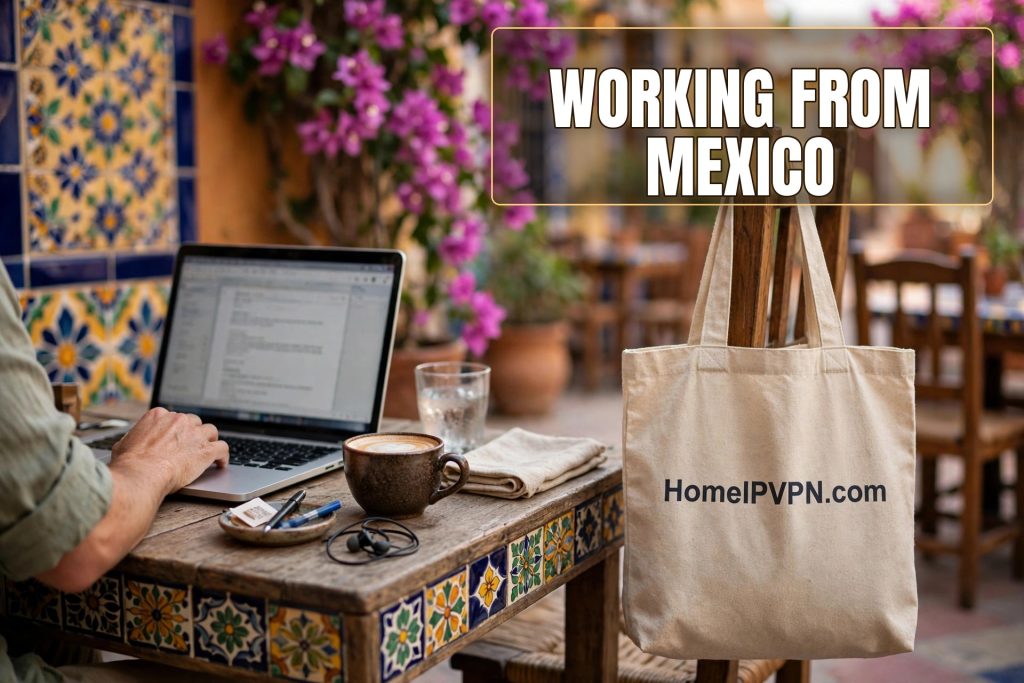
The plane banks over the Gulf, and through the window you can see the coastline curving away in both directions. You have a one-way ticket, a carry-on, a laptop bag, and a plan that sounded bulletproof back in Ohio: live in Mexico for a few months, work US hours, spend less, live more. The guy in the seat next to you is doing the exact same thing. So is half the plane, probably.
Mexico is the default first move for American remote workers, and for good reason. It is close, it is affordable, the food is incredible, and there are established nomad communities that make landing soft. But “everyone does it” does not mean it is effortless. The difference between a great Mexico stint and a stressful one comes down to the practical stuff nobody posts about on Instagram.
This is the starter guide I wish every US remote worker read before the flight: internet, banking, visas, taxes, and the unglamorous details that actually determine whether the whole thing works.
Getting In: The Visa Basics
Let us start with the good news. For US citizens, entering Mexico is refreshingly simple. You do not apply for a visa in advance for a typical remote work stay. When you arrive, by air or land, you fill out a tourist permit called the FMM, and the immigration officer grants you a stay of up to 180 days. I say “up to” because the length is genuinely at the officer’s discretion, and travelers report receiving anywhere from a few weeks to the full six months.
Be polite, have your return or onward travel details handy even if they are flexible, and do not volunteer a complicated explanation of your work situation. You are visiting. You are allowed to bring your laptop. Mexico’s digital nomad visa conversations come and go in the news, but as of now the standard path for Americans is the tourist permit, renewed by leaving and re-entering, which many long-term nomads do via quick trips to the US or elsewhere.
One thing to know: working for a US employer or your own US clients while on a tourist permit exists in a gray area that thousands of people navigate without issue. You are not taking a Mexican job. Keep it simple, keep it quiet, and you will be fine. This is not legal advice, just the widely reported reality.
Internet: Better Than You Fear, Worse Than You Assume
Mexico’s internet is a tale of two countries. In the nomad hubs, Mexico City, Playa del Carmen, Tulum, Puerto Vallarta, Oaxaca City, the infrastructure is genuinely good. Fiber optic connections are common in newer buildings, speeds of 100 to 200 Mbps are routinely reported, and mobile data is fast and cheap. A local SIM with a big data plan costs a fraction of a US plan and makes an excellent backup hotspot.
Outside those hubs, it gets spottier. Smaller beach towns and mountain villages may rely on older infrastructure, and the connection can slow dramatically in the evenings when everyone is streaming. If you are booking a month in a sleepy surf town, message the host and ask for a real speed test screenshot, taken in the evening. Morning numbers lie.
The coworking scene is one of Mexico’s genuine strengths. Playa del Carmen and Mexico City have excellent coworking spaces with redundant connections, call booths, and communities that will answer every question you have. Budget for it. Even if your Airbnb internet is fine, having a coworking backup for important meeting days is worth every peso.
The Money Part: Banking Across the Border
Here is where Mexico trips up more remote workers than the internet ever does. Your money life is built around being in the US, and Mexico quietly breaks several of its assumptions.
First, your banks will notice. Logging into your accounts from a Mexican IP address, which is basically your internet’s return address, triggers security alerts. Expect verification codes, security questions, and occasionally a temporary lock until you confirm it is really you. Before you fly, call your banks and credit card companies and tell them you will be in Mexico. It does not prevent every flag, but it reduces them dramatically.
Second, keep a US address on file with every financial institution. Banks are required to have a US address for you, and changing it to a foreign one can trigger account reviews or closures. Many nomads use a family member’s address or a mail forwarding service. Whatever you do, do not let your bank discover your move from a login location change before you have told them your plan.
Third, think about how you actually get cash and pay for things. Mexican ATMs charge fees, and your US bank may add its own on top. A debit card that reimburses ATM fees is one of the highest-value things a Mexico-bound remote worker can own. For daily spending, cards are widely accepted in cities and tourist towns, but cash is still king in markets, small restaurants, and smaller towns. Learn to carry pesos.
Taxes: The Part Nobody Wants to Read
I will keep this short because nobody enjoys it, but it matters. As a US citizen, you owe US taxes on your worldwide income no matter where you live. Living in Mexico does not change that. There are provisions like the Foreign Earned Income Exclusion that can reduce what you owe if you qualify, but the filing obligation remains.
Mexico may also have claims on income earned while physically present there, and the US-Mexico tax treaty exists to prevent double taxation. In practice, most short-term remote workers on tourist permits file in the US and do not engage with the Mexican tax system, but this is genuinely an area where a conversation with a tax professional who understands expat situations is worth the money. A one-hour consultation before a long stay can save you from expensive surprises.
Time Zones: Mexico’s Quiet Superpower
This deserves its own section because it is the single biggest practical advantage Mexico has over Asia or Europe for US remote workers. Mexico City is on Central Time. Playa del Carmen is on Eastern Time year-round. Puerto Vallarta is on Central. You can work your normal US schedule, join every meeting live, and still have your afternoons free for the beach.
This sounds minor until you have tried working US hours from Lisbon or Bali. The time zone alignment means no 6 AM standups, no missed hallway conversations, no “sorry, I was asleep” in the team chat. Your professional life continues almost unchanged. For many people, this alone is the reason Mexico wins.
Housing: What to Actually Book
For your first month, book an Airbnb with a strong track record and reviews that mention the Wi-Fi specifically. “Fast Wi-Fi” in a listing means nothing; a review from a previous guest saying “worked great for my Zoom calls” means everything. Filter for places with dedicated workspaces, and message the host before booking to confirm the internet speed and ask whether the building has fiber.
After the first month, you will know the neighborhoods and the rhythms, and you can switch to local rentals, which are dramatically cheaper. Facebook groups for digital nomads in each city are full of medium-term rental listings. Just be careful with deposits and always see a place in person before committing to multiple months. The photos lie more often than the hosts do.
The Digital Identity Problem
Here is the issue that surprises people most, because it has nothing to do with Mexico specifically. The moment you start working from abroad, your digital life starts treating you like a stranger. Your bank sees logins from Mexico and gets nervous. Your employer’s security tools flag the foreign IP. Streaming services switch catalogs. Two-factor codes arrive late or not at all because your US phone number is not roaming properly.
Each of these is a small friction. Together, over months, they become a constant low-grade tax on your attention. You are in paradise, but you are spending twenty minutes on hold with your bank’s fraud department while everyone else is at the beach.
The fix that experienced nomads swear by is keeping their US home internet as their digital home base. Through a home IP VPN setup, your laptop connects back to your own house first, so every site and service sees your familiar US address. Your bank thinks you are home. Your work tools think you are home. You are in Playa del Carmen, but digitally, you never left. If that sounds like the kind of thing you would rather have set up properly before you fly, HomeIPVPN builds exactly these setups for remote workers.
The Root Problem Is the Friction, Not the Country
Mexico is genuinely one of the easiest places in the world for an American to work remotely. The entry is simple, the internet in the hubs is solid, the time zones align, and the cost of living lets your salary stretch in ways that feel almost unfair. Thousands of people do this successfully every year, and there is no reason you cannot be one of them.
What sinks Mexico stints is rarely Mexico itself. It is the accumulated friction of a financial and digital life that was built for someone who never leaves Ohio: the bank flags, the locked accounts, the verification loops, the work tools that panic at a foreign connection. That fragmentation, the feeling of being physically in paradise but digitally homeless, is the problem HomeIPVPN was built to solve. If you would rather have someone set it up and verify it works, the Pre-Travel Audit & Advisory session is 1 hour, costs $79, and that fee comes straight off the $279 Secure Home IP VPN System session if you go ahead.
Book the flight. Call your bank first. And land with your digital life already sorted, so the hardest decision of your first week is tacos al pastor versus tacos de pescado.