REMOTE WORK & DIGITAL NOMAD
Kuala Lumpur for Remote Workers: Asia’s Most Practical Nomad Base in 2026
I arrived in Kuala Lumpur on a humid Tuesday evening with no particular expectations. It was supposed to be a two-week stopover between other places. I stayed…
✓Why KL keeps winning on✓The real cost of living in 2026✓Internet: the part that actually
Quick Answer
Kuala Lumpur is one of the most practical long-term bases for remote workers in Asia in 2026: low costs, fast and reliable internet, abundant coworking spaces, and straightforward visa options. A comfortable nomad life runs roughly $1,200 to $1,800 a month, and the city pairs big-city infrastructure with prices far below Singapore or Hong Kong. It is less glamorous than Bali and more functional, which is exactly the point.
- Cost: expect $1,200 to $1,800 a month for a comfortable setup, with modern one-bedroom apartments from around $400 to $700.
- Internet: fast fiber is standard in condos, coworking spaces are plentiful and cheap, and mobile data is among the cheapest in the region.
- Visas: most nationalities get 90 days visa-free, and Malaysia’s digital nomad pass covers longer stays for qualifying remote workers.
- Work from KL smoothly: HomeIPVPN lets you keep your home internet identity while based in Malaysia, so banking and work tools never notice you left.
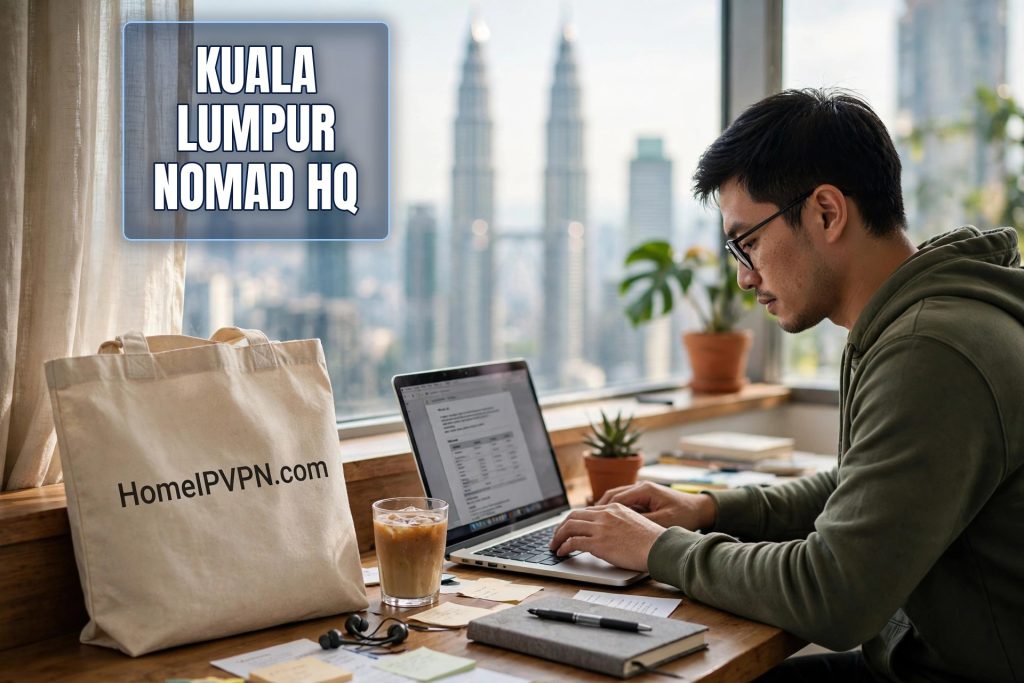
I arrived in Kuala Lumpur on a humid Tuesday evening with no particular expectations. It was supposed to be a two-week stopover between other places. I stayed four months. Nobody writes songs about Kuala Lumpur. Nobody gets a KL tattoo. But if your actual goal is to get work done, live well, and spend less than you would in almost any Western city, it is quietly one of the best bases in Asia, and in 2026 that case is stronger than ever.
This is not a tourism guide. This is the practical stuff: what it costs, how the internet holds up, where you work, how the visa works, and what daily life actually feels like when the novelty wears off and you still have deadlines.
Why KL keeps winning on practicality
Every nomad destination is a tradeoff. Bali has the vibe but the infrastructure can be shaky and the visa situation is a moving target. Bangkok is bigger and wilder but more chaotic. Singapore is flawless and priced accordingly. Kuala Lumpur sits in the sweet spot: a genuine modern capital with malls, metro, and fiber internet, at prices that feel like a different decade.
The city was built for business, which turns out to be exactly what remote workers need. Reliable power. Good hospitals. An international airport with cheap flights everywhere in Asia. English widely spoken. None of this is exciting, and all of it matters enormously when you live somewhere rather than vacation there.
The expat and nomad community is large enough that you will find your people within a week, but not so large that the city feels like a theme park. There are meetups, coworking events, and the usual WhatsApp and Telegram groups, without the influencer saturation that has made some destinations exhausting.
The real cost of living in 2026
Let us talk numbers, because this is where KL pulls ahead. A modern one-bedroom condo in a good area, think Bangsar, Mont Kiara, or near KLCC, runs roughly $400 to $700 a month on a longer rental. These are not shoeboxes. Malaysian condos tend to be spacious, and most come with pools, gyms, and security, the kind of amenities that cost a fortune elsewhere.
Food is where the savings get almost silly. A meal at a hawker center or food court costs a few dollars and is genuinely excellent. Malaysia’s food culture is one of the great underrated pleasures of living there: Malay, Chinese, and Indian cuisines colliding on every street. Even eating out daily, a food budget of $200 to $300 a month is comfortable. Cook sometimes and it drops further.
Transport is cheap. The metro and monorail cover the central areas well, and rideshares are inexpensive by global standards. Many nomads spend under $100 a month getting around. Add coworking at $100 to $150 a month, mobile data at pocket change, and miscellaneous spending, and a comfortable total lands around $1,200 to $1,800 a month. Live simply and you can go lower. Live well and you are still spending less than rent alone in most Western cities.
Internet: the part that actually matters
Fiber internet is standard in most modern condos, and speeds are genuinely good. It is common to get 100 Mbps or more in a rental, and the infrastructure in the city center is solid. This is not a place where you plan your work around the internet. The internet just works, which is the highest praise infrastructure can get.
Coworking spaces are plentiful and affordable. The main names have multiple locations across the city, with day passes, monthly memberships, and the usual mix of hot desks and private offices. Monthly memberships typically run $100 to $150, and the spaces tend to be professional rather than party-oriented, which suits people who actually need to work.
Cafes are a mixed bag for working. The local kopitiam culture is wonderful for breakfast but not designed for laptops. The international-style cafes in Bangsar and Mont Kiara are better bets, with reliable wifi and a tolerance for campers. As always, buy something every couple of hours and nobody minds.
Mobile data deserves a special mention. Malaysia has some of the cheapest mobile data in the region, and coverage in KL is excellent. A local SIM with a generous data plan costs very little and makes an outstanding backup connection. Many nomads tether as their plan B during the rare fixed-line hiccup.
Visas: how long you can stay
Most Western nationalities get 90 days visa-free on arrival, which covers a solid trial run or a medium-length stay. It is a generous window, and it is one of the reasons KL works so well as a flexible base. You can show up, see if the city fits, and decide later.
For longer stays, Malaysia introduced a digital nomad pass aimed specifically at remote workers. The details and income thresholds have evolved since launch, so check the current requirements before planning around it, but the direction is clear: Malaysia wants remote workers and has built a product for them. This is a meaningful signal. Countries that actively court nomads tend to keep improving the experience.
The usual caveat applies everywhere: visa rules change, and forum posts from two years ago are not a legal opinion. Verify the current requirements from official sources before you book a one-way flight. The 90-day visa-free entry is the stable foundation. Everything beyond that deserves fresh research.
Daily life beyond the spreadsheet
Numbers aside, what is it like to actually live there? KL is a multicultural city in a way that feels natural rather than curated. Malay, Chinese, and Indian communities shape everything from the food to the festivals to the languages you hear on the metro. English works everywhere that matters, which removes a huge layer of friction from daily life.
The weather is the weather: hot and humid year-round, with dramatic afternoon downpours. You adapt faster than you expect. Air conditioning is everywhere, and you learn to schedule outdoor time for mornings. If you need seasons to feel oriented in time, this is not your city. If you can live without them, it is a non-issue.
Safety is good by big-city standards. The usual urban awareness applies, but KL does not have the edge that some larger Asian capitals do. Solo travelers, including solo women, generally report feeling comfortable, which matches my own experience.
The honest downside: KL is not beautiful in the way travelers mean beautiful. It is a working city of highways and malls and condo towers. The charm is in the food, the ease, and the value, not in postcard views. If you need daily aesthetic inspiration, you will take weekend trips. The good news is that those trips are cheap and the whole region is an hour or two away by budget airline.
Banking, work tools, and the location problem
Here is the practical issue every long-stay nomad hits regardless of destination. The longer you are away, the more your digital life starts flagging you. Banks notice the foreign logins. Work security tools get twitchy. Streaming services reassign your catalog. None of this is about Malaysia specifically. It is about being away from home for months, and it happens in every base city.
The travelers who handle this smoothly are the ones whose internet still looks like home. Routing through your own home connection means your bank sees your home address in month four just like it did in week one. No escalating verification challenges. No “unusual activity” emails. Your digital life stays calm while your physical life moves.
This is worth setting up before a long KL stay, not during it. HomeIPVPN is the setup I point people to: a small device on your home internet that makes every login, everywhere, look like you never left.
Who KL is for, honestly
Kuala Lumpur is for the nomad who has moved past the honeymoon phase of remote work. You are not looking for the most Instagrammable base. You are looking for the base where you can work efficiently, live comfortably, save money, and fly anywhere in Asia for the price of a nice dinner. You want infrastructure that disappears into the background and a cost of living that lets you actually save.
It is less for the nomad who needs constant novelty or beach access. If your ideal base has surf breaks and sunset coworking, look elsewhere and visit KL for the food. But if your ideal base has fast internet, a $500 apartment with a pool, and $3 lunches that ruin you for food back home, you have found it.
I came for two weeks and stayed four months. The city does that to practical people. It does not seduce you. It just makes sense, day after day, until leaving feels like the irrational choice.
Making a foreign base feel like home, digitally speaking, is the problem HomeIPVPN was built to solve. If you would rather have someone set it up and verify it works, the Pre-Travel Audit & Advisory session is 1 hour, costs $79, and that fee comes straight off the $279 Secure Home IP VPN System session if you go ahead. Book a Pre-Travel Audit & Advisory session before you fly, and land in KL with your digital life already settled.
See you at the hawker center. Order the char kway teow.