REMOTE WORK & DIGITAL NOMAD
Medellin for Digital Nomads: Internet, Costs, and the Nomad Visa
The rain in Medellin does not mess around. I watched it arrive from the balcony of a short-term apartment in Laureles, a gray curtain rolling over the green…
✓The internet situation: genuinely✓Where nomads actually live✓What it actually costs
Quick Answer
Medellin is one of the easiest cities in Latin America to work from remotely. Travelers report fiber internet of 100 to 300 Mbps in most modern apartments, comfortable living costs of roughly $1,200 to $1,800 a month, and a digital nomad visa path for remote workers earning foreign income.
- Internet: fiber is common in Laureles and El Poblado, with travelers reporting 100 to 300 Mbps down and stable video calls
- Costs: a comfortable nomad month runs roughly $1,200 to $1,800, including a furnished apartment, food, and coworking
- Visa: Colombia offers a digital nomad visa for remote workers, with a low income threshold compared to other programs in the region
- Before you fly: sort out how you will reach home banking and accounts securely, which is the problem HomeIPVPN was built to solve
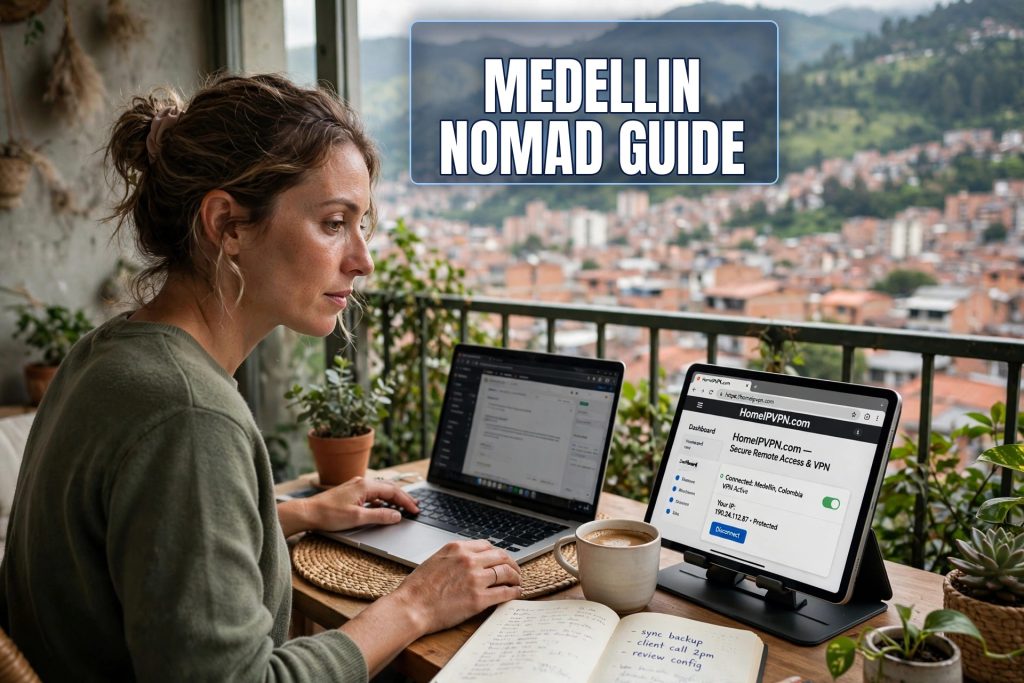
The rain in Medellin does not mess around. I watched it arrive from the balcony of a short-term apartment in Laureles, a gray curtain rolling over the green mountains while a courier waited calmly below the awning. Twenty minutes later the sun was back, steam rising off the pavement, and my neighbor was watering his plants like nothing had happened. This is the city of eternal spring doing its thing: 22 degrees, forever, with dramatic skies.
And inside, my video call had not dropped once. That is the real headline about Medellin for remote workers. It is not the weather (lovely), not the fruit (astonishing), not the cost of a proper dinner (half of what you pay in Austin). It is that you can live well and work well here at the same time, which is the one thing that actually matters when you are choosing a home base.
So let us talk about what working from Medellin is really like: the internet, the money, the neighborhoods, and the visa. No hype. Just the stuff you need to know before you book the flight.
The internet situation: genuinely good
Let us start with the question everyone asks first, because everything else is secondary if you cannot join a call. The short version: the internet in Medellin is genuinely good, and in many modern buildings it is excellent.
Medellin sits on real fiber infrastructure. In neighborhoods like Laureles, El Poblado, and Envigado, apartments in newer buildings typically have fiber connections where travelers report speeds of 100 to 300 Mbps down. Upload speeds are usually in the range of 50 to 100 Mbps on fiber plans, which is what actually matters when you are presenting on a video call with your camera on and your screen shared.
Providers like Claro, Tigo, and Movistar compete across the city, and that competition works in your favor. When you are apartment hunting, ask the host or landlord for a speed test screenshot before you commit. If you rent an apartment for a month or more, getting your own fiber line installed is usually possible and often cheap by North American standards, with technicians who can often show up within a few days.
One practical note: older buildings in the valley can have slower or shared connections, so the neighborhood matters less than the building. A gleaming coworking space in El Poblado might sit next to an older apartment block with tired copper wiring. Always test the actual connection where you will be sitting, not just the neighborhood’s reputation.
Power outages are the thing nobody warns you about. They are not constant, but heavy rain can knock out power in some areas for an hour or two. If your work cannot tolerate that, a small UPS (an uninterrupted power supply, basically a battery your router plugs into) costs little and saves your call when the lights flicker. Many experienced nomads in Medellin consider it as essential as their coffee setup.
Where nomads actually live
Two neighborhoods dominate the nomad conversation, and they are very different experiences.
Laureles is the working nomad’s favorite. Tree-lined streets, a slightly local feel, cafes with plugs and decent wifi on every block, and prices that feel fair rather than inflated. It is flat enough to walk, safe enough to feel relaxed, and close enough to everything that you rarely need a car. If you want the balanced life, this is where you start.
El Poblado is glossier and pricier. It has the biggest concentration of coworking spaces, the best-known restaurants, and the Parque Lleras nightlife strip. It is also where prices have crept up the most, and some nomads find it a little too polished, a little too removed from the real city. Still, if you want maximum convenience and a social scene that runs 24/7, it delivers.
Envigado, just south, is the sleeper pick. It technically became its own municipality, but it flows straight into Medellin. It is quieter, greener, a touch cheaper than Poblado, and popular with nomads who want calm evenings after loud workdays. Belen is further out and cheaper still, but the commute to the coworking hubs gets old fast.
Coworking is everywhere and good. Selina, WeWork-style local chains, and independent spaces like Tostao (a coffee chain that doubles as half the city’s unofficial coworking) mean you will never struggle to find a desk with fast wifi and people to talk to. Day passes typically run a few dollars; monthly memberships usually land somewhere between $80 and $150 depending on the space and plan.
What it actually costs
Let us talk money honestly, because Medellin is affordable but not magic.
A furnished one-bedroom apartment in a good neighborhood typically runs $500 to $900 a month, depending on the area and how long you stay. Monthly rentals are much cheaper per night than the daily rates on short-stay platforms, so if you know you will be here a while, negotiate a monthly deal. Many landlords prefer a stable tenant and will drop the price 20 to 30 percent for a three-month commitment.
Food is where Medellin shines. The menu del dia, the fixed lunch menu at local restaurants, usually costs $3 to $6 and is genuinely filling: soup, a main with rice and beans, a drink. Cook at home and your grocery bill for a month can sit around $200 to $300 for one person, especially if you shop at the markets where a bag of mangoes costs less than a coffee back home. A nice dinner out with drinks might run $15 to $25 per person.
Transport is cheap. The metro system is clean, fast, and genuinely pleasant to ride, with integrated cable cars that climb into the hillside neighborhoods. A metro ride costs well under a dollar. Taxis and ride apps are inexpensive enough that you stop thinking about them.
All in, most remote workers report a comfortable month in Medellin costs somewhere between $1,200 and $1,800. You can spend less if you live simply, and plenty of people do. You can spend more if you want the penthouse in Poblado and dinner out every night. But the middle ground is wide and comfortable.
The digital nomad visa, in plain English
Colombia has a digital nomad visa, and it is one of the more accessible programs in Latin America. Here are the basics, kept simple.
The idea: if you work remotely for companies or clients outside Colombia, and your income comes from abroad, you can apply for a visa that lets you live and work in Colombia legally. You do not need a Colombian employer. You do not need to start a company. You just need to show that you earn your money remotely and that the income is enough to support yourself.
The income threshold is lower than many competing programs, which is a big part of why it is popular. Travelers and immigration advisors generally describe it as achievable for a typical remote worker salary, not just executives. You will need documents that prove your income, like recent bank statements or a letter from your employer or clients, plus a valid passport and the usual application paperwork.
A few honest caveats. First, visa rules change, and the details you read in a blog post (including this one) are no substitute for checking with an immigration advisor or the Colombian consulate before you apply. Second, the application involves bureaucracy, and bureaucracy in any country takes longer than you expect. Start early, keep copies of everything, and be patient. Third, many nomads arrive on the standard tourist entry first, settle in, and then begin the visa process from inside the country with local help.
The banking headache nobody mentions
Here is the part of the Medellin nomad story that rarely makes the guides, because it is not photogenic. Your bank still thinks you live at home.
It usually goes like this. You are three weeks into your Medellin stay, everything is going great, and then you try to log into your bank or your brokerage account and you get flagged. A security check. A verification code sent to a phone number you no longer use. A locked account that requires a phone call to a fraud department that operates on your home country’s business hours, which is the middle of your night.
Banks use your location as a security signal. When your internet location suddenly jumps from, say, Chicago to Medellin, some banks treat that as a possible account takeover. It does not matter that you are a legitimate customer on a legitimate trip. The system sees a foreign location and gets nervous.
There are workarounds. Tell your bank you are traveling before you go, and keep your home-country phone number active for verification codes. But the underlying issue stays: as long as your connection looks like it is coming from Colombia, some of your home services will treat you as a stranger.
The clean fix is to make your connection look like it is coming from home even when you are not. HomeIPVPN sets up a small device at your actual home (or a trusted location) and routes your internet through it, so your bank, your streaming services, and your work tools see the same home IP address they have always seen. No flags, no lockouts, no panicked calls to fraud departments at 2 a.m. It is the difference between fighting your own bank every month and simply getting on with your life.
Daily life, the small stuff
A few practical things worth knowing before you arrive.
Cash still matters. Cards are accepted in most restaurants and shops in the nicer neighborhoods, but markets, small vendors, and some taxis are cash-only. ATMs are everywhere, though fees add up, so consider a bank account that reimburses foreign ATM fees if you do not have one already.
Spanish helps enormously. You can survive in Poblado with English alone, but the city opens up the moment you can handle basic conversations. Even a month of learning before you arrive changes the experience completely.
Safety is the question everyone asks and nobody answers well. Medellin is dramatically safer than its 1990s reputation, and millions of people live their whole lives here without incident. It is also a big Latin American city with real street crime, and you should act like it: do not flash expensive gear, do not wander dark streets at night, use ride apps after dark, and ask locals which areas to be careful in. Standard big-city sense, not fear.
The weather deserves one more mention because it shapes everything. At about 1,500 meters above sea level, Medellin sits in permanent spring. Days around 22 to 24 degrees, cool nights, rain that arrives dramatically and leaves quickly. You will pack a light jacket you wear most evenings and sunglasses you wear every day.
Getting set up before you fly
If Medellin is calling, here is a sensible checklist for the week before you leave.
First, tell your banks you are traveling. Set up travel notifications and make sure you can receive verification codes abroad, whether that means keeping your home number on an eSIM or setting up backup authentication methods.
Second, sort out your remote connection. Decide how you will reach the services that care about your location: banking, brokerage, maybe streaming. If you want to skip the monthly dance of security flags, set up a home IP solution before you leave, because it has to be installed at home before you travel. HomeIPVPN handles exactly this: a small device at home that makes your connection look like it never left, so you land in Medellin and everything just works.
Third, book your first two weeks, not your first two months. Arrive, walk the neighborhoods, test the actual wifi in the building, and then commit. The nomad who books Laureles for a month sight unseen usually does fine. The nomad who samples first always does better.
Here is the honest summary of the whole thing. The biggest recurring headache for nomads in Medellin is not the internet, which is good, and not the cost, which is fair. It is the slow drip of location-based security problems: banks, brokers, and work tools that get suspicious every time your connection jumps countries. That exact problem, your location changing while your life stays the same, is what HomeIPVPN was built to solve, in plain English: your internet looks like it comes from home, so the services that protect you stop treating you like a stranger.
If you would rather have someone set it up and verify it works, the Pre-Travel Audit & Advisory session is 1 hour, costs $79, and that fee comes straight off the $279 Secure Home IP VPN System session if you go ahead.
Medellin rewards the nomads who come prepared and stay curious. Bring a light jacket, learn some Spanish, test the wifi before you sign, and enjoy the eternal spring. You are going to like it here.