REMOTE WORK & DIGITAL NOMAD
Romania: Europe’s Cheapest Fast Internet for Remote Workers
You run the speed test mostly as a joke. The Airbnb host in Bucharest promised “very fast internet,” and you have heard that line in twelve…
✓Why Romania’s internet is so✓Bucharest: the capital’s case✓Cluj-Napoca, Timisoara, and
Quick Answer
Romania consistently ranks among the world’s fastest and cheapest internet markets, with gigabit fiber available in cities for a fraction of Western European prices. Bucharest, Cluj-Napoca, and Timisoara all have excellent connectivity for remote work, plus low living costs and a growing nomad scene. It is one of Europe’s best value bases for bandwidth hungry remote workers.
- Speed: Gigabit fiber is common in cities, often costing less per month than a couple of coffees.
- Best cities: Bucharest, Cluj-Napoca, Timisoara, and Brasov all combine fast internet with livable costs.
- Value: Total living costs run far below Western Europe while connectivity matches or beats it.
- Remote setup: Fast local internet handles the work; a home IP from HomeIPVPN handles your bank and account logins.
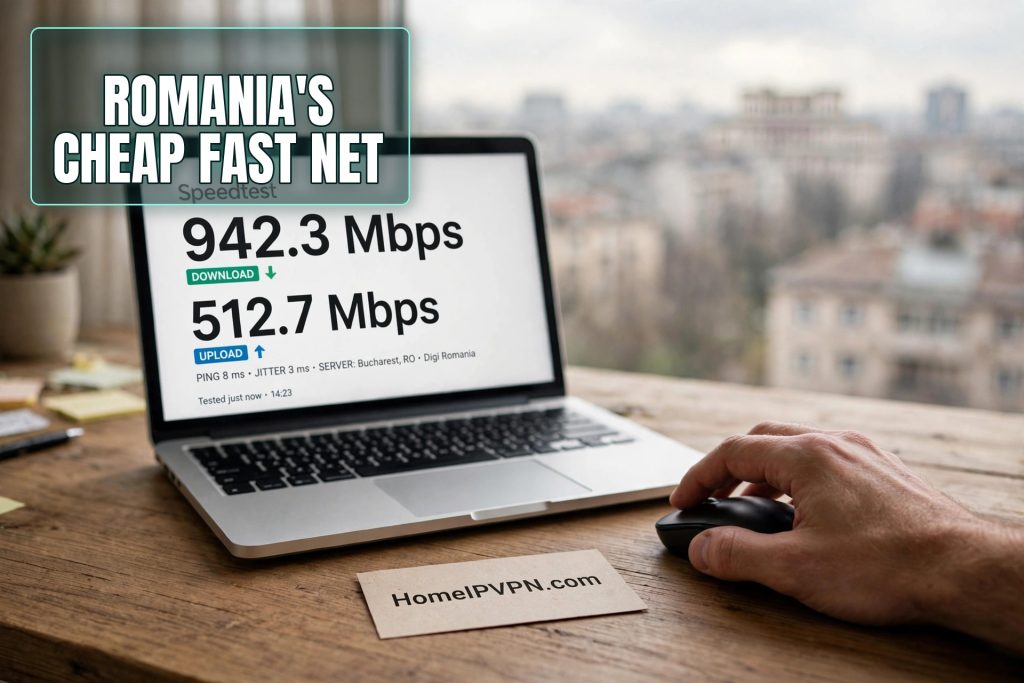
You run the speed test mostly as a joke. The Airbnb host in Bucharest promised “very fast internet,” and you have heard that line in twelve countries. The numbers come back: 940 megabits down, 880 up. You stare at the screen. Your office back home, the one your company pays real money for, gets a third of this.
Then you check what the host pays for it. The monthly bill for this gigabit fiber connection is less than what you spent on lunch. Welcome to Romania, the country that quietly built some of the best internet on earth and priced it like a utility instead of a luxury.
Why Romania’s internet is so fast and so cheap
The story is one of those accidents of history that worked out beautifully. After the fall of communism, Romania had almost no legacy telecom infrastructure, which turned out to be an advantage. Instead of upgrading old copper networks piece by piece like Western Europe, small local providers just ran fiber directly to buildings. Neighborhood networks sprang up everywhere, competition was fierce, and prices collapsed while speeds soared.
The result is a market where gigabit fiber to the apartment is normal in cities, not premium. Providers compete on speed the way others compete on price, because the infrastructure is already in the ground and the marginal cost of going faster is tiny. For remote workers, this means the connectivity question that dominates planning in so many countries simply does not exist here. You will have fast internet. The only question is which neighborhood you want it in.
This is worth pausing on, because it inverts the usual nomad logic. In most of the world, you choose a city and hope the internet cooperates. In Romania, the internet is a solved problem, and you get to choose based on everything else: cost, culture, mountains, food, pace of life. That is a liberating way to pick a base.
Bucharest: the capital’s case
Bucharest is the obvious first choice and the easiest landing. It has the deepest fiber coverage, the most coworking spaces, the largest international community, and flight connections to everywhere. The city itself surprises people: grand Belle Epoque boulevards next to communist era blocks, a genuinely good food scene, huge parks, and nightlife that goes until morning if that is your thing.
For remote work specifically, Bucharest offers everything on the checklist. Gigabit fiber in most central apartments. Coworking spaces ranging from corporate polished to creative chaotic. Neighborhoods like Floreasca and Aviatorilor for the upscale quiet life, the Old Town for energy, and university areas for affordability. Rents for modern one bedroom apartments in good areas cost a fraction of Berlin or Amsterdam equivalents.
The honest downsides: Bucharest is not a pretty city in the conventional sense, though it grows on people. Traffic is bad. Winters are gray and cold. And the bureaucracy for longer stays can be trying. But as a pure remote work base, measured in megabits per euro, it is arguably the best value in Europe.
Cluj-Napoca, Timisoara, and Brasov: the alternatives
Cluj-Napoca is Romania’s tech capital, home to universities, startups, and a young international crowd. The internet is as fast as Bucharest’s, the cafe culture is strong, and the vibe is more manageable than the capital: a real city that still feels human scale. Many nomads who try both end up preferring Cluj. It is the thinking person’s choice.
Timisoara, in the west near the Hungarian and Serbian borders, is the underrated pick. Beautiful Austro Hungarian architecture, a relaxed pace, excellent connectivity, and costs even lower than Cluj. It was a European Capital of Culture recently, which tells you the cultural life is real. For remote workers who want Europe’s cheapest fast internet in its most pleasant packaging, Timisoara deserves a serious look.
Brasov offers a different proposition: a medieval old town in the Carpathians, skiing nearby in winter, hiking in summer, and fiber internet in a fairy tale setting. It is smaller, so the coworking scene is thinner and the international community is cozier, but for writers, developers, and anyone whose work is mostly async, Brasov is the “why doesn’t everyone know about this” option. Test the specific apartment’s connection, as mountain town buildings vary more than Bucharest blocks.
What fast internet actually changes about your work life
It is easy to underrate this until you have lived it. Gigabit symmetric fiber, meaning uploads as fast as downloads, transforms the annoying parts of remote work. Pushing large files to clients takes seconds. Video calls are flawless even with screen sharing and a VPN running. Cloud backups complete before your coffee cools. Two people can work full video schedules from the same apartment without negotiating bandwidth.
It also changes what you can attempt. Running a home media server, hosting video streams, doing live coding sessions, moving massive datasets: all the things that are painful on a 20 megabit hotel connection become trivial. Romania is one of the few places where a remote worker’s home setup can exceed their company’s office setup, and people who experience that rarely want to go back.
The price dimension matters too. When gigabit fiber costs pocket change monthly, you stop thinking about internet as an expense at all. It joins water and electricity as background infrastructure. That mental shift, from connectivity as a scarce resource to connectivity as a given, is the real luxury Romania sells, and it sells it cheaper than anyone.
Costs: the full picture beyond internet
Internet is the headline, but the supporting costs make Romania a genuine value play. Rents in Bucharest and Cluj for comfortable modern apartments run at a fraction of Western European capitals. Eating out is affordable, with excellent value at traditional restaurants and mid range places. Groceries are cheap, especially at markets. Transport, whether the excellent Bucharest metro or intercity trains, costs little.
The total monthly budget for a comfortable nomad life, decent apartment, coworking membership, eating out regularly, weekend trips, lands well below what the same life costs in Berlin, Amsterdam, or Barcelona. The gap is large enough to be life changing for freelancers: the same income buys a noticeably better life, or the same life on fewer billable hours.
Two cost caveats. Imported goods and electronics carry normal European prices, so do not expect cheap laptops. And the leu floats, so your costs in dollars or euros move with the exchange rate. Neither is a dealbreaker, but both belong in the spreadsheet.
Visas and the practicalities of staying
Romania is in the Schengen area, which simplifies the short term picture enormously for many nationalities: up to ninety days in any rolling one hundred eighty day period, no special visa, just show up. For a season of fast internet and low costs, that is all most people need.
For longer stays, Romania has a digital nomad visa aimed at remote workers employed by foreign companies. As with every visa in this series, the income threshold and document list are moving targets, so verify the current requirements with the Romanian authorities or an immigration lawyer before planning around them. The general shape is familiar: proof of remote employment, income above the threshold, health insurance, and patience with paperwork.
EU citizens have the simplest path of all, with the right to live and work freely. For non EU nomads doing the Schengen shuffle, Romania pairs well with non Schengen neighbors for the out periods: a season in Romania, a season in a nearby non Schengen country, and the calendar math works out. The region is dense with options, which is part of the appeal.
The banking and login layer
Fast Romanian internet solves the work half of the equation completely. It does nothing for the administrative half. Your bank still sees logins from Bucharest, your employer’s systems still see a Romanian IP, and the fraud algorithms still do their nervous math. Romania is in the EU, which helps with some services, but your home country’s bank does not care about EU membership when its model flags an unfamiliar login location.
This is the odd couple of the Romanian nomad life: the best internet in Europe paired with the same account security friction as everywhere else. The fix is the same one that works on every continent. Keep your digital location constant with a home IP, so the blazing Romanian fiber carries traffic that looks, to your bank, like it never left home. HomeIPVPN sets this up as a permanent layer under your travels: Bucharest today, somewhere else next season, one unchanging home address throughout. It is the kind of infrastructure that makes the fast internet actually usable for real life, not just speed tests.
Who Romania is perfect for
Romania is perfect for the remote worker whose priorities are, in order: connectivity, cost, and European quality of life. Developers pushing big repos, video editors moving huge files, anyone running live sessions or streams, data people, and teams that live on video calls will feel the difference daily. Freelancers watching their margins will feel it monthly.
It is less perfect for those whose dream is beaches, eternal summer, or a huge established nomad party scene. Romania has winter, it has no coastline worth the name, and while the nomad community is growing, it is not Lisbon or Bali. Know what you are optimizing for. If the answer is “do great work, cheaply, comfortably, in Europe,” Romania is very hard to beat.
The pattern here is worth naming: sometimes the best nomad destination is not the most photographed one. Romania will not fill your feed with sunsets. It will fill your workdays with frictionless connectivity and your bank account with the savings from sane prices. For a working person, as opposed to a vacationing person, that trade is often the right one.
That trade, by the way, is exactly why the invisible infrastructure matters as much as the visible kind. Gigabit fiber gets your work done; a stable home IP keeps your financial life from interrupting it. One is Romania’s gift, the other is what HomeIPVPN was built to provide, and together they make an unusually complete remote work base. If you would rather have someone set up the home IP side and verify it works before you fly, the Pre-Travel Audit & Advisory session is 1 hour, costs $79, and that fee comes straight off the $279 Secure Home IP VPN System session if you go ahead.
Run the speed test. Then try not to smile.