REMOTE WORK & DIGITAL NOMAD
Costa Rica Beach Towns vs. San Jose: Where Internet Is Reliable Enough to Work
You have two browser tabs open. In one, a sleek apartment in Escazu: floor to ceiling windows, a dedicated office nook, fiber internet listed in the amenities…
✓The honest reliability gap✓San Jose and the Central Valley:✓The beach towns, town by town
Quick Answer
For reliable remote work internet in Costa Rica, San Jose and the Central Valley win decisively: fiber is widespread, outages are rare, and coworking spaces have backup connections. Beach towns can work, but reliability varies by street and season, with rain and power cuts as the main risks. If your income depends on video calls, base in the valley and visit the coast on weekends.
- San Jose: Fiber widely available, stable power, proper coworking spaces; the safe choice for call heavy work.
- Beach towns: Improving fast but inconsistent; always test the specific rental and have mobile data backup.
- Rainy season: Afternoon storms can knock out power and wireless relays on the coast from May to November.
- Banking anywhere: Logging in from changing Costa Rican networks triggers fraud alerts; a constant home IP from HomeIPVPN keeps your accounts calm.
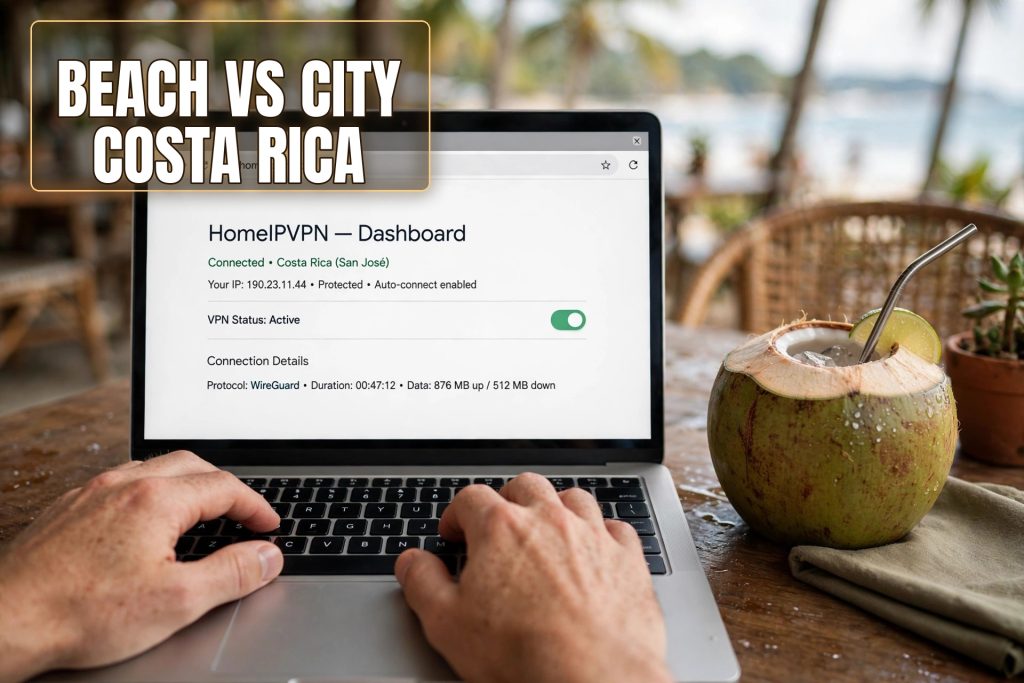
You have two browser tabs open. In one, a sleek apartment in Escazu: floor to ceiling windows, a dedicated office nook, fiber internet listed in the amenities with an actual speed number. In the other, a bungalow in Santa Teresa: hammock on the porch, surfboards on the rack, outdoor shower, and a WiFi description that just says “good wifi” with no further details.
Your heart wants the bungalow. Your calendar, full of client calls, wants the apartment. This is the central tension of working from Costa Rica, and it deserves more than a vibes based decision. Let us compare the two options the way your livelihood depends on it, because it does.
The honest reliability gap
Start with the unvarnished truth. San Jose and the surrounding Central Valley sit on proper telecommunications infrastructure: buried fiber, redundant routing, stable grid power, and a competitive market of providers. When something breaks, technicians exist and arrive. This is the environment remote work was designed for, transplanted to the tropics.
The beach towns sit on infrastructure that was built for tourism and is being retrofitted for remote work in real time. That retrofit is genuinely underway: fiber reaches further every year, and the main strips of Tamarindo, Nosara, and Santa Teresa are far better connected than they were five years ago. But the last mile problem is literal here. Your specific rental may be on fiber, on a wireless relay from a nearby mast, or on a connection the owner optimistically describes as “high speed” because it loads Instagram.
The gap is not just about speed. It is about failure modes. In Escazu, an outage is an event: rare, noticed, fixed. On the coast, an outage is weather: a heavy afternoon storm takes out power, the wireless relay loses line of sight in the rain, and you are offline until the sky clears. Neither is anyone’s fault. Only one of them is compatible with a 2pm client presentation.
San Jose and the Central Valley: the case for boring
Let us give the valley its due, because remote workers underrate it badly. Escazu, Santa Ana, and Rohrmoser have modern apartment buildings with fiber to the unit, speeds that handle 4K video calls without a thought, and power stability that you will not think about until you visit the coast and remember what thinking about power feels like.
The coworking scene is the real deal. Multiple established spaces with redundant internet connections, phone booths, meeting rooms, and communities of people who are also there to work. For your first month in Costa Rica, a coworking membership in the valley is the highest ROI purchase available: every work variable solved on day one while you learn the country at your own pace.
The lifestyle case is better than its reputation too. The valley has the best restaurants in the country, real supermarkets, cinemas, gyms, and weekend access to volcanoes, cloud forests, and both coasts. What it lacks is the beach outside your window, and that is a real lack, but it is a lack you can fix every single weekend with a two hour drive. Many veteran nomads consider the valley plus beach weekends the optimal Costa Rica strategy, and they are not wrong.
Costs in the valley are also saner than the beach. Rents for modern one bedrooms in good neighborhoods run meaningfully below equivalent beach town rentals, and daily life, groceries, transport, eating out, is cheaper away from the tourist pricing of the coast. Your money goes further where the toucans are not.
The beach towns, town by town
Tamarindo is the most workable beach option and the most expensive. The main commercial strip and the residential areas around it have the coast’s best infrastructure, multiple coworking spaces, and a deep bench of cafes with usable WiFi. If you must be at the beach and must take video calls, Tamarindo is the lowest risk choice. You pay for that risk reduction in rent and in crowds.
Santa Teresa and the southern Nicoya coast are the surfer’s choice, and connectivity here is a street by street lottery. The main road through town is increasingly well served, but venture a few hundred meters in any direction and you are in relay territory. Vet ruthlessly: demand a live speed test from the exact unit, ask about the rainy season specifically, and confirm the backup plan. Santa Teresa rewards the careful and punishes the hopeful.
Nosara has a dedicated wellness nomad community and better than average infrastructure for its size, partly because the long term foreign residents demanded it. The main areas around Playa Guiones work fine for most remote jobs. It is pricier than its size suggests, and the unpaved roads mean “close to town” can still be a dusty twenty minutes, but the work life balance, yoga at dawn, calls by mid morning, surf at sunset, is genuinely achievable here.
Puerto Viejo and the Caribbean coast are the wildcard. Beautiful, culturally rich, affordable, and the most variable connectivity in the country. Limon’s infrastructure lags the Pacific coast, storms hit harder, and power cuts are a lifestyle. It can work for async workers with flexible schedules and good backup systems. For anyone with fixed daily calls, it is a vacation, not a base.
How to actually test a beach rental
The vetting process for a coastal rental deserves more rigor than the valley equivalent, because the variance is higher. Start with the four questions: fiber or relay, current speed test screenshot from inside the unit, router location and sharing, and mobile signal strength by carrier. Then add the coastal extras.
Ask about the rainy season explicitly. “How is the internet in October?” is a question that separates honest hosts from optimistic ones. Ask about power cuts: how often, how long, and does the building have any backup. Ask whether the rental has a UPS on the router, and if the answer is a confused silence, plan to bring your own portable battery. Ask which coworking space or cafe the current long term tenants use when their home connection dips, because every coastal nomad has one, and the answer tells you how often “dips” happen.
For stays over a month, consider a redundancy stack: the rental WiFi as primary, a local SIM with a big data plan in your phone as secondary, and a portable hotspot on a different carrier as tertiary. This sounds excessive until the first stormy week, when it sounds like genius. Total cost is modest. Total peace of mind is enormous.
The hybrid strategy most veterans land on
Here is what the Costa Rica old hands actually do, after the bungalow fantasy meets the first rained out deadline. They keep a base in the Central Valley, usually Escazu or Santa Ana, with a proper lease, fiber, and a coworking membership. Then they do long weekends and full weeks at the beach, working lighter schedules from rentals they have personally vetted over time.
This strategy wins on every axis. Work reliability is valley grade. Beach access is a regular feature of life, not a relocation gamble. Costs stay reasonable because the expensive beach rentals are short stays, not monthly commitments. And the psychological effect is real: the beach stays special when it is a reward, and goes stale surprisingly fast when it is the backdrop to your Tuesday standup.
The alternative that also works: pick one beach town, commit to it, and build your redundancy stack properly. Tamarindo or Nosara, a vetted rental, dual carrier mobile backup, a UPS, and a coworking membership for call heavy days. This is a real remote work base, not a fantasy. It just costs more and requires more systems thinking than the valley equivalent.
What does not work is the pure fantasy version: booking the cheapest cute bungalow with “good wifi” in the listing, arriving with no backup, and hoping the rainy season respects your sprint schedule. Hope is not a connectivity strategy.
The invisible infrastructure: your digital location
There is one more reliability question, and it has nothing to do with megabits. Every time you move between the valley and the coast, between rentals, between a coworking space and a cafe, your visible IP address changes. Your bank, your employer’s VPN, your payment processors: they all see a person whose digital location jumps around Costa Rica like a pinball.
Individually, each login is innocent. In aggregate, the pattern is exactly what fraud detection is tuned to flag. The account freeze always comes at the worst moment: the rent transfer, the client invoice, the emergency fund access. And resolving it from a beach town, possibly without reliable SMS reception on your home number, turns a fifteen minute verification into a multi day saga.
The fix is to take location out of the equation entirely. A home IP setup routes your traffic through your own residential connection, so whether you are on valley fiber or a Nosara hotspot, your accounts see one stable home address. HomeIPVPN builds this for remote workers who move around: the IP stays constant while everything else changes, and your bank never has a reason to ask questions. It is the kind of infrastructure you set up once and benefit from in every town you ever work from.
Making the call
So: valley or beach? If your work is call heavy, deadline driven, or client facing in real time, the valley is the professional choice, and the beach is the weekend reward. If your work is async, flexible, and tolerant of the occasional stormy afternoon offline, a well vetted beach base is absolutely viable. Be honest about which worker you are, not which one you wish you were.
And whatever you choose, choose it with data. Speed tests, not adjectives. Backup plans, not hope. A redundancy stack, not a prayer. Costa Rica will happily host your remote work life for years. It just asks that you respect the difference between its two infrastructures, and plan for the one you actually have.
The deeper lesson generalizes beyond Costa Rica: every nomad destination has a reliable core and a romantic edge, and your job is to know which one your work requires. The reliable core is never the Instagram version, but it is where careers survive. Get the connectivity right, keep your digital identity stable with the home IP setup that HomeIPVPN provides, and the romance takes care of itself on weekends. If you would rather have someone set up that stable home connection and verify it works before you choose your town, the Pre-Travel Audit & Advisory session is 1 hour, costs $79, and that fee comes straight off the $279 Secure Home IP VPN System session if you go ahead.
Pick the boring internet. Visit the exciting beach. That is the whole secret.