REMOTE WORK & DIGITAL NOMAD
Voting From Abroad as a Digital Nomad: The Basics
The first election I spent abroad, I almost missed it entirely. Not because I did not care, but because every step assumed I was standing in Ohio. The…
✓Yes, you can vote. That part is✓The one form that does almost✓How the ballot actually reaches you
Quick Answer
US citizens can vote from abroad in federal elections no matter where they live, and most states let you vote in state and local races too. The process runs through an absentee ballot request filed with your last US voting address, and the earlier you file, the smoother it goes.
- Your right does not expire: federal law protects overseas voting for US citizens, including people who have never lived at a US address in their adult life.
- One form covers registration and ballot: the Federal Post Card Application (FPCA) registers you and requests your ballot in a single filing with your state.
- Deadlines are earlier than you think: ballot request deadlines fall weeks before election day, and mail from abroad is slow, so file months ahead.
- Reach election sites reliably abroad: some state voter portals and ballot-tracking tools behave oddly on foreign connections, which is why many overseas voters keep a home IP address with HomeIPVPN.
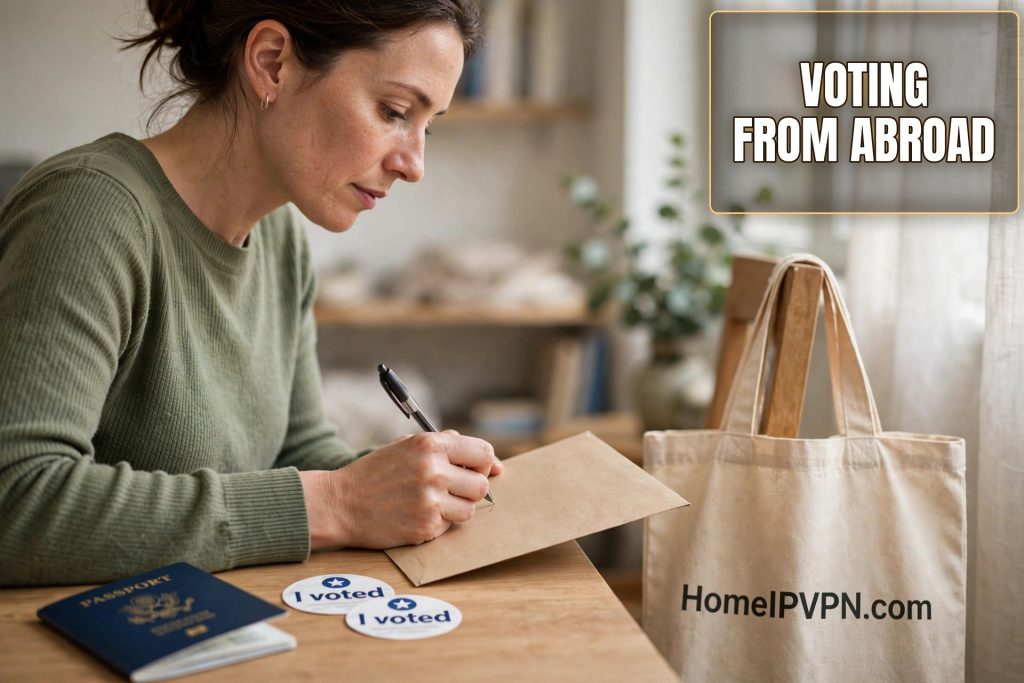
The first election I spent abroad, I almost missed it entirely. Not because I did not care, but because every step assumed I was standing in Ohio. The registration site wanted a current address and would not accept my Airbnb. The ballot request form asked for a mailing address and the dropdown only listed US states. I kept thinking there must be a separate system for people like me, and there was, I just had to find it buried three clicks deep on a county website last updated during the previous administration.
I got my ballot in the end, voted from a kitchen table in Portugal, and felt absurdly proud dropping that envelope in a foreign mailbox. If you are a US citizen living the nomad life, your vote still counts exactly the same. You just have to navigate a system that was designed by people who never imagined you. Here is how it actually works.
Yes, you can vote. That part is settled law.
Let us clear the biggest worry first. US citizens living abroad have a federally protected right to vote in federal elections: president, Senate, and House. This comes from a law called UOCAVA (the Uniformed and Overseas Citizens Absentee Voting Act), and it applies whether you moved abroad last month or have lived overseas for twenty years. It even applies if you have never established your own US residence as an adult, as long as a parent’s last US address can anchor you to a state.
Most states go further and let overseas voters participate in state and local elections too, though the rules vary. A handful of states limit overseas citizens who have never resided there to federal races only. The details depend on your state, which for voting purposes means the last US address where you lived, or your parent’s last address if you never lived in the States yourself.
The key concept is your “voting residence.” It is not where you live now. It is the last place in the US where you had a real residential connection. You do not need to own property there, receive mail there, or have any current ties at all. That address is simply the anchor that determines which state’s ballot you receive and which local office processes your paperwork.
The one form that does almost everything
The Federal Post Card Application, mercifully shortened to FPCA, is the workhorse of overseas voting. One form, filed with your local election office, both registers you to vote and requests your absentee ballot. You can fill it out online through the Federal Voting Assistance Program’s website, print it, sign it, and send it to your county.
Timing matters more than anything else in this process. States set their own deadlines for receiving the FPCA, and they fall well before election day, often forty-five days out or more. Then your ballot has to reach you, you have to vote it, and it has to get back by the state’s return deadline. Every leg of that journey involves mail systems, and international mail is where timelines go to die.
File the FPCA in January of an election year and you will be early for everything. File it in October and you are gambling. Election officials strongly recommend filing a fresh FPCA every calendar year and every time you change your mailing address, because states purge inactive overseas voters from the rolls more aggressively than most people expect.
How the ballot actually reaches you
When you file the FPCA, you choose how to receive your ballot: by mail, by email, or by fax, depending on what your state allows. Email delivery sounds obviously better, and for most nomads it is, but there is a wrinkle. Some states that email your ballot still require you to return the voted ballot by physical mail. Others allow electronic return. A few still insist on the full paper round trip.
If your state requires mailing the ballot back, plan like a pessimist. International post from many countries takes two to three weeks, and election offices count receipt deadlines strictly. Many overseas voters use courier services for the return leg, or vote the ballot and hand it to the nearest US embassy, which can pouch it back through diplomatic mail, a slower but free option with its own deadlines.
There is also a federal backup ballot, the FWAB, which you can use if your official ballot has not arrived close to the deadline. It is essentially an emergency ballot that counts as long as your official ballot does not also show up. Knowing it exists removes a lot of election-week panic. Look it up before you need it, not after.
The address problem, solved
Every nomad hits the same wall: forms that demand a current residential address and refuse to proceed without one. For voting purposes, the answer is straightforward. Your voting residence is your last US address, and your current mailing address is wherever you can reliably receive mail right now. These are two different fields, and mixing them up causes most of the confusion.
For the mailing address, use whatever actually works: a mail forwarding service, a family member who will express-ship your ballot, a poste restante arrangement, or in some cases your email if your state supports electronic ballot delivery. The critical thing is reliability. A ballot sitting in the mailroom of an Airbnb you left two weeks ago helps no one.
Some voters worry that listing a foreign mailing address will trigger tax obligations or affect their residency status. Voting from abroad does not create tax residency or change your legal domicile. Election offices and tax authorities are separate systems. Millions of overseas Americans vote every cycle without it affecting anything else about their status.
What can go wrong (and how to prevent it)
The most common failure mode is the silent one: you filed everything correctly, but your ballot never arrived, and you found out too late. Prevent this by tracking your ballot. Most states now offer online ballot tracking that shows when your ballot was mailed, received, and counted. Check it the way you would check a package you actually care about.
Second most common: signature mismatch. Your ballot envelope signature gets compared against the signature on file, which for many people is a hurried scrawl from a DMV visit a decade ago. Sign carefully and consistently. If your signature has evolved, some states let you update it on file before the election.
Third: the witness and notarization requirements a few states still impose. A small number of states require your ballot envelope to be signed by a witness or notarized. If yours is one of them, sort this out early, because finding a qualifying witness or a US-style notary abroad takes planning. US embassies offer notarial services by appointment, which is one more reason not to leave things to the last week.
A practical note on doing this from foreign wifi
Almost every step of overseas voting happens online now: the FPCA, ballot tracking, checking your registration status, downloading the backup ballot. And almost every one of those sites was built for domestic users. Overseas voters regularly report state portals that load strangely, time out, or flag their sessions when accessed from foreign IP addresses.
This is the same category of problem as banking portals that freeze when they see a login from a new country. The fix is the same too: do your election admin over a connection that appears to come from home. Many long-term travelers keep a home IP address through HomeIPVPN precisely for this kind of civic housekeeping, filing forms and tracking ballots without fighting geolocation quirks. It is a small piece of the process, but the process has enough friction already.
Your pre-election checklist
Here is the whole thing as a sequence. One, confirm your voting residence state and find your county election office. Two, file the FPCA early in the year, choosing electronic ballot delivery if your state allows it. Three, verify your registration a few weeks later through your state’s lookup tool. Four, when ballots go out, track yours and follow up immediately if it does not arrive. Five, vote it the day you get it and return it by the fastest reliable method available. Six, confirm it was received and counted.
Put the deadlines in your calendar the moment you file. Set reminders for the ballot request deadline, the expected ballot arrival window, and the return deadline. Nomad life runs on shifting schedules, and the election will not wait for you to remember.
The bigger picture
The underlying friction in all of this is that you are a US citizen participating in civic life from outside the country’s digital borders. Forms assume a US address, portals assume a US connection, and mail assumes US timelines. That mismatch between where you are and where systems expect you to be is the problem HomeIPVPN was built to solve, by giving your devices a home IP address so the sites and services tied to home treat you like you never left. If you would rather have someone set that up and verify it works, the Pre-Travel Audit & Advisory session is 1 hour, costs $79, and that fee comes straight off the $279 Secure Home IP VPN System session if you go ahead.
Your vote counts the same from a kitchen table in Lisbon as it does from a polling place in Ohio. The system just makes you work a little harder for it. File early, track everything, and give that envelope the send-off it deserves.