REMOTE WORK & DIGITAL NOMAD
What Happens to Your Health Insurance When You Work Abroad?
I was in Chiang Mai when my tooth started aching. Not an emergency, just a dull throb every time I drank something cold. Back home, this would have been a…
✓The uncomfortable starting point:✓Travel insurance vs. international✓The questions to ask before you
Quick Answer
Most home-country health insurance stops covering you the moment you move abroad, or covers only emergencies. Nomads usually bridge the gap with international health insurance or travel medical plans, and the right choice depends on how long you will be gone and whether you keep a home address.
- Your domestic plan likely ends at the border: employer and marketplace plans generally cover emergencies abroad at best, not routine care, prescriptions, or checkups.
- Travel insurance is not health insurance: it covers sudden emergencies and evacuation, but not ongoing treatment, mental health visits, or preventive care.
- Gaps have real consequences: going uninsured between plans can mean denied claims later, so line up new coverage before the old coverage ends.
- Access your insurer from anywhere: many insurer portals and telehealth services restrict logins by location, which is one more reason travelers keep a home connection with HomeIPVPN.
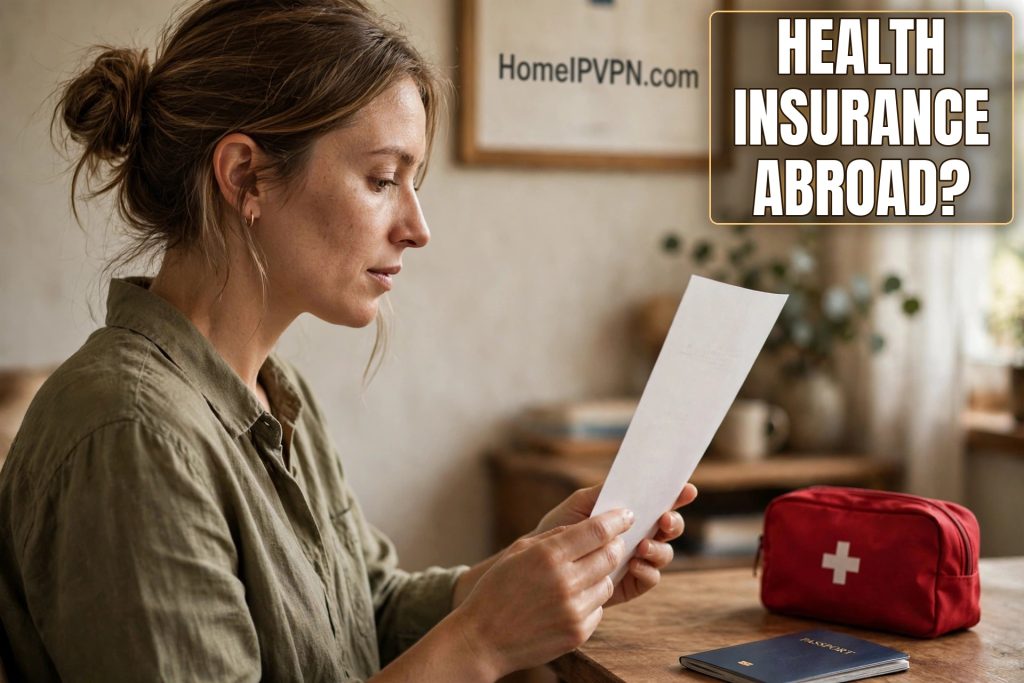
I was in Chiang Mai when my tooth started aching. Not an emergency, just a dull throb every time I drank something cold. Back home, this would have been a forty-minute errand: call the dentist, show the insurance card, pay the copay, done. In Thailand, I stood in a pharmacy aisle doing mental math in a foreign currency, wondering whether my insurance covered any of this, and slowly realizing I had no idea what my insurance even was anymore.
It turned out fine. A local dentist fixed it for less than my old copay. But the experience exposed a gap I had been ignoring for months: I had left my home country with a vague sense that I was “probably covered,” and that vague sense was doing a lot of heavy lifting. If you work abroad, health insurance is one of those topics that feels boring until the afternoon it becomes the only topic.
Here is the plain-language version of what every nomad eventually has to figure out.
The uncomfortable starting point: your home plan probably does not travel with you
Most domestic health insurance is built on an assumption you are about to break: that you live in one place. Employer plans, government marketplace plans, and national health systems generally define coverage by residency. Once you stop being a resident, or once you are outside the country for more than a short trip, the coverage shrinks or stops.
What usually survives is emergency coverage. If you are hit by a scooter in Bali, your home plan may well pay for the emergency room, after deductibles, paperwork, and possibly a fight. What does not survive is everything else: the dentist, the prescription refill, the dermatologist appointment, the therapy sessions, the blood test your doctor wanted to follow up on. Routine and ongoing care abroad is almost always on you.
There are exceptions, and they are worth checking rather than assuming. Some premium employer plans include real international coverage. Some countries have reciprocal healthcare agreements. But the default assumption should be that your home coverage ends at the border, and you should verify the exceptions in writing, not from memory of a brochure you skimmed during onboarding.
Travel insurance vs. international health insurance: different tools
People mix these up constantly, and the difference matters enormously when you actually need care. Travel insurance, the kind you buy for a two-week vacation, is built for sudden disasters. It covers the emergency room visit, the medical evacuation, the trip home if something goes badly wrong. It is cheap because it assumes you are going home soon, where your real insurance takes over.
International health insurance, sometimes called expat insurance or global medical insurance, is built for people who live abroad. It covers routine care, prescriptions, mental health, maternity, and ongoing treatment, the everyday health stuff that travel insurance explicitly excludes. It costs more, because it does more.
Here is the trap: a nomad who buys travel insurance for a year abroad feels covered, right up until they need a prescription refill or a specialist visit and discover that none of it qualifies as an emergency. If you are living abroad rather than vacationing, you almost certainly want the international kind. Read the actual policy document, not the marketing page. The exclusions section, boring as it is, tells you what you really bought.
The questions to ask before you buy anything
Shopping for international coverage is confusing, but a short list of questions cuts through most of it. First, where are you covered? Many plans exclude the United States specifically, because US healthcare prices are so high that including them would double the premium. If you visit home often, check this carefully.
Second, what counts as pre-existing? Most plans have waiting periods or exclusions for conditions you already had. If you take a daily medication or see a specialist regularly, this is the single most important clause in the policy. Third, how do claims actually work? Some plans pay providers directly, which is wonderful. Others make you pay out of pocket and file for reimbursement, which means you need the cash flow and the patience for paperwork in a foreign language.
Fourth, what about mental health? Nomad life is isolating in ways people do not discuss enough, and therapy coverage varies wildly between plans. If this matters to you, and it should, check the number of covered sessions and whether telehealth therapy counts. Fifth, evacuation: if you are seriously hurt somewhere remote, who flies you to a real hospital, and what triggers that decision? This is the clause you hope never to use and cannot afford to get wrong.
Keeping your home doctor in the loop
One underrated strategy is to not fully cut ties at home. If you keep a home address, perhaps at a family member’s place or a mail service, you may be able to keep your domestic plan active and use it during visits home. Some nomads schedule their annual checkups, dental work, and specialist visits for trips back, batching a year’s worth of routine care into one visit.
This works best as a complement to international coverage, not a replacement for it. Your domestic plan will not help with the toothache in Chiang Mai. But for predictable, plannable care, the home-visit batch is efficient and often cheaper than paying out of pocket abroad, depending on the country.
There is a practical wrinkle worth knowing: many insurer websites, patient portals, and telehealth platforms restrict access based on where your internet connection appears to come from. People abroad routinely find themselves locked out of the portal where their claims, records, and virtual appointments live. Travelers deal with this by keeping a home IP address through a service like HomeIPVPN, so the portal sees a login from home and lets them in. It is a small thing until the day you need your records and the site will not load them.
What about the country you are living in?
Depending on where you settle, local options may beat international plans on price. Many countries popular with nomads have excellent private healthcare that costs a fraction of US prices. A local health insurance plan, or simply paying out of pocket for routine care, can be the rational choice in places where a specialist visit costs less than your old copay.
The calculation changes with visa status. Some countries require proof of insurance for long-stay visas, and they may specify minimum coverage amounts. Digital nomad visas in particular often come with insurance requirements attached. Check the visa rules for each country before you assume you can sort it out after arrival.
Also consider the worst case honestly. Local care might be cheap and good for routine things, but if you develop something serious, do you want to be treated there, or evacuated somewhere with more advanced facilities? Your answer determines how much evacuation coverage you need, and it is worth thinking about before you are making the decision from a hospital bed.
The paperwork nobody does (but should)
Here is the unglamorous part that saves people. Before you leave, download or print everything: your policy documents, your insurer’s international contact numbers, your claims forms, your prescription records, your vaccination history, and a summary of any ongoing conditions. Store copies in the cloud and keep one set on your phone for offline access.
Tell your insurer you are traveling, if your plan requires notification. Get any prior authorizations for ongoing treatments in writing. If you take prescription medication, ask your doctor for a letter describing what it is and why you need it, which smooths things over at foreign pharmacies and border crossings alike.
And mind the gap. If your old coverage ends on the last day of the month and your new plan starts on the first, you are fine. If there is a two-week hole in the middle, that is exactly when something will happen. Overlap your coverage by a few days on each end. The extra premium for a week of double coverage is the cheapest peace of mind you will ever buy.
The bigger picture
Strip away the details and the real problem is this: your health coverage was designed for someone who stays put, and you are not that person anymore. Every system involved, your insurer, your doctor’s portal, your pharmacy, assumes a fixed home address and a local internet connection. That mismatch is the problem HomeIPVPN was built to solve on the connectivity side, by giving your devices a home IP address so the services tied to home keep working wherever you actually are. If you would rather have someone set that up and verify it works, the Pre-Travel Audit & Advisory session is 1 hour, costs $79, and that fee comes straight off the $279 Secure Home IP VPN System session if you go ahead.
Sort your coverage before you need it. The toothache version of the story is funny in retrospect. The emergency-room version is not, and the difference between them is usually just planning.