REMOTE WORK & DIGITAL NOMAD
What Is a Bank Travel Notice (and Why It Only Lasts 90 Days)
Somewhere in your banking app, buried under settings or card controls, there is a feature called a travel notice (some banks call it a travel plan or travel…
✓What a travel notice is✓How to set one (it takes two✓Why it only lasts 90 days (or 30,
Quick Answer
A bank travel notice tells your bank which countries you will be in and when, so card purchases there do not trigger fraud alerts. Most banks cap notices at 30 to 90 days, and they mainly cover card swipes, not online banking logins. Long-term travelers outlast their notice and start getting flagged again.
- What it covers: Mostly in-person and online card purchases in the countries you list.
- What it does not cover: It does not fully protect online banking logins, which are scored separately.
- The expiry trap: Notices lapse after 30 to 90 days, exactly when long-term travelers stop thinking about them.
- Beyond the notice: Logging in from your own home internet address works indefinitely, which is what HomeIPVPN arranges for people living abroad.
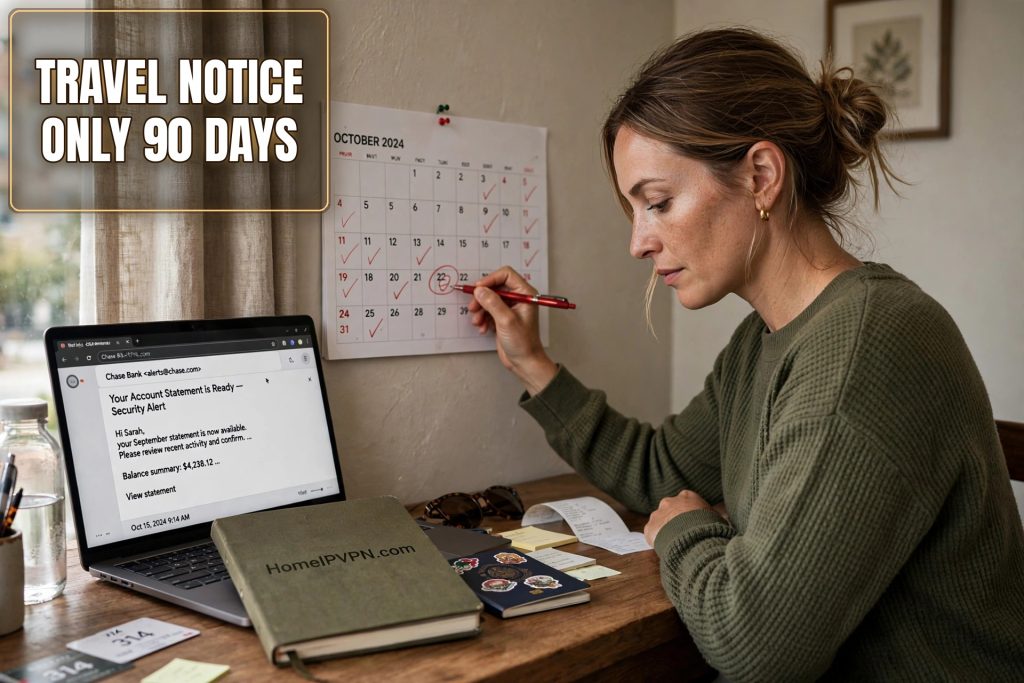
Somewhere in your banking app, buried under settings or card controls, there is a feature called a travel notice (some banks call it a travel plan or travel alert). If you have never used it, you are missing the single easiest fraud-prevention step for any trip. If you have used it, you might have discovered its limits the hard way. Let us walk through what it actually does.
What a travel notice is
A travel notice is a short message from you to your bank’s fraud system: “I will be in these countries on these dates, so charges from there are me.” You enter your destinations and your travel dates, and the bank files it next to your account.
After that, when you buy dinner in Rome or book a train in Tokyo, the fraud system checks the notice first. Country matches, date matches, and the purchase goes through instead of triggering a declined card and a “was this you?” text. That is the whole magic. It is a heads-up, nothing more.
How to set one (it takes two minutes)
The exact taps vary by bank, but the pattern is nearly universal:
- Open your banking app and look under your debit or credit card settings. Search for “travel” in the app’s search bar if you cannot find it.
- Choose the card or cards you are taking with you. Set a notice per card if your bank does it that way.
- Enter your destinations. List every country, including layover countries where you might buy a coffee during a connection.
- Enter your dates with a buffer of a few days on each end. Flights get delayed; give yourself slack.
- Save it and look for a confirmation message or email.
No travel notice option in your app? Call the number on the back of your card and ask a representative to add one. Some smaller banks and credit unions still do this by phone.
Why it only lasts 90 days (or 30, or 60)
Here is the part that surprises people. Banks put a hard cap on how long a travel notice can run, usually somewhere between 30 and 90 days depending on the bank. This is not them being difficult. A travel notice is designed for vacations and business trips, and from the bank’s perspective, someone who has been “traveling” for six straight months starts to look like someone who has moved.
And that distinction matters. A tourist and an expat are different risk profiles to a bank. Extended foreign card activity can eventually trigger account reviews, requests for updated address documentation, or in strict cases (this has hit British expats particularly hard) account closure notices. The travel notice was never built for the digital nomad life. It was built for two weeks in Italy.
The gap long-term travelers fall into
This is the classic nomad story. You set a travel notice before your big trip. Ninety days pass. You are now in your third country, living your best life, and you have completely forgotten the notice existed. Then your card gets declined at a grocery store, or your online banking locks you out, and you are confused because you “did the travel notice thing.”
You did. It just expired quietly, with no reminder, exactly as designed.
Some travelers try chaining notices back to back, setting a new one every 90 days. This can work for a while, but it is fragile: banks notice the pattern, the notices still do not cover online banking logins well, and one forgotten renewal puts you right back in the declined-card line.
What the travel notice does not do
Worth saying plainly, because the name overpromises:
- It does not guarantee approval. Large or unusual purchases can still get flagged, notice or not.
- It mostly covers card transactions. Logging into your online banking from abroad is scored by a separate system that cares more about your internet address than your itinerary.
- It does not stop all “verify it is you” texts and emails. Expect some anyway.
- It does nothing for other accounts. Set one per bank, per card.
How to check whether your notice is still active
Here is an uncomfortable question: do you actually know if your travel notice is still running right now? Most travelers set one and never look at it again. In most banking apps, you can check in the same place you set it: card settings, then travel or travel notice. It should show your destinations and the end date. If the end date has passed, or the notice is simply gone, you are traveling unprotected and did not know it.
Make this a habit. Every time you cross into a new country on a long trip, take thirty seconds to open the app and confirm the notice is live and the country is listed. It is the cheapest insurance in travel, and it lapses silently, so the checking has to be deliberate. Set a recurring calendar reminder for a week before the expiry date. Future you will be grateful.
What if your bank does not offer travel notices?
Not every bank has this feature. Many smaller banks, credit unions, and online-only banks never built one, or buried it so deep it might as well not exist. If yours is one of them, you are not out of options.
Call the number on the back of your card before you travel and simply tell a representative where you are going and for how long. Ask them to put a note on your account. It is the manual version of the same thing, and it works. While you have them on the phone, ask two more questions: “What is the best number to reach the fraud department from abroad?” and “Is there anything else I should do before an extended trip?” Write down the answers. That five minute call replaces the feature your app never had.
Some modern banks skip travel notices entirely because their fraud systems are built differently: they learn your patterns instead of asking for itineraries. If your bank tells you “you do not need one,” believe them, but still make the call about extended travel. A human note on the account never hurts.
The snowbird pattern banks actually like
There is a kind of long-term traveler that banks are completely comfortable with: the predictable one. Think of the retiree who spends every winter in the same town in Mexico, uses the same two ATMs, shops at the same grocery store, and comes home in April. After the first season, the bank’s system learns the pattern. Year two barely generates a ripple.
The lesson for nomads: consistency calms the system down. If you find yourself returning to the same base, a favorite city you keep coming back to, your fraud score there drops over time. It is the constantly-moving traveler, new country every two weeks, who looks the most like a stolen account. You cannot always control your itinerary, but when you can build a rhythm, the bank notices in a good way.
Quirks worth knowing before you fly
A few patterns travelers report often enough to be worth knowing. Many US banks now verify suspicious transactions by texting a code to your phone, which is great unless your US SIM is sitting in a drawer back home. Before a long trip, make sure you can still receive those texts: keep roaming on, move the number to a service that forwards texts over WiFi, or switch your verification method in the app to email or an authenticator.
Another common one: some banks treat the first transaction in a new country as a test and approve small amounts while flagging large ones. So your $4 coffee goes through and your $800 apartment deposit gets blocked. If you know a big payment is coming, make it after a day or two of small normal transactions, not as the very first thing you do in a new country.
And a quiet but important detail: travel notices usually cover the countries you list, but the bank still sees the countries you pass through. A layover purchase in a country not on your notice can trigger the exact flag you were trying to avoid. When in doubt, list the layover countries too. It costs nothing.
The setup that does not expire
If your travels are measured in months rather than weeks, you need something that does not have a countdown timer. The most reliable signal to a bank is not a notice about where you are going. It is a login that comes from the same home internet address the bank has trusted for years.
HomeIPVPN sets up exactly that: your own home connection, carried with you anywhere in the world, so your bank always sees the address it knows. No renewals, no 90 day limits, no remembering to file paperwork before every trip. If you want it built and tested for you, our Pre-Travel Audit & Advisory session is $79 (credited toward the full $279 setup), done over screen share in 1 hour.
For your next short trip, though: set the travel notice. It is free, it takes two minutes, and it prevents the most common headaches. Just set a calendar reminder for the day it expires.