REMOTE WORK & DIGITAL NOMAD
Your Hourly Rate vs. Your Location: The Bias Freelancers Talk About
Ana is a web designer from Porto. Her portfolio is solid, her reviews glow, and for two years she charged $55 an hour without anyone blinking. Then she flew to
✓Your rate is not just a number, it✓Where your location actually shows✓What clients are really asking
Quick Answer
Freelancers consistently report that the country a client thinks you are in changes the rate they consider normal. The same portfolio and the same proposal can get a very different reaction depending on the location shown. Your location leaks through your profile, your time zone, and even the connection behind your logins.
- The bias shows up in real money: traveling freelancers say new clients haggle harder and anchor to “local prices” once they learn you are working from a cheaper country.
- Location leaks in small ways: your profile country, time zone, message timestamps, and the IP address attached to your sessions all quietly tell a location story.
- Clients are usually worried about reliability: being reachable, hitting deadlines, and overlapping their workday matter far more to them than your actual street address.
- Keep your signals consistent: a steady online location, for example with a HomeIPVPN home ip vpn setup that makes your connection appear from home, removes one more thing for clients to wonder about.
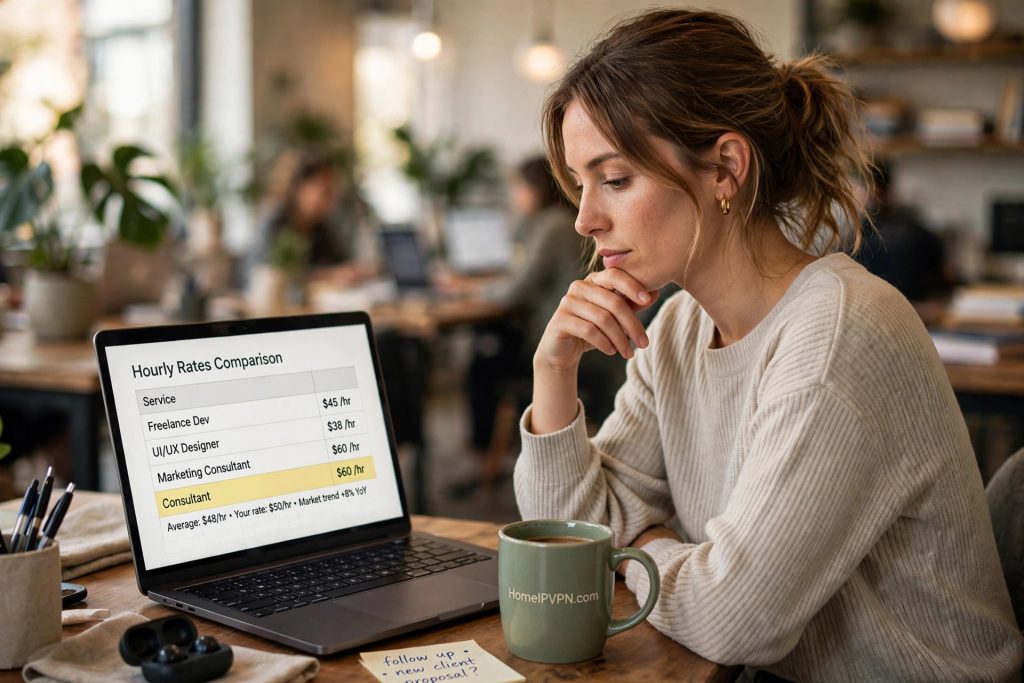
Ana is a web designer from Porto. Her portfolio is solid, her reviews glow, and for two years she charged $55 an hour without anyone blinking. Then she flew to Vietnam for three months, set up her laptop in a bright apartment in Da Nang, and kept doing exactly the same work for exactly the same clients. Nothing about her craft changed. But something curious started happening on sales calls. New clients began haggling harder. One asked, with a friendly laugh, whether her rates reflected “local prices now.” Another went quiet after she mentioned her time zone, then came back offering twenty dollars less per hour than her published rate.
Ana had run into something freelancers talk about in private messages and forum threads all the time: the location bias. It is the quiet assumption that where you sit determines what your work is worth. It is not fair, and it is not about your skills, but it is real enough that ignoring it costs traveling freelancers real money. The good news is that once you understand how it works, you can handle it honestly and well.
Your rate is not just a number, it is a story clients tell themselves
When a client sees your hourly rate, they are not just doing math. They are building a little story in their head about who you are. A designer charging $55 an hour from Porto reads as a mid-career professional. The same designer charging $55 an hour from a country the client associates with cheap outsourcing can trigger a different story entirely: maybe she is desperate, maybe the quality is lower, maybe I can talk her down.
None of that is logical. Ana’s pixels did not get cheaper when her plane landed. But clients are human, and humans use shortcuts. Location is one of the strongest shortcuts there is. Freelancers who have worked from both expensive and inexpensive countries report the pattern over and over: quotes that sailed through in one place get questioned in another, and the only thing that changed was the client’s idea of where you are.
This is why the bias conversation comes up so often on platforms like Upwork. A profile shows your country. Your proposals carry a time zone. Your messages arrive at odd hours. Clients put these clues together, sometimes without even realizing it, and the number they are willing to pay shifts. Understanding this is not about gaming anyone. It is about recognizing that your location is part of your pricing presentation, whether you planned it that way or not.
Where your location actually shows up
Most freelancers think their location is private unless they mention it. It is not. On freelance platforms and in everyday client tools, your location leaks through a handful of small signals that add up to a clear picture.
First, there is the obvious one: your profile. Upwork and similar platforms display your country or region. Some clients filter by it before they ever read your proposal. Then there is your time zone, which shows up in scheduling tools, calendar invites, and the timestamps on your messages. If you tell a client you are in Lisbon but your replies consistently arrive at 3 a.m. Lisbon time, people notice.
Then there is the one almost nobody thinks about: your internet connection. Every time you log in, send a message, or join a call, your connection carries an IP address, which is basically the return address the internet stamps on your traffic. That return address is tied to a location. Platforms, email providers, and even some client project tools can see roughly where your sessions come from. One login from Da Nang does not mean much. Three months of logins from Vietnam while your profile says Portugal starts to raise eyebrows, and some clients and platforms do check.
This is also where the fix starts. If your connection simply looks like it comes from home, all of those quiet signals stay consistent, which is what HomeIPVPN sets up for traveling freelancers: your own home internet connection, reachable from anywhere, so every session looks like you never left.
What clients are really asking when they ask where you are
Here is the part most freelancers miss: when a client asks “where are you based?”, they are rarely asking about geography. They are asking about risk. Will you be awake during my workday? If something breaks at 2 p.m. my time, can I reach you? Will you disappear into a twelve-hour time gap? Is it legal and simple for my company to pay someone in that country?
These are reasonable worries, and they have reasonable answers. You can overlap four hours with a client’s workday from almost anywhere in the world. You can be more responsive than the local freelancer they hired last year who went silent for a week. You can show a track record of hitting deadlines across time zones. The freelancers who handle the location question best do not dodge it. They answer it and immediately address the worry underneath: “I am in Vietnam for a few months, I overlap your mornings, and here is how my current clients reach me.”
What does not work is getting defensive or, worse, being dishonest. Clients can smell evasiveness, and platforms have verification systems that will eventually surface the truth. If a client discovers you misled them about something as basic as where you are, the trust damage is far bigger than any rate discount would have been. Honesty is not just the right move ethically. It is the practical one.
How traveling freelancers handle the bias without lying
Talk to enough traveling freelancers and a playbook emerges. First, lead with proof, not place. Your portfolio, your reviews, and your response time should hit the client before your location ever comes up. A client who has already decided your work is excellent will fight much less hard over the rate.
Second, name your availability explicitly. Put your overlapping hours in your profile and your proposals. “I overlap 9 a.m. to 1 p.m. Eastern, every weekday” answers the client’s real question before they ask it. Third, keep your story boring and consistent. Your profile, your invoices, your email signature, and your login location should all tell the same story. Inconsistency is what triggers suspicion, not travel itself. Plenty of clients are perfectly happy working with someone abroad. What spooks them is feeling like the story keeps shifting.
Fourth, do not apologize for your rate or explain it in terms of your cost of living. Your rate reflects the value of your work, not the price of rent in Da Nang. When Ana stopped justifying her $55 and started simply stating it, attached to her portfolio and her availability, the haggling faded. The freelancers who hold their rates while traveling share one trait: they talk about outcomes, not geography.
The signals you can keep steady
You cannot control a client’s assumptions, but you can control the signals you send. Keep your profile location honest and your availability explicit. Use scheduling tools that display your working hours in the client’s time zone. And consider what your connection says about you, because it speaks every single day without you noticing.
A home ip vpn setup means your sessions, logins, and messages consistently show your home city no matter where your laptop actually is. There is no mismatch for a client or a platform to stumble over, no 3 a.m. login from an unexpected country, no quiet contradiction between your profile and your traffic. Many traveling freelancers have HomeIPVPN set this up for them before a long trip, precisely so their location story stays simple: home, steady, professional.
None of this is about hiding. It is about removing noise. Your clients should be thinking about your work, not puzzling over why your login location changed three times this month. The freelancers who earn the most while traveling are usually the ones whose setup is so boring and consistent that location never becomes a topic at all.
The root cause of the rate bias is simple: every login, message, and session carries location signals, and clients read those signals whether you want them to or not. That is the problem HomeIPVPN was built to solve, giving freelancers a home connection that looks the same no matter where they are actually working from. If you would rather have someone set it up and verify it works, the Pre-Travel Audit & Advisory session is 1 hour, costs $79, and that fee comes straight off the $279 Secure Home IP VPN System session if you go ahead. You can book a Pre-Travel Audit & Advisory session whenever you are ready.
Charge what your work is worth, wherever you happen to be sitting when you do it.