PRIVACY & SECURITY
ATM Skimmers Abroad: How to Spot Them Before You Insert Your Card
Quick Answer An ATM skimmer is a fake card reader fitted over the real one that copies your card’s magnetic stripe while a hidden camera or fake keypad records your PIN. Before you insert your c
Quick Answer
An ATM skimmer is a fake card reader fitted over the real one that copies your card’s magnetic stripe while a hidden camera or fake keypad records your PIN. Before you insert your card, spend ten seconds pulling on the card slot, checking for loose parts, and covering your hand when you type your PIN, and you will defeat the vast majority of skimmers.
- The 10 second check: Wiggle the card slot and the keypad. Real ATM parts are solid metal bolted to the machine; skimmer parts are plastic overlays that shift, wobble, or peel.
- Watch for the camera: Look for tiny holes or odd attachments above the keypad, on the brochure holder, or on the light bar. Always cover your typing hand with your other hand.
- Pick safer machines: ATMs inside bank branches beat standalone machines on the street. Daylight beats midnight. A machine you have used before beats a new one.
- The digital side of cash safety: Skimmers target your card, but travelers also manage money through online banking on unfamiliar networks, and HomeIPVPN provides a home IP VPN so your banking logins look like they are coming from your own house.
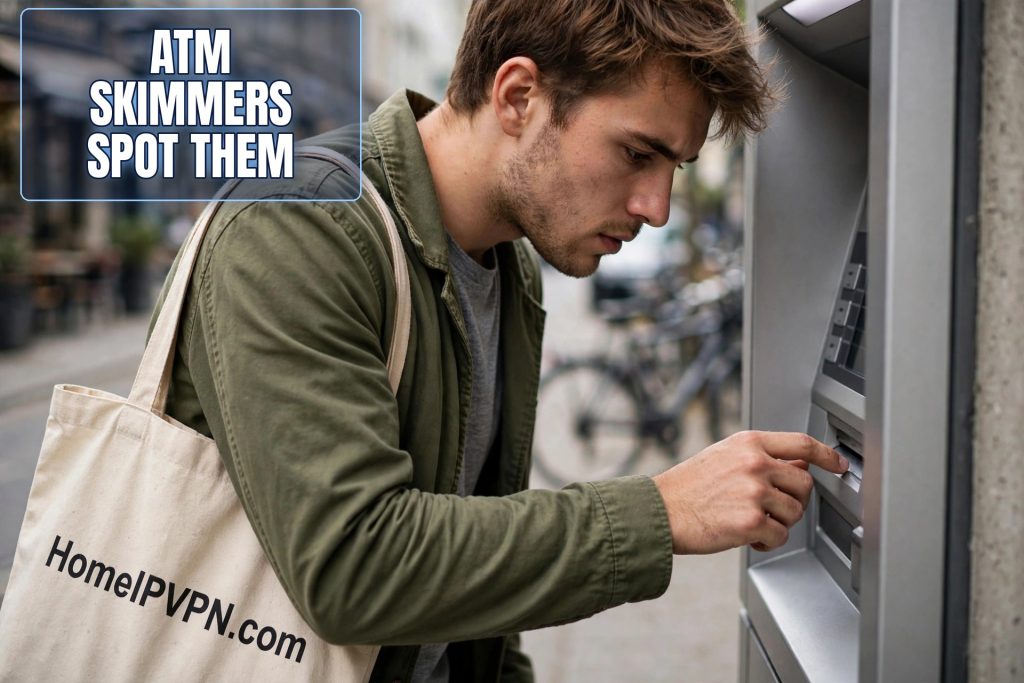
The ATM looked completely normal. It was on a busy street in broad daylight, attached to the wall of an actual bank, with a little queue of locals behind me. I did what everyone does: inserted my card, typed my PIN, took my cash, walked away thinking about lunch.
Three days later my bank called. Someone had withdrawn money from my account in a city I had never visited, using a cloned copy of my card. The machine I had used was fitted with a skimmer, a device I had walked right past without seeing, on a machine I had judged safe because it looked official.
Here is the thing nobody tells you until it happens to them: skimmers are designed to be invisible to people who are not looking. Once you know what to look for, the ten second inspection becomes automatic, like checking your mirrors before pulling out. This is that lesson, before it costs you.
What a Skimmer Actually Is
Forget the movie version with wires hanging out. A modern skimmer is a precision made piece of plastic, often 3D printed, shaped to fit exactly over the ATM’s real card slot. You slide your card in, it passes through the fake reader first, and the fake reader copies everything stored on the magnetic stripe: your card number, your name, the expiration date. The whole thing takes a fraction of a second, and the machine works perfectly normally, so you never suspect a thing.
The second half of the device gets your PIN. That is usually a tiny camera, hidden in a fake panel above the keypad, in the brochure holder, or in the light bar that runs across the top of the machine. Sometimes instead of a camera there is a fake keypad laid over the real one, thin enough that you do not notice the extra layer, recording every key you press. Card data plus PIN equals a working clone of your card, and the thieves can empty the account or sell the clone within hours.
There is also a low tech version worth knowing about: the Lebanese loop, a thin sleeve inserted into the card slot that traps your card inside the machine. You think the ATM ate your card. A helpful stranger appears, suggests you type your PIN again to release it, and watches you do it. Then after you leave, they pull out the sleeve with your card in it. If a machine ever keeps your card, do not type your PIN repeatedly, and do not let a stranger “help.” Call the bank number printed on the machine itself.
The 10 Second Inspection
Do this every time, at every machine, in every country, and it will become muscle memory. It takes ten seconds.
First, grab the card slot and try to wiggle it. Pull it gently. Twist it slightly. A real card reader is a solid piece of the machine, bolted into metal, and it will not move. A skimmer is a shell fitted over the top, held by glue or friction, and it will shift, wobble, or feel like loose plastic. If anything moves that should not move, walk away and use a different machine. Also look at the slot itself: does it look deeper than usual, like there is an extra tunnel your card passes through? Compare it to the machine next to it if there is one. Skimmers are usually only on one machine in a row.
Second, check the keypad the same way. Press the edges of the keypad surround. A fake overlay keypad will flex or lift at the corners. Look at whether the keys sit at a slightly odd height compared to what you expect. And no matter what, cover your typing hand with your other hand or your wallet every single time you enter your PIN. This one habit defeats every hidden camera ever installed, because a camera that cannot see your fingers is just a decoration.
Third, scan the machine’s face for anything that does not belong. A brochure holder that seems unusually thick. A small panel above the keypad with a pinhole in it. A strip along the top that looks added on. Extra mirrors or “security” attachments that seem designed to watch you rather than protect you. Trust the feeling of “that looks slightly off.” Your instincts about physical objects are better than you think.
Fourth, look around the machine, not just at it. Is someone standing a little too close behind you? Is there a person loitering who seems very interested in the ATM but never uses it? Shoulder surfing, simply watching you type your PIN, is the oldest method of all and still works. Stand close to the machine, keep your body between your hands and anyone behind you, and if someone crowds you, cancel the transaction and leave.
Choosing Safer Machines
Not all ATMs carry the same risk, and where you withdraw matters as much as how.
ATMs inside bank branches are the safest option, full stop. They are under cameras, inside a space the bank controls, and criminals have to walk past staff to tamper with them. Many banks leave their lobby ATMs accessible after hours with a card swipe at the door. Use those.
Next best are ATMs in busy, well lit, high traffic locations: inside shopping malls, airports, and hotels. Criminals installing skimmers want privacy and time. A machine with a constant stream of people and security cameras nearby is a bad place to spend five minutes fitting a fake card reader.
Avoid standalone machines in quiet spots: the lone ATM on a dark side street, the one in the corner of a deserted parking area, the portable machine at a festival or market. These are the easiest to tamper with and the hardest to verify. If it is the only option and you need cash, take the minimum and inspect it twice as carefully.
One more tip that experienced travelers swear by: use the same machine more than once. The first time you use an ATM in a new city, give it the full inspection. The second time, you will notice immediately if anything has changed, because you know what it looked like before. Familiarity is a security tool.
What to Do If You Suspect a Skimmer
If something wobbles or looks wrong, do not use the machine. Do not try to remove the device yourself (in some places tampering with an ATM, even a criminal device on one, can cause you legal trouble, and you do not know who is watching). Walk away, and tell the bank. If it is a branch machine, go inside and report it. If not, call the number printed on the machine or on the bank’s website.
If you already used a machine and later suspect it was compromised, call your bank immediately and ask them to watch the account for unusual activity, or to reissue the card. Check your transactions daily for the next few weeks; skimmers often test with a small charge before going for the big withdrawal. Set up transaction alerts on your banking app if you have not already, so every charge pings your phone in real time. A thief testing your cloned card at 4 a.m. is a lot less dangerous when your phone buzzes and you can freeze the card on the spot.
And consider what the card actually exposes. A debit card linked directly to your main account gives a thief access to everything. Many long term travelers keep a separate travel account with a limited balance and move money into it as needed, so the worst case is bounded. It takes an hour to set up and it caps the damage from any single incident, skimmer or otherwise.
The Other Half of Money Safety
Here is the part people miss: you can be perfect about physical ATMs and still get your money taken through the digital door. The same trip where you are carefully inspecting card slots is also the trip where you are logging into your bank over the hotel WiFi, checking balances on the cafe network, and approving transfers from connections you have never used before. Banks watch for unusual login locations just as closely as they watch for unusual card use, and a login from a foreign network can trigger the same kind of freeze as a suspicious withdrawal.
The principle is identical to the ATM inspection: use the familiar, trusted channel, not the random one. When your banking session comes from your own home IP address, through a HomeIPVPN home IP VPN, your bank sees the same login location it has always seen. No foreign network, no midnight hotel WiFi session, no reason for the fraud system to raise an eyebrow. It is the digital version of using the ATM inside the bank branch: the safe, boring, familiar option.
Physical vigilance plus a home connection covers both doors. Most travelers only guard one.
Guarding both doors, the card in your hand and the connection your logins travel over, is exactly the problem HomeIPVPN was built to solve: a home IP VPN that makes your internet look like home wherever you are, explained in plain English and set up for you. If you would rather have someone set it up and verify it works, the Pre-Travel Audit & Advisory session is 1 hour, costs $79, and that fee comes straight off the $279 Secure Home IP VPN System session if you go ahead.
Ten seconds at the machine, every time. Wiggle the slot, cover the PIN, and keep your money yours.