PRIVACY & SECURITY
The Taxi Driver’s ‘Broken Meter’ and Other Arrival Scams
Quick Answer The “broken meter” is the classic arrival scam: a taxi driver claims the meter does not work and quotes a flat fare that is three to five times the real price. The fix is simp
Quick Answer
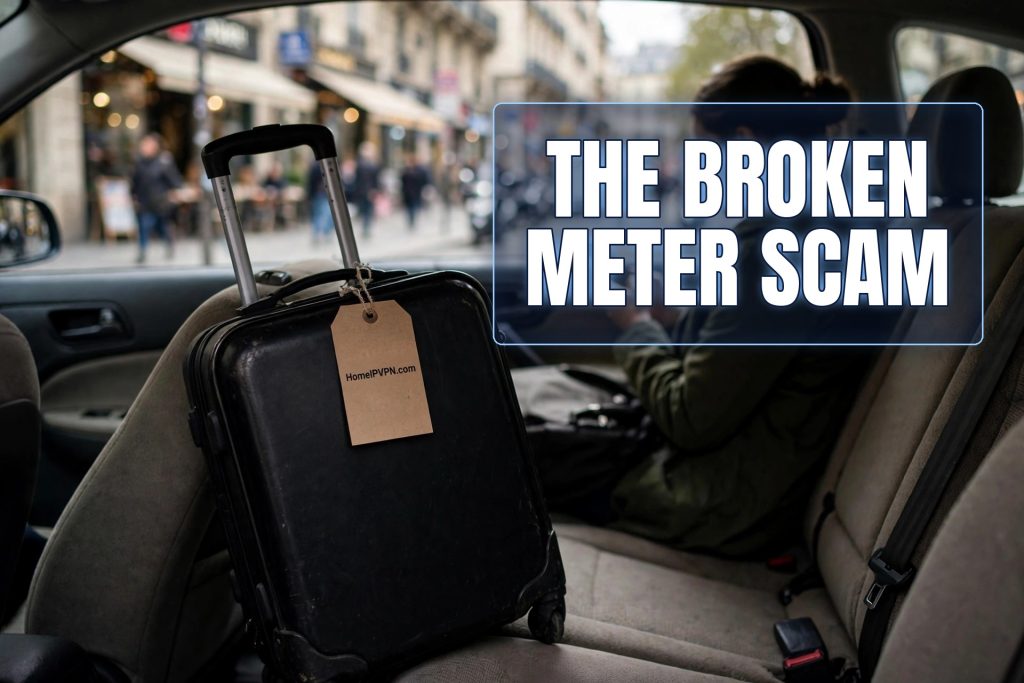
The “broken meter” is the classic arrival scam: a taxi driver claims the meter does not work and quotes a flat fare that is three to five times the real price. The fix is simple and works everywhere: agree on the price before you get in, use a ride hailing app when one exists, or walk past the touts to the official taxi rank.
- The broken meter: Driver taps the meter, shrugs, and names a flat price. Real price for the same trip would be a fraction of it. Always settle the fare before the doors close.
- The scenic route: The driver takes the long way while the meter runs. Having the route open on your own phone map ends this instantly.
- Why arrivals are targeted: You are tired, you do not know the local prices yet, and you just want to get to the hotel. Scammers know the first hour in a country is when your judgment is weakest.
- Protecting yourself on the road: Arrival scams are only the start; travelers also handle banking and accounts from unfamiliar networks, and HomeIPVPN gives you a home IP VPN so sensitive logins happen from a connection that looks like your own house.
The sliding doors opened onto heat, noise, and a wall of men holding signs. I had been awake for twenty two hours. My backpack weighed roughly as much as a small car. And the first man to reach me had the friendliest smile I had seen all day.
“Taxi? Where you go? My friend, very cheap.”
He quoted me a price for the ride into town that sounded reasonable, because I had no idea what reasonable was. I had not checked. I had not downloaded the local ride app. I had not even looked at a map. Twenty minutes later I was in a car with no meter, no seatbelt in the back, and a driver who had decided the “very cheap” price was just the starting point of a negotiation.
That was my education, and it cost me about forty dollars. Consider this post the cheaper version. These are the classic arrival scams, how each one works, and the calm, specific things you do instead.
The Broken Meter
This is the one everyone has heard of, and it still works because the script is so smooth. You get in, the driver starts driving, and at some point you notice the meter is dark. You ask about it. He taps it, shakes his head sadly, and says it is broken. Then he names a flat fare.
The flat fare is never fair. It is usually three to five times the metered price, sometimes more at night or from airports where he knows you have no alternative. If you argue, he has answers ready: traffic is bad, the meter rate would be higher anyway, the airport charges a fee. He is practiced. You are jet lagged. Guess who wins that argument.
The defense is boring and total: settle the price before you get in the car. Not after you are moving, not at the destination, before. Ask two or three drivers so you learn the real going rate within minutes. Better yet, check the price on a ride hailing app first, even if you do not use it, because the app’s estimate tells you what the trip should cost. A driver quoting five times the app price has just told you everything you need to know about him.
If a driver refuses to use a working meter where meters are the law, get out and find another car. There is always another car. The drivers who use their meters are usually parked right behind the ones who do not.
The Scenic Route
A close cousin of the broken meter, and harder to catch because the meter is running and everything looks legitimate. The driver simply takes the long way: the ring road instead of the direct road, a loop around the block, a “shortcut” that adds fifteen minutes. Each extra kilometer is money in his pocket, and you would never know, because you have never been to this city before.
The fix fits in your pocket. Open the route on your own phone before the car moves, and keep it open where the driver can see you watching it. You do not need to say a word. A driver who notices a passenger following the blue line on a map almost always drives the honest route, because the game is over before it started.
If you do spot a detour, stay calm and factual: “This does not look like the route to my hotel, can we take the direct road?” Said evenly, this resolves nearly every case. Drivers who are running a deliberate scam prefer confused passengers; a passenger who is clearly tracking the route is too much work, and they move on to easier targets.
The Helpful Tout With a Commission
Sometimes the scam is not the driver at all. It is the friendly person in the arrivals hall who “helps” you find a taxi, a hotel, or a tour. What you do not know is that he gets a cut of whatever you spend. The taxi he puts you in charges double. The hotel he recommends pays him for every guest he delivers, and the price you pay covers his commission. The “my cousin’s shop” he suggests on the way is a trap with inflated prices and aggressive salespeople.
None of these people are your friend, no matter how warm the smile. The rule is simple: never accept transport, accommodation, or shopping help from someone who approached you. Walk past the touts, out the doors, to the official taxi rank or the clearly marked ride hailing pickup point. The legitimate options are always a two minute walk away, past the gauntlet.
The same applies to the classic “your hotel is closed / overbooked / burned down, but I know a great place” line. Your hotel is fine. Call them yourself if you are worried. The tout’s great place pays him, and you will pay for that.
The Currency Confusion
You have just landed. You have not internalized the exchange rate yet. The numbers have too many zeros, or too few, and your brain has not calibrated. Scammers love this window, which lasts about a day.
The taxi driver quotes “fifty” and you hand over a fifty of the wrong denomination, or you pay in dollars or euros at a rate he invents on the spot. The money changer at the little booth with no posted rates gives you a rate that would make a banker weep. The restaurant near the station lists prices in a currency you do not recognize and does the conversion at whatever rate flatters them.
The defense is preparation, and it takes five minutes before you fly. Learn the rough rate: one dollar equals about X, so a coffee should cost about Y. Save a screenshot on your phone. Download a currency converter app that works offline. And for the first day, pay with a card where you can, because the card network’s rate, while not perfect, is honest, which is more than you can say for the man at the booth with the handwritten sign.
The Fake Official
This one is rarer but nastier. Someone in plain clothes flashes something that might be a badge and asks to see your wallet, your passport, or your bag, claiming to be police or tourist police checking for counterfeit money or drugs. While you are flustered, your cash disappears, either lifted directly or swapped for fakes.
Real police do not do random wallet inspections on tourists in the street. If someone claims to be an officer, you are allowed to ask for proper identification and to walk to the nearest police station or your hotel to sort it out. A real officer will accept this. A fake one will suddenly remember he is needed elsewhere. Never hand your wallet to a stranger, badge or no badge, and keep your passport in the hotel safe, carrying only a photo of it on your phone.
Staying Calm Is the Whole Game
Here is what ties all of these together: every arrival scam runs on the same fuel, which is your disorientation. Tired, unfamiliar, carrying everything you own, wanting nothing more than a bed. The scammers are not smarter than you. They just meet you at your weakest hour, and they have practiced.
So the master defense is not any single trick. It is arriving prepared. Before you land: know the rough taxi fare, have the ride app installed, screenshot the exchange rate, save your hotel’s address in the local language, and know that the official taxi rank is past the touts. Five minutes of preparation deletes ninety percent of these scams, because a prepared traveler is simply not worth the effort.
And keep the same careful mindset for the digital side of arrival. That first night in a new country is also when you are most likely to log into your bank over the hotel WiFi, check work email on an open network, or approve a payment from a connection you have never used before. Your accounts are just as exposed as your wallet in that first jet lagged hour. Doing sensitive logins from a connection that looks like home, through a HomeIPVPN home IP VPN, means your bank sees the same familiar login it always sees, not a strange foreign network at 3 a.m.
Looking like you never left, online and off, is the quiet superpower of the experienced traveler, and it is exactly the problem HomeIPVPN was built to solve: a home IP address that travels with you, set up in plain English with no technical background needed. If you would rather have someone set it up and verify it works, the Pre-Travel Audit & Advisory session is 1 hour, costs $79, and that fee comes straight off the $279 Secure Home IP VPN System session if you go ahead.
Walk past the touts, agree the fare first, and enjoy the ride. The scams only work on people who did not read the guide. You just did.