TROUBLESHOOTING
British Expats Are Losing Their UK Bank Accounts: What to Do Before Yours Goes
Quick Answer Barclays, Lloyds, and other UK banks have been closing accounts held by customers living abroad, mostly because post-Brexit rules make it expensive to serve customers in countries where t
Quick Answer
Barclays, Lloyds, and other UK banks have been closing accounts held by customers living abroad, mostly because post-Brexit rules make it expensive to serve customers in countries where the bank holds no license. If you keep a UK address on file, use the account regularly, and keep logging in from a familiar UK location, your account is far more likely to survive.
- Why it is happening: UK banks need a local banking license for every EU country they serve, and many decided expats were not worth the cost, so accounts got closed with a few months notice.
- Who is most at risk: Expats with no UK address on file, accounts that sit idle for months, and customers whose logins always come from abroad.
- What protects you: A current UK correspondence address, regular small transactions, and keeping your online banking active, ideally from a connection that looks like it is coming from home.
- Staying connected to home: Expats who manage UK accounts from abroad often run into location checks on banking, BBC iPlayer, and Sky Go, and HomeIPVPN gives you a home IP VPN so your logins look like they are coming from your own house in the UK.
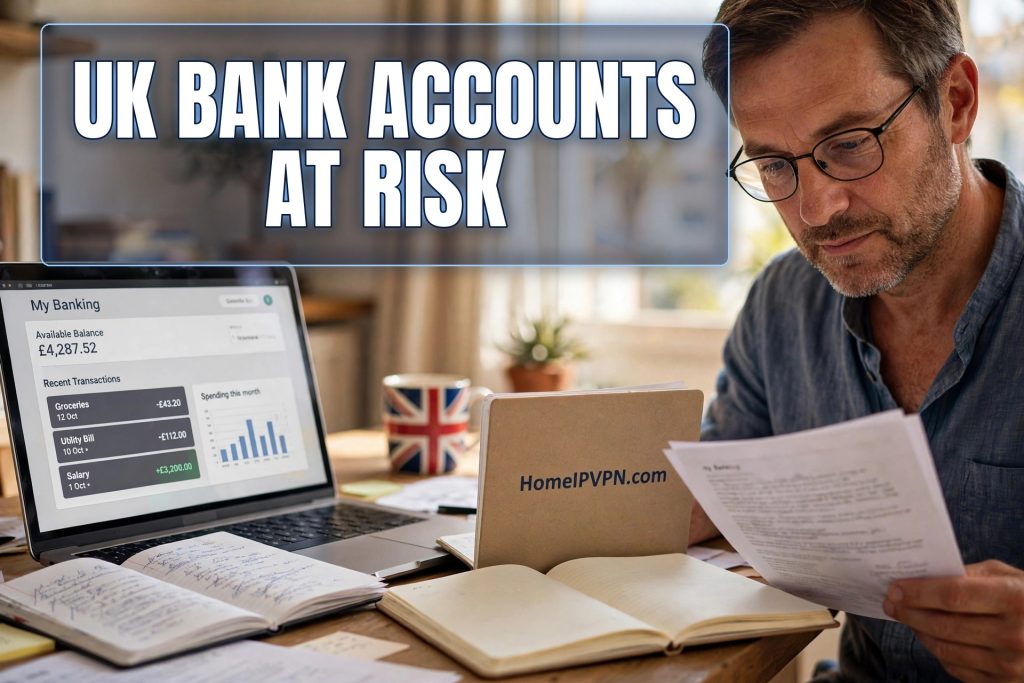
The letter arrived at her mum’s house in Leeds, which was the whole problem in one envelope. Two pages, polite and final: the bank was closing her current account in ninety days. Twelve years of banking history, gone, because she had moved to Lisbon eighteen months earlier and never quite sorted out the address thing.
She is not alone. Over the past few years, British expats have been getting these letters in waves. Barclays made headlines for closing accounts held by customers in the EU. Lloyds and Halifax followed with their own rounds. The forums are full of stories: people who have banked with the same institution since they were teenagers, suddenly told to make other arrangements, sometimes with only a couple of months to move direct debits, salaries, and savings somewhere else.
If you are British and living abroad, or planning to leave, this is the one you do not want to learn about from a letter. Here is why it is happening, who is most at risk, and what you can actually do before your account ends up on the list.
Why UK Banks Are Doing This
The short version is paperwork and money. Before Brexit, a UK bank could serve customers anywhere in the European Economic Area under a system called passporting: one license, good everywhere. When the UK left, that ended. A bank that wanted to keep serving customers living in, say, Spain or France now needed permission in each of those countries, and getting and keeping those permissions costs serious money.
For the big banks, the math was simple and cold. A customer living abroad who keeps a few thousand pounds in a current account and logs in twice a month is not worth the compliance cost of a foreign license. So the banks did the rational thing from their point of view and the brutal thing from yours: they started closing accounts where the account holder’s address was outside the UK.
It is not only an EU story either. Banks also review accounts held by customers in other parts of the world, and anti money laundering rules mean any account that looks unusual gets a closer look. An account registered at a UK address but only ever logged into from Thailand, with money moving in and out in foreign currencies, will eventually attract attention. The bank does not have to prove anything to close your account. In most cases, they just have to give you notice.
Who Is Most at Risk
The closure letters do not go out randomly. Certain patterns make an account stand out, and if you recognize yourself in this list, take it as an early warning.
First, no UK address on file. This is the big one. If your registered address is in another country, or the bank has figured out you live abroad because every login and every card transaction comes from overseas, you are in the highest risk group. Banks ask for proof of address precisely because residency is the thing they are checking.
Second, dormant accounts. An account you opened years ago and barely touch is easy for a bank to close, because you clearly do not need it. Ironically, the account you are “keeping just in case” is the one most likely to be taken away. Banks close idle accounts first because the complaints are quieter.
Third, logins that never come from the UK. Banks track where you log in from, and a customer whose every single session originates abroad looks like a customer who lives abroad, whatever the address on file says. This is not about any one login. It is about the pattern: eighteen months of sessions from Lisbon, zero from anywhere in Britain.
Fourth, returned post. If the bank sends a letter to your UK address and it bounces, that is a red flag that the address is not real. Using a relative’s address is common and often fine, but if nobody at that address opens your mail, you will miss the warning letter and the closure notice alike.
What to Do Before Yours Goes
Start with the address. If you have a genuine UK correspondence address, a parent, a sibling, a trusted friend, make sure the bank has it and make sure the person there actually opens your post and tells you about it. Some expats use mail forwarding services that provide a UK address and scan your letters. These exist precisely because of this problem, and they are worth the small monthly fee.
Next, use the account. Banks notice activity. A current account with a monthly standing order, a few direct debits, and regular card use looks like a living account. The account that receives one transfer a year and otherwise sits silent looks like a liability. Move a couple of small recurring payments through it: a streaming subscription, a charity donation, anything regular and legitimate.
Keep your contact details current. An up to date phone number and email address matter more than you think, because when the bank’s review team has a question about your account, they try to reach you first. The customers who get closed without warning are often the ones the bank could not reach. If your old UK mobile number is dead and your email is one you never check, fix both.
Log in from home when you can. This is the one people overlook. If every session comes from abroad, the bank’s systems quietly build a picture of a customer who has left. Logging in from a UK connection now and then, visiting the branch when you are back for Christmas, using the card for a purchase while visiting family, all of it adds up to a normal looking pattern. A HomeIPVPN home IP connection lets your online banking sessions come from your UK home address even when you are sitting in a flat in Lisbon or a cafe in Bangkok, which keeps your login pattern looking exactly like it always did.
And do the unglamorous admin. Read the terms and conditions changes the bank emails you (they are legally required to warn you before closures, and the warning usually hides in one of those emails). Keep a second account at a different bank as a backup, because if one bank closes you, you do not want to be starting from zero with no UK banking at all.
The BBC iPlayer and Sky Go Problem
Banking is the serious part, but there is a lighter frustration every British expat knows: the evening you settle in abroad, open BBC iPlayer, and get told the content is not available in your location. Same with Sky Go, same with Channel 4, same with half the UK services you used to take for granted.
The mechanism is the same one the banks use: your internet connection reveals where you are. These services are licensed to show content only to people in the UK, so they check every visitor’s location and block the ones that look foreign. It is not personal. It is just licensing.
The fix travelers use is also the same idea: make your connection look like it is coming from home. A home IP address in the UK is the gold standard here, because it does not look like the shared, obviously commercial addresses that these services have learned to block. It looks like an ordinary person sitting in an ordinary British house, which is exactly what you are, just temporarily somewhere else.
If the Letter Already Arrived
First, do not panic, and do not ignore it. You usually get two to three months, and that is enough time to act if you move quickly.
Open a replacement account immediately, before the old one closes, so your direct debits and salary have somewhere to go. If you still have a UK address, apply to another UK bank. If you do not, look at the banks and electronic money institutions that explicitly accept expat customers; some do, and they advertise it. The key is to apply while you still have an active account, because “please give me an account” is a much easier conversation when you are not already unbanked.
Move your direct debits one by one and confirm each has landed before the closure date. The UK’s Current Account Switch Service can move everything in seven days, but it works best when you initiate it with time to spare, not in the final week.
Finally, write back. A polite letter or secure message asking for reconsideration sometimes works, especially if you can show a UK address and a reason the account should stay. Banks do reverse these decisions occasionally. It costs you twenty minutes to ask.
Keeping Your Financial Home Base
Here is the uncomfortable truth underneath all of this: banks are allowed to decide you are too expensive to keep. They do not need your permission. The only real defense is to look, on paper and in practice, like a normal UK customer with a UK address, UK activity, and UK logins. Most of that is just admin discipline. The login part is the one that needs a technical answer, and it is a simple one.
Your bank, your iPlayer, your Sky Go: they all ask the same silent question, which is “are you at home?” Everything else follows from the answer. Keeping that answer consistent, month after month, from wherever you actually are, is what keeps the letters from arriving.
This quiet battle, looking like you never left while living somewhere else entirely, is the problem HomeIPVPN was built to solve, with a home IP VPN set up in plain English for people who never want to think about networks. If you would rather have someone set it up and verify it works, the Pre-Travel Audit & Advisory session is 1 hour, costs $79, and that fee comes straight off the $279 Secure Home IP VPN System session if you go ahead.
Sort the address, keep the account alive, and check your mum’s post pile now and then. The letter you open yourself is always better than the one you hear about too late.