PRIVACY & SECURITY
The Hotel Front Desk Call Scam: “We Need Your Card Again”
Quick Answer The hotel front desk phone scam is a late night call to your room from someone pretending to be the front desk, saying they need your card number again to fix a payment problem. Real hote
Quick Answer
The hotel front desk phone scam is a late night call to your room from someone pretending to be the front desk, saying they need your card number again to fix a payment problem. Real hotels never ask for card details over the phone, so the whole scam collapses if you offer to come downstairs instead.
- How it sounds: “This is the front desk, our card machine is having trouble with your booking, can you read me your card number to reconfirm?” The voice is calm, polite, and in a hurry.
- Why it works: The call comes through the room phone, so it feels official. You are half asleep, maybe jet lagged, and your guard is completely down.
- The one question that stops it: “Can I come down to the desk and sort this in person?” A real employee will always say yes. A scammer will push you to just read the number over the phone.
- The bigger picture: Scams like this are one more reason travelers keep sensitive money tasks behind a connection that looks like home, and HomeIPVPN sets up a home IP VPN so your banking and logins happen from your own house instead of a foreign hotel room.
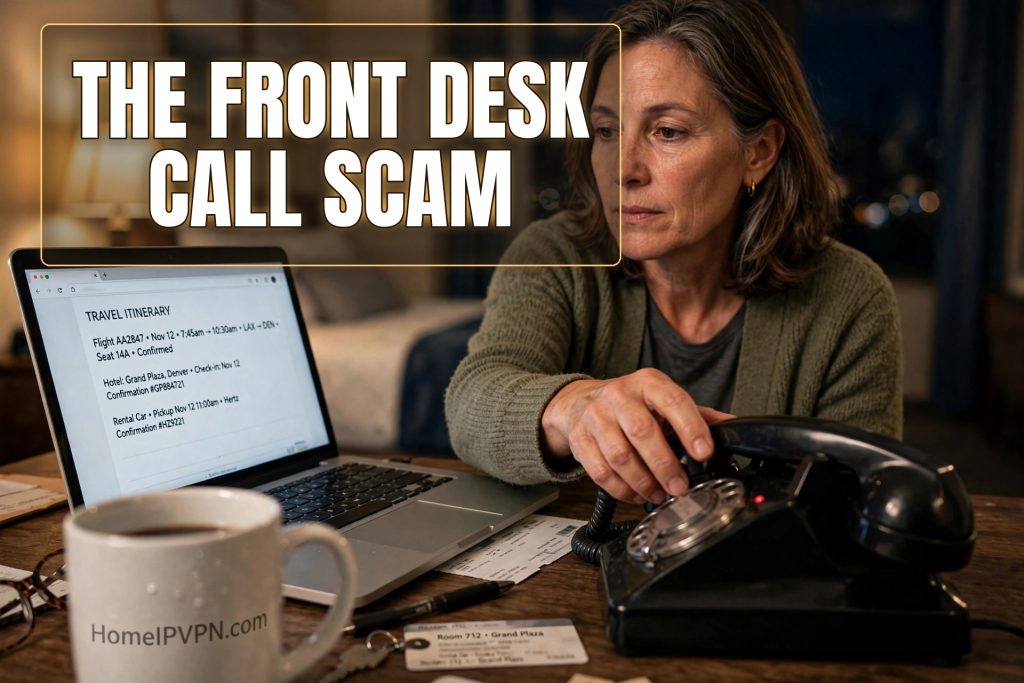
The phone rang at 2:14 in the morning. I know the exact time because I stared at it on the nightstand clock while the ringing cut through the weird half sleep you get on the first night in a new time zone. I had landed in Kuala Lumpur about six hours earlier. My body thought it was still afternoon back home. My brain was soup.
“Hello, front desk,” said the voice, smooth and unhurried. “I apologize for calling so late. We are having a small problem with your card payment and the system will not let me check you in for tomorrow. Could you please read me your card number so I can reconfirm?”
I was halfway to sitting up and reaching for my wallet before the rational part of my brain woke up. They were calling me. They already had my card, because I had paid a deposit when I booked. Why would the front desk need it again at two in the morning? I mumbled something about coming downstairs, and the line went dead so fast it was almost funny.
That call is one of the oldest tricks in the travel world, and it is still working on people every single night. Here is how it works, why it works, and the one simple response that shuts it down completely.
How the Call Usually Goes
It almost always happens late at night or very early in the morning, and that is not a coincidence. The scammer wants you groggy. A sharp, well rested traveler might spot the problem right away. A traveler who crossed eight time zones that day is running on fumes, and fumes do not question things.
The setup is simple. Someone calls your room phone, either by guessing the room number, by watching the front desk write it down, or in some cases by having an inside connection at the hotel. When you pick up, they identify themselves as the front desk, the night manager, or the reservations department. They apologize for the late hour, which is a nice touch, because the apology makes them sound more legitimate.
Then comes the problem. The card on file was declined. The booking system glitched. The deposit did not go through. The story changes, but the ask is always the same: read out your full card number, expiration date, and the three digits on the back. Sometimes they ask for the name exactly as it appears on the card too. In two or three minutes, they have everything they need to start spending your money.
There is a nastier version where the caller says there is an issue with your account and asks you to “verify” a code that was just texted to your phone. That code is real, it is your bank’s fraud check, and it was triggered because the scammer is already trying to use your card number. Read that code aloud and you have just approved the theft yourself. Never read a code from your bank to anyone on the phone. Ever.
Why It Works So Well on Tired Travelers
Think about the signals your brain uses to decide whether someone is trustworthy. A familiar voice, a familiar setting, a reasonable sounding request. This scam ticks all three boxes. The call comes through the hotel’s own phone system, so it shows up as a room call, not a random number. The person sounds professional. The request sounds boring and administrative, not scary. Nothing about it triggers alarm bells, especially at 2 a.m.
There is also the politeness trap. Most of us are people who cooperate. When an authority figure (and the front desk is an authority figure when you are a guest) asks for something small, our default is to help. Scammers count on that. They also count on speed. The caller creates a gentle sense of urgency: the system needs it now, the booking might be cancelled, there could be a charge for the late checkout. Not panic level, just enough pressure to keep you from pausing to think.
And then there is the simple math of travel. You are in a place where you do not know the norms. Maybe hotels in this country really do call about payments at night. Maybe the card machine really is glitchy. When you are far from home, “that seems weird” turns into “maybe that is just how things work here” far too easily. I have watched experienced travelers, people who travel for a living, nearly fall for this one. The first night in a new country is when all of us are at our most suggestible.
The One Question That Stops It Cold
Here is the entire defense, and it fits in one sentence: “Thanks, I will come down to the desk and sort this in person.”
That is it. Memorize it. A real front desk employee will always say yes to this. If there is a genuine payment problem, they would much rather deal with it face to face at the counter, with their actual card terminal, than collect card numbers over the phone. Hotel staff are trained never to take full card details by phone because of the exact liability this creates.
A scammer, on the other hand, will never agree to this. Meeting you in person is the one thing they cannot do. So they will stall, deflect, or pressure you. “No, that is not necessary, this will only take a minute.” “The desk is very busy right now.” “If you come down we may lose the room.” Any version of “please just read the number” is your answer. It is not the front desk.
And when they push, just hang up. You owe a stranger on the phone nothing. No explanation, no politeness, no second chance. Hang up, and if you are worried there might be a real payment issue, call the front desk yourself using the number on the hotel’s card or the lobby directory, or walk downstairs. When you do, tell them about the call. Good hotels want to know this is happening because it is their guests getting targeted, and some will warn other guests or check their own staff.
What to Do If You Already Gave the Number
No shame in this. It has happened to careful people. What matters is speed now, because the scammer will use or sell those details quickly, often within hours.
First, call your bank immediately and tell them the card number was given to a suspected scammer. Do not downplay it. The words to use are simple: “I believe my card details have been compromised, please block the card and issue a new one.” The bank deals with this every day. They will freeze the card, review recent charges, and reverse anything fraudulent. Ask them to confirm there are no pending transactions you do not recognize.
Second, check your other accounts. If you use the same card for subscriptions, travel bookings, or automatic payments, make a list so you can update them when the replacement card arrives. This is the annoying part, and it is why having a backup card from a different bank is one of the smartest things a frequent traveler can do. One frozen card should never strand you.
Third, if you gave any personal details beyond the card (passport number, home address, phone number), consider that information exposed and act accordingly. You may want to put a fraud alert on your credit file, which in most countries is free and takes a few minutes.
Fourth, report it. Tell the hotel management in writing, and file a report with the local police if the hotel suggests it. You probably will not get your money back through the police, but reports are how patterns get noticed. If the same hotel gets five reports of late night card calls, something happens.
How to Make Yourself a Harder Target
A few habits shrink your exposure to this and scams like it. None of them are difficult.
When you check in, ask the front desk directly: “Will you ever call my room about payment?” Most will look surprised and say no, which is a useful baseline. Some travelers also ask the desk not to forward outside calls to their room, which kills this scam entirely because the scammer can never reach the room phone in the first place.
Keep your room number private. Do not say it out loud in the lobby, do not leave the key card sleeve with the number printed on it lying around, and be careful who overhears when you tell a taxi driver your hotel. Scammers who know your room number can reach your room phone.
For money tasks on the road, use the same rule you would at home: never do sensitive banking over a connection you do not trust. Hotel WiFi is a shared network run by strangers, and it is exactly the kind of place where your login session is most exposed. When you sit down to check your accounts or move money, you want that session to look like it is coming from your own house. HomeIPVPN gives travelers a home IP address wherever they are, so your bank sees the familiar login from home instead of a foreign hotel network at midnight.
And the oldest rule of all: the bank, the hotel, and the airline will never call you out of the blue and ask you to read out card numbers or codes. Anyone who does is either a scammer or doing something so wrong that hanging up is still the right move.
The Root of It
The front desk call scam is really a story about being cut off from home. You are in a strange bed, in a strange city, half asleep, and someone uses your own hotel’s phone against you. The defense is wonderfully simple: deal with money in person, at the counter, face to face, never over the phone with a voice you cannot see.
That instinct, keep the important stuff where you can see it and verify it, is worth carrying into the rest of your travel life. Your banking, your work logins, your accounts: all of them are safer when they happen from a connection you control and recognize instead of whatever network happens to be nearby. The scammer’s whole trick is making the unfamiliar feel familiar. Your best counter is keeping the familiar actually familiar.
If handling all of this from the road sounds like a lot, that is because it is, and it is exactly the problem HomeIPVPN was built to solve: making your internet connection look like home no matter where you actually are, explained in plain English and set up for you. If you would rather have someone set it up and verify it works, the Pre-Travel Audit & Advisory session is 1 hour, costs $79, and that fee comes straight off the $279 Secure Home IP VPN System session if you go ahead.
Sleep well tonight. If the phone rings at 2 a.m., let it ring, and deal with it downstairs in the morning, in person, with your eyes open.