PRIVACY & SECURITY
The Money Exchange Rip-Off: Street Rates vs. Real Rates
Quick Answer The money exchange rip off works by quoting you a rate far worse than the real market rate, then hiding the difference behind fees, “no commission” signs, and fast talking. Be
Quick Answer
The money exchange rip off works by quoting you a rate far worse than the real market rate, then hiding the difference behind fees, “no commission” signs, and fast talking. Before you exchange anything, check the real rate on your phone, do the math for the amount you are changing, and walk away from any booth that will not show you the exact amount you will receive before you hand over your money.
- Know the real rate: Check the mid market rate on your phone before you approach any booth. That number is your anchor; every honest exchange will be close to it.
- Watch the tricks: “No commission” usually means the fee is baked into a terrible rate. Buy and sell rates get swapped on the sign. The rate on the big board is not always the rate for your currency.
- The street money changer: The man offering a “better rate” on the street is offering counterfeit bills, a rigged count, or a robbery setup. Never exchange money with strangers outside a licensed booth.
- Handling money safely abroad: Exchange counters are only one way travelers lose money; unfamiliar networks put your accounts at risk too, and HomeIPVPN provides a home IP VPN so your banking logins come from your own house instead of a foreign connection.
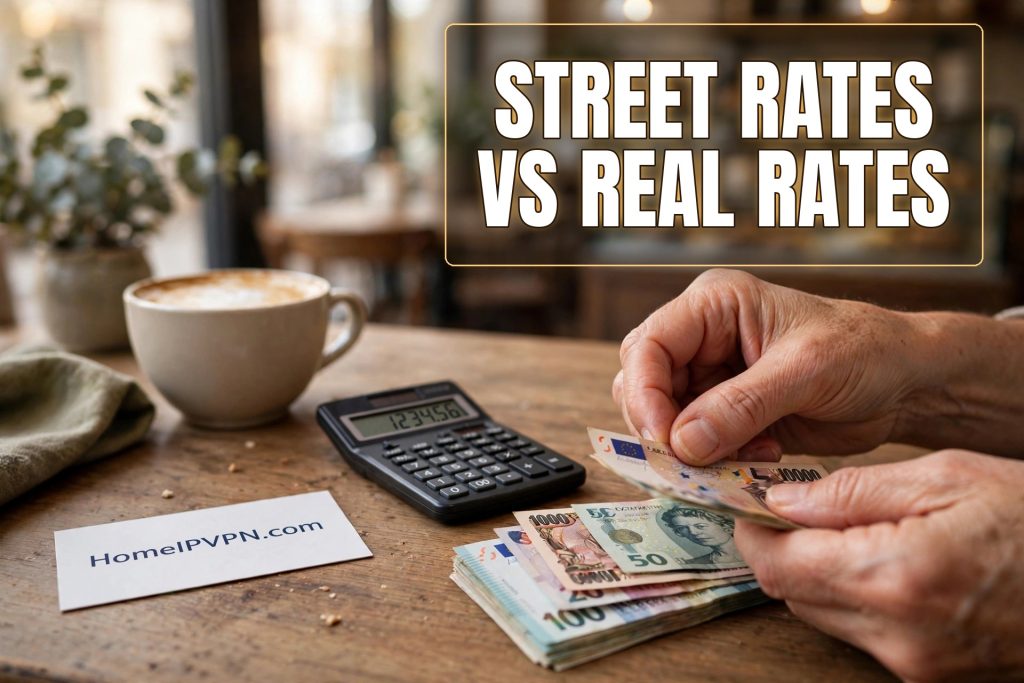
The sign said NO COMMISSION in letters a foot high, and the rate on the board looked fine, or at least it looked fine to someone who had landed four hours earlier and had not yet learned what the local money was actually worth. I handed over two hundred dollars. The man counted out a stack of unfamiliar bills, smiled, and slid them across the glass.
It was not until I was sitting in a taxi, doing the math properly for the first time, that I realized what had happened. The “rate” on the board had been the rate for buying dollars, not selling them. The “no commission” sign was technically true and completely meaningless, because the fee was baked into an exchange rate about twelve percent worse than the real one. On two hundred dollars, I had paid roughly twenty four dollars for the privilege of standing at that counter. The smile had been free.
Currency exchange is one of those things that feels like it should be simple and turns out to be a minefield of small print, fast talk, and outright cons. Here is how the game works and how to stop losing it.
What the Real Rate Is (and Why Nobody Gives It to You)
Every currency pair has a real market price, called the mid market rate. It is the rate banks use when they trade with each other, and it is the number you see when you search for an exchange rate on your phone. Think of it as the wholesale price of money.
Nobody exchanging cash for travelers gives you the wholesale price, and that is fair. The booth has rent to pay and staff to employ. An honest exchange takes a small cut, usually one to three percent off the mid market rate, and shows you clearly what you are getting. The problem is everything beyond that: the booths taking eight, ten, fifteen percent, and the tricks they use to make you think you got a good deal.
Your phone is the entire defense here. Before you walk up to any counter, check the mid market rate and do the math for the amount you are changing. If the real rate says your two hundred dollars should buy roughly X of the local currency, and the booth is offering you fifteen percent less than X, you are looking at a rip off wearing a friendly sign. Write the expected number on your phone’s notes app so you have it in front of you at the counter. Jet lag makes mental math unreliable, and the booths know it.
The Classic Tricks
The buy sell swap is the most common. Exchange boards show two rates: the rate at which the booth buys your foreign currency, and the rate at which it sells foreign currency to you. You are selling dollars, so you want the buy rate. Dishonest booths display the sell rate in big bright numbers and the buy rate in tiny print, or they simply point at the wrong number when you ask. Always confirm: “How much local currency will I get for two hundred dollars?” Make them state the final number, not the rate.
“No commission” is the most successful lie in the industry. It sounds like a promise of a good deal. What it actually means is that there is no separate fee, because the fee is hidden inside a worse exchange rate. A booth advertising no commission with a bad rate is more expensive than a booth charging a small flat fee with a good rate. Ignore the signs. Do the math.
The dynamic currency trick appears when you pay by card: the terminal offers to charge you in your home currency “for convenience.” The convenience costs you, because the merchant’s exchange rate is always worse than your card network’s rate. Always choose to pay in the local currency and let your own bank do the conversion.
Then there is the short count, which is just old fashioned theft. The cashier counts your money quickly, palms a bill or two, and counts again with a flourish. Count your money yourself, at the counter, before you walk away, every time. If the count is short, say so immediately and calmly. Once you leave the counter, your leverage is gone.
The Street Money Changer
In many cities, a man on the street will offer you a rate better than the booths. He is friendly. He shows you a thick stack of real looking bills. The rate genuinely looks amazing. This is a trap, and it has three common endings.
Ending one: the bills are counterfeit. They look right at a glance, especially in a currency you barely know, and you discover the truth when a shopkeeper refuses them or, worse, calls the police. Ending two: the count is rigged. He counts the money in front of you, does a sleight of hand fold, and hands you a stack missing a third of what you agreed on. By the time you count it, he is gone. Ending three, the worst: the “exchange” is a setup for a robbery, with his partner waiting around the corner once they know you are carrying cash.
There is no version of this story where the stranger on the street gives you a genuinely good deal out of kindness. Licensed booths exist for a reason. Banks exist for a reason. ATMs attached to banks exist for a reason. The few percent you might save with the street changer is not worth any of the three endings above. Walk past him the way you walk past the taxi touts.
How to Actually Get a Fair Rate
The boring truth is that the best rates come from the least exotic methods. A debit card withdrawal from a bank ATM usually gives you something close to the mid market rate plus your bank’s foreign transaction fee, which for many travel friendly accounts is zero or tiny. That is hard to beat, and it beats every booth in the airport by a wide margin.
If you need cash and prefer a booth, go where the locals go, not where the tourists go. The booth in the arrivals hall pays the highest rent in the city and you are paying it. Walk ten minutes into town and the rates improve dramatically. Booths in commercial districts with posted rates for many currencies, serving local businesses, are consistently fairer than the ones with flashing NO COMMISSION signs next to the souvenir shops.
Change money in sensible amounts. Changing a little at a time means a bad rate costs you a little. Changing your whole trip’s budget at once at the first booth you see is how people lose real money. And keep the receipt. In many countries you need it to change leftover currency back at the end of the trip, and it is your only proof of what rate you actually got.
Finally, consider how much cash you actually need. In most of the world now, cards work nearly everywhere, and every cash exchange is a transaction where someone takes a cut. The travelers who lose the least to exchange games are the ones who mostly do not play: card for everything, small cash withdrawals from bank ATMs for the rest.
The Money You Cannot See Leaving
Here is the part that does not involve a booth at all. While you are standing at that counter doing mental math, your phone is in your pocket, connected to the airport WiFi, with your banking app logged in. The same trip that exposes you to exchange tricks exposes your accounts to unfamiliar networks: hotel WiFi, cafe networks, airport hotspots, all shared with strangers, all in countries your bank has never seen you in before.
Banks notice this. A login from a foreign network can trigger the same fraud alerts as a suspicious card charge, and plenty of travelers have had accounts frozen not because of anything they did wrong, but because their bank saw logins hopping across countries and decided to play it safe. The exchange booth takes a cut of your cash; a frozen account takes all of it, temporarily.
The fix is the same principle as choosing the bank ATM over the street changer: use the trusted, familiar channel. When your banking sessions come from your own home IP address through a HomeIPVPN home IP VPN, your bank sees the same login location it has always seen, no matter which country you are standing in. It is the digital equivalent of banking at your own branch instead of a stranger’s counter.
Keeping your money safe abroad has two halves: the cash in your pocket and the accounts on your phone. Guard both, and the trip gets a lot cheaper.
That double protection, your money and your connection, is exactly the problem HomeIPVPN was built to solve: a home IP VPN that makes your internet look like home wherever you are, explained in plain English and set up for you. If you would rather have someone set it up and verify it works, the Pre-Travel Audit & Advisory session is 1 hour, costs $79, and that fee comes straight off the $279 Secure Home IP VPN System session if you go ahead.
Check the rate, count the cash at the counter, and walk past the man on the street. Your money will thank you.