REMOTE WORK & DIGITAL NOMAD
Bali Power Outages: How Remote Workers Keep Working When the Lights Go Out
The fan stopped first. Then the little green light on the WiFi router blinked out. Then the whole villa went dark, and I sat there in a quiet room in Canggu…
✓Why Bali’s Power Goes Out So✓The Hotspot Habit: Your Phone Is✓Power Banks and Chargers: The
Quick Answer
Bali’s power outages are common and usually short, but they can knock out your WiFi mid-meeting. A phone hotspot with a local SIM, a charged power bank, and a known coworking space with a generator turn a blackout from a crisis into a coffee break.
- Keep a backup connection ready: a local SIM with a data plan means your phone becomes your office WiFi the moment the lights go out.
- Know your escape routes: identify one coworking space or cafe with a generator near where you live before you ever need it.
- Charge everything by default: power banks, laptops, and phones stay topped up so a surprise outage never catches you at 5 percent.
- Work like you never left home: HomeIPVPN helps you keep your home-country connection reachable even when you are working around Bali’s unreliable power grid.
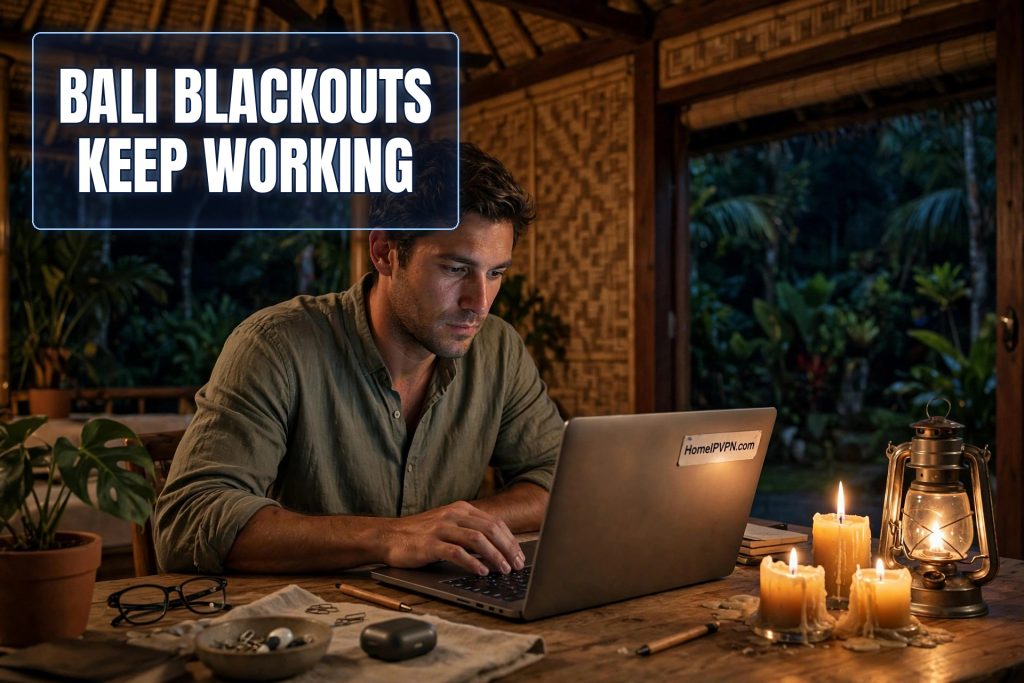
The fan stopped first. Then the little green light on the WiFi router blinked out. Then the whole villa went dark, and I sat there in a quiet room in Canggu staring at my laptop screen with four minutes left before a client call I had been dreading for a week.
That was my introduction to Bali’s power grid. Nobody had warned me, or maybe they had and I had not listened, the way you do not listen to the sunscreen warnings until the first sunburn. Within a month I had lived through maybe a dozen outages. Some lasted twenty minutes. One lasted most of an afternoon. All of them taught me the same lesson: in Bali, electricity is a suggestion, not a promise.
If you are planning to work from Bali, or you are already there watching the lights flicker every time a storm rolls over the rice fields, this is the practical guide I wish someone had handed me on day one. No electrical engineering required. Just the habits, gear, and backup plans that keep remote workers earning when the grid takes a break.
Why Bali’s Power Goes Out So Often
Let me start with the reassuring part. Bali’s blackouts are almost never a sign of anything catastrophic. They are the normal behavior of an island grid that was built for a sleepy tourist destination and then had to power one of the world’s busiest remote-work hubs.
The outages come in a few flavors. The most common is the short neighborhood cut, maybe twenty to forty minutes, when the local utility (PLN) does maintenance on lines or a transformer trips during heavy load. Everyone’s air conditioning, the cafes’ espresso machines, and a few thousand laptops all draw power at once in the heat of the afternoon, and somewhere a breaker says enough.
Then there are the storm outages. Bali’s rainy season, roughly October through March, brings sudden downpours that can knock out power for a couple of hours. Lightning hits a line, a palm frond takes down a wire, a flooded substation needs to dry out. These are less predictable but usually well announced by the sky turning an alarming shade of green.
And then there is Nyepi, Bali’s Day of Silence, which comes once a year (usually in March) and is worth mentioning because it is the one planned outage nobody can work around. The whole island shuts down for 24 hours. No lights, no going outside, no flights, no internet. It is beautiful and strange and you will not be working that day. Plan around it.
What surprised me most was how casually the locals treated it all. A power cut in a Canggu cafe just meant the barista switched to making drinks by hand and someone produced a candle from behind the counter like it had been waiting there all along. The panic was mine alone. Over time I learned to borrow their calm, with a few systems of my own underneath it.
The Hotspot Habit: Your Phone Is Your Real Office
The single most important thing I can tell you is this: in Bali, your backup internet connection matters more than your primary one. The villa WiFi might be fast and the fiber connection solid, but fiber means nothing when the router has no electricity. Your phone, on a local SIM with a generous data plan, keeps working through all of it, because the cell towers mostly have their own backup power.
I bought a Telkomsel SIM at the airport my first day, and it was the best 150,000 rupiah (about ten dollars) I spent that month. I got a plan with a big data allowance and just left it in my phone permanently. The moment the lights went out, I turned on my hotspot, reconnected my laptop, and kept working like nothing had happened. That first client call, the one I thought the outage would destroy? I took it from my phone hotspot on my villa’s porch, and the client never knew a thing.
A few things worth knowing about the hotspot habit. First, hotspotting drains your phone battery fast, so this pairs with a charged power bank (more on that below). Second, mobile data speeds in the main nomad areas, Canggu, Ubud, Uluwatu, Seminyak, are genuinely fine for video calls most of the time. You will not be streaming in 4K, but a Zoom call works. Third, buy more data than you think you need. It is cheap, and running out of data during an outage is a special kind of frustration.
Fourth, and this matters: test your hotspot before you need it. The week you arrive, sit at your desk and switch your laptop from WiFi to your phone hotspot for one normal workday. Learn how it feels, how long the battery lasts, which apps behave differently. Then when the outage comes, it is routine instead of a scramble.
Power Banks and Chargers: The Unsexy Essentials
Here is a truth about blackouts that nobody mentions until you have lived through one: the outage itself is rarely the problem. The problem is that your laptop was at 12 percent when it hit, because you had been meaning to plug it in.
Bali taught me to keep everything charged as a lifestyle, not a chore. My rule was simple. Laptop stays above 60 percent during work hours, always. Phone stays above 50 percent, always. It became as automatic as looking both ways before crossing the chaotic little streets of Canggu. When an outage hit, I had hours of work left in my devices instead of minutes.
The power bank is the real hero of this story. I carried a big one, 20,000 mAh, which sounds technical but just means it could charge my phone about four times or keep my laptop alive for a couple of extra hours. It lived in my work bag and came with me to every cafe. On days the grid was acting up, I charged the power bank whenever I found an outlet, like a squirrel storing nuts.
One more piece of gear that earned its place: a good universal adapter with multiple ports. Bali uses the standard two-round-pin plugs (Type C and F, like much of Europe), but the real value is having one adapter with three or four USB ports so a single working outlet charges your laptop, phone, and power bank at once. In a cafe during a brownout, when outlets with actual power become prime real estate, that multi-port adapter makes you the most popular person at the table.
Know Your Escape Routes Before You Need Them
There are levels to the backup plan. Your hotspot and power bank handle the short outages, the twenty to forty minute ones. But when the power stays out for hours, or when you have a day packed with video calls, you need somewhere to go.
Every nomad area in Bali has coworking spaces with generators, and knowing your nearest one is like knowing where the fire exits are. In Canggu, the big coworking spaces all have generator backup and keep the WiFi running through outages. In Ubud, the same. Most of them sell day passes, usually around 150,000 to 250,000 rupiah (ten to sixteen dollars), and honestly a day pass during a blackout is the best money you will spend that week.
Here is my advice: do not wait until the blackout to discover these places. In your first week, visit two or three coworking spaces near you. Buy a day pass, work a normal day, learn the layout. Notice which ones have generators (ask the staff, they will know and they are proud of it). Notice how far they are from your villa and how you would get there in the rain. When the lights go out at 9am and you have a 10am call, you want to already know exactly where you are going.
Cafes are the lighter version of the same plan. Many of the bigger cafes in Canggu and Ubud have generators or at least keep running on battery backup for a while. The trick is knowing which ones. Ask other nomads. The answer is always known, always shared, and always changing as places open and close. This is the kind of local knowledge that flows through every WhatsApp group and coworking kitchen in Bali.
The Rainy Season Survival Routine
If you are working in Bali from October through March, outages get more frequent and longer. This is when the backup habits become a daily routine rather than an emergency plan.
My rainy season routine looked like this. Every morning I checked the sky and my battery levels with the same glance. Every device fully charged before the afternoon storms, because outages clustered around 2pm to 6pm when the rain hit hardest. I kept my work bag packed with the power bank, the multi-port adapter, my headphones, and a rain cover, so I could grab it and relocate in ninety seconds if the power died and the generator cafe was calling.
I also learned to front-load important calls to the morning. If you can choose when your critical meetings happen, mornings in Bali are more reliable for both power and internet. The afternoon storms are beautiful from a cafe with a working generator, but they are a terrible time to be mid-presentation on villa WiFi.
And I downloaded offline versions of everything I might need. Key documents, the slides for upcoming calls, the files I was editing. Most tools let you do this with a toggle, and it means that even in a total connectivity blackout, I could keep writing, keep reviewing, keep working. When the connection came back, everything synced. It felt like having a time machine.
What About My Home-Country Accounts During All This?
There is a second layer to the Bali blackout story that most guides skip, and it has nothing to do with electricity. When your power is out and you are hotspotting from a phone, you are connecting through an Indonesian mobile network. To your bank back home, your employer’s systems, and every service that watches logins for fraud, you suddenly look like a different person in a different country than you were an hour ago.
I learned this the awkward way. Mid-outage, hotspotting from my phone, I tried to log into my bank to approve a transfer, and the bank locked me out with a fraud alert. The timing could not have been worse. I had to call the bank’s international line, verify my identity over a crackling connection, and explain that yes, it was really me, I was just sitting on a porch in Indonesia because the power was out.
The deeper fix is to make your connection look the way it always looked. That is the whole idea behind HomeIPVPN: your traffic goes through your own home internet connection, so wherever you physically are, your logins come from the address your bank and your employer already know and trust. The blackout problem needs hotspots and power banks, and those are covered above. But the “my bank thinks I am a different person” problem is solved by looking like you never left home in the first place, even when the lights go out in Bali.
In practice, this means your routine becomes: outage hits, hotspot goes on, and your home-IP connection reconnects over the phone data just like it did over the villa WiFi. Same address. Same trust. One fewer emergency to deal with while you are sitting in the dark.
A Word on Expectations (and Enjoying It)
After a few months, something shifted for me. The outages stopped feeling like emergencies and started feeling like rhythm. The lights would go out, and instead of a spike of panic I would feel something closer to relief. Oh good, a forced break. I would make tea, sit on the porch, watch the geckos come out, and answer emails from my phone until the hum of the air conditioner came back.
I am not romanticizing it. A four-hour outage during a deadline week is genuinely stressful, and you should have every backup in this guide ready. But there is something the locals understand that took me a while to learn: the grid going down is also a reminder that you came to Bali to live differently. The island has a way of insisting on pauses, and sometimes the pause is exactly what the work needed.
So pack the power bank, buy the SIM, learn the generator cafes, and charge everything like your income depends on it, because it does. Then, when the lights go out and your laptop hums on happily through your phone hotspot, let yourself enjoy the small victory. You are working through a blackout on a tropical island, and your client on the call has no idea. That is a particular kind of nomad magic.
When the Problem Is Bigger Than a Power Cut
Blackouts are a solvable logistics problem, and the habits above solve them. But they sit inside a bigger pattern that is worth naming: working from Bali means your whole digital life is running through connections that are nothing like the home internet your bank, your employer, and your clients expect. Looking like you never left home is the problem HomeIPVPN was built to solve, in plain terms, your logins come from your own home address no matter where the power is out.
If you would rather have someone set it up and verify it works, the Pre-Travel Audit & Advisory session is 1 hour, costs $79, and that fee comes straight off the $279 Secure Home IP VPN System session if you go ahead.
May your batteries stay full, your hotspot stay fast, and your calls stay blissfully unaware of the darkness outside.