REMOTE WORK & DIGITAL NOMAD
Indonesia’s Remote Worker Visa (E33G): Requirements Without the Jargon
For years, the standard Bali move was the visa run. Fly to Singapore or Kuala Lumpur for a weekend, come back, get a fresh stamp, repeat until immigration…
✓What the E33G actually is✓The income requirement, in real✓The rest of the paperwork
Quick Answer
Indonesia’s E33G remote worker visa lets you live and work remotely in Indonesia for up to one year, renewable for one more. The headline requirement is proof of income of at least 60,000 US dollars per year from sources outside Indonesia, plus a valid passport, health insurance, and a clean record. It does not allow working for Indonesian companies.
- Income bar: You must show at least $60,000 USD in annual income from foreign employment or business, documented with bank statements or contracts.
- Duration: Valid for one year and renewable once, so a maximum of two years before you need a different arrangement.
- What it forbids: No working for Indonesian employers and no earning income from Indonesian sources. Your clients and paychecks must stay foreign.
- Keep home accounts calm: Long stays abroad trigger bank fraud flags, so route sensitive logins through your home connection with HomeIPVPN to avoid lockouts.
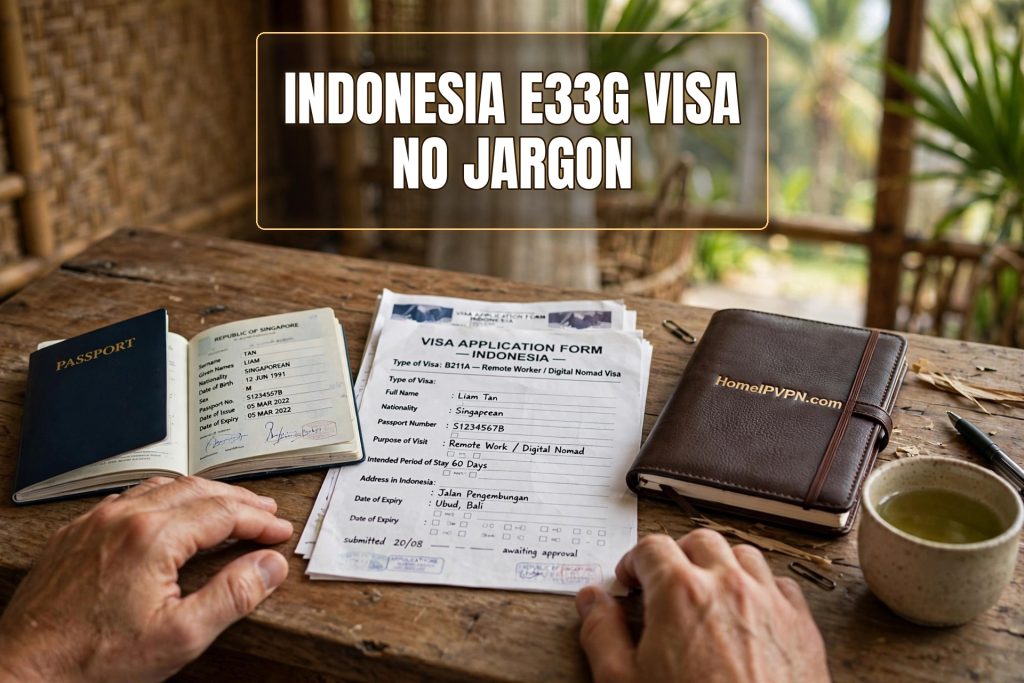
For years, the standard Bali move was the visa run. Fly to Singapore or Kuala Lumpur for a weekend, come back, get a fresh stamp, repeat until immigration started asking uncomfortable questions. It worked until it did not, and it always felt like living on borrowed time.
Indonesia finally built a proper front door for remote workers: the E33G visa, sometimes called the remote worker KITAS. It is a real one-year residence permit for people who earn their money abroad and want to live in Indonesia legally, without the border-hop anxiety. But government visa pages are written in a dialect of English that seems designed to confuse, so here is the whole thing translated into normal human language.
What the E33G actually is
Think of the E33G as Indonesia saying: you can live here for a year, work remotely for your foreign employer or your own foreign clients, and nobody will hassle you at immigration. It is a residence permit, which means it comes with a KITAS card, the document that makes you officially resident rather than a tourist who overstays their welcome.
The visa is valid for one year and can be renewed once, for a maximum stay of two years. After that, you would need to switch to a different visa type or leave and reapply. Two years is a long time in nomad terms. It is enough to rent a proper villa, build a routine, and stop thinking about visa math every month.
One important boundary: the E33G does not let you work for Indonesian companies or earn money from Indonesian sources. Your income must come from outside Indonesia. If you are employed by a US company, freelancing for European clients, or running an online business registered abroad, you fit. If you want a job at a Bali coworking space, this is not your visa.
The income requirement, in real numbers
Here is the headline number: 60,000 US dollars per year. You need to prove you earn at least that much from sources outside Indonesia. In monthly terms, that is 5,000 dollars a month.
This is the part that stops most people, so let us be precise about what counts as proof. Immigration wants documentation, not promises. Typically that means recent bank statements showing regular income deposits, employment contracts stating your salary, or client contracts plus invoices if you are freelance. The cleaner and more consistent the paper trail, the smoother the application.
If your income fluctuates, gather more months of statements, not fewer. Six months of records showing you consistently clear the bar beats three months of barely making it. And keep everything in English or get it translated. An Indonesian immigration officer should be able to look at your documents and understand them in sixty seconds.
Is the bar high? Compared to some digital nomad visas, yes. Colombia asks for far less. But the E33G is aimed at established remote workers, not backpackers with a laptop. If you clear 60k, the visa is genuinely straightforward.
The rest of the paperwork
Beyond income, the requirements are the usual immigration bundle. A passport valid for at least 18 months beyond your planned stay, with blank pages. A recent bank statement showing you can support yourself, separate from the income proof. Health insurance or travel insurance covering your time in Indonesia. A return or onward ticket. Passport photos in the specified size. And a statement that you will not work for Indonesian employers, which is standard.
You will also need a sponsor. Indonesian residence permits require a local sponsor, which for the E33G is typically handled by a visa agent. This is normal and expected, not a red flag. Budget roughly 10 to 15 million rupiah for a reputable agent to handle the sponsorship and the application. Doing it yourself is possible but the bureaucracy is in Indonesian, the offices have their own rhythms, and one wrong form can cost you weeks. Most nomads consider the agent fee the best money they spend in Indonesia.
How the application actually works
The process starts online through Indonesia’s immigration system, where your agent submits the application and documents. Once approved in principle, you receive the visa authorization, enter Indonesia, and then complete the in-country steps: reporting to the immigration office, giving biometrics, and receiving your KITAS card and the associated police and residency documents.
Realistic timeline: four to eight weeks from starting the application to holding the KITAS, assuming your documents are clean. The most common delay is document problems, a bank statement that does not clearly show income, a passport scan that is blurry, a photo that does not meet the spec. Get the paperwork right the first time and the process is boring, which is exactly what you want from immigration.
One practical note: apply while you are still home if you can. Gathering bank statements, getting documents in order, and dealing with an agent across time zones is all easier from your couch than from a Canggu cafe with spotty WiFi.
Taxes: the question everyone asks next
Here is the honest, non-advice version. Indonesia’s tax rules say that staying more than 183 days in a year can make you a tax resident, which in theory means worldwide income becomes taxable in Indonesia. In practice, enforcement on remote workers is inconsistent, the rules interact with tax treaties between Indonesia and your home country, and your personal situation matters enormously.
This is not something a blog post can resolve for you. If you are planning a full year on the E33G, talk to an accountant who understands both Indonesia and your home country’s tax system before you go. The visa gives you legal residency. The tax question is separate, and getting it wrong is expensive in a way that visa fees are not.
E33G versus the alternatives
How does the E33G compare to the other ways people stay in Indonesia? The tourist visa on arrival gives you 30 days, extendable once, and no right to work at all. The B211A visit visa gives you 60 days, extendable twice to 180 total, and is the classic long-stay tourist option. Visa runs string these together with increasing risk.
The E33G beats all of them on peace of mind. One application, one year, legal remote work, no border hops, no counting days. The price is the income bar and the agent fee. If you qualify, it is the grown-up option. If you do not qualify yet, the B211A route still works for shorter stints while you build your income up.
Bringing family
Spouses and children can typically join you on dependent permits tied to your E33G, with their own document requirements: marriage certificates, birth certificates, and the usual translations. If you are moving the whole family to Bali for a year, start the dependent paperwork at the same time as yours, not after. Immigration offices process families as units when the applications arrive together.
The money logistics nobody mentions
Here is what the visa guides skip. Living in Indonesia for a year on foreign income means a year of logging in to your home-country bank from an Indonesian IP address. Banks notice. A year of Bali logins on an account that used to log in from Texas is exactly the pattern fraud systems are built to flag.
Set up your banking defenses before you fly: a US address on file through a mail forwarding service, two-factor authentication on an authenticator app or a VoIP number you control, and a home IP connection for sensitive logins. HomeIPVPN routes your banking sessions through your own home internet, so your bank sees the same residential IP it has always seen, month after month. One year abroad with zero fraud flags is worth a small travel router.
Is the E33G right for you?
The E33G makes sense if you earn over 60,000 dollars a year from foreign sources, you want to base in Indonesia for six months to two years, and you value legal certainty over saving the agent fee. It does not make sense if your income is under the bar, if you only want three months, or if you plan to work for Indonesian clients.
For the right person, it changes the whole Bali experience. No visa-run weekends eating your time and money. No low-grade anxiety at immigration counters. Just a year of legal, settled life in one of the best remote work bases on earth.
The visa solves the immigration problem. The quieter problem is everything back home that assumes you never left: your bank, your broker, your employer’s login systems. That is the mismatch HomeIPVPN was built to fix, keeping your connection anchored at your home IP no matter how long you stay. If you would rather have someone set it up and verify it works before you fly, the Pre-Travel Audit & Advisory session is 1 hour, costs $79, and that fee comes straight off the $279 Secure Home IP VPN System session if you go ahead.
Get the paperwork right, keep your home accounts calm, and go enjoy the island. The geckos are waiting.