REMOTE WORK & DIGITAL NOMAD
Canggu vs. Ubud: Where the WiFi Is Actually Better for Remote Work
Every Bali nomad eventually faces the choice. Canggu or Ubud. Surf town or jungle town. Sunset beach bars or morning yoga. It feels like a lifestyle question,…
✓Canggu: the infrastructure winner✓Ubud center: good, with a smaller✓The Ubud outskirts: where the WiFi
Quick Answer
Canggu generally has better and more consistent WiFi for remote work, thanks to denser fiber coverage and a bigger coworking scene. Ubud’s internet is fine in the town center but drops off quickly in the surrounding jungle villas where many nomads stay. If reliable video calls are your priority, base yourself in Canggu or within walking distance of a Ubud coworking space.
- Canggu: Fiber is widespread, coworking spaces are everywhere, and typical speeds run 50 to 200 Mbps with solid uploads.
- Ubud center: Good fiber in town, 50 to 150 Mbps in most cafes and coworking spaces, but quality falls off within a few kilometers of the center.
- Ubud outskirts: Jungle villas often rely on 4G routers or long copper runs, with speeds that can dip under 10 Mbps in the rain.
- Work logins from either town: Indonesian IPs can trigger bank and employer fraud flags, so route sensitive sessions through your home connection with HomeIPVPN.
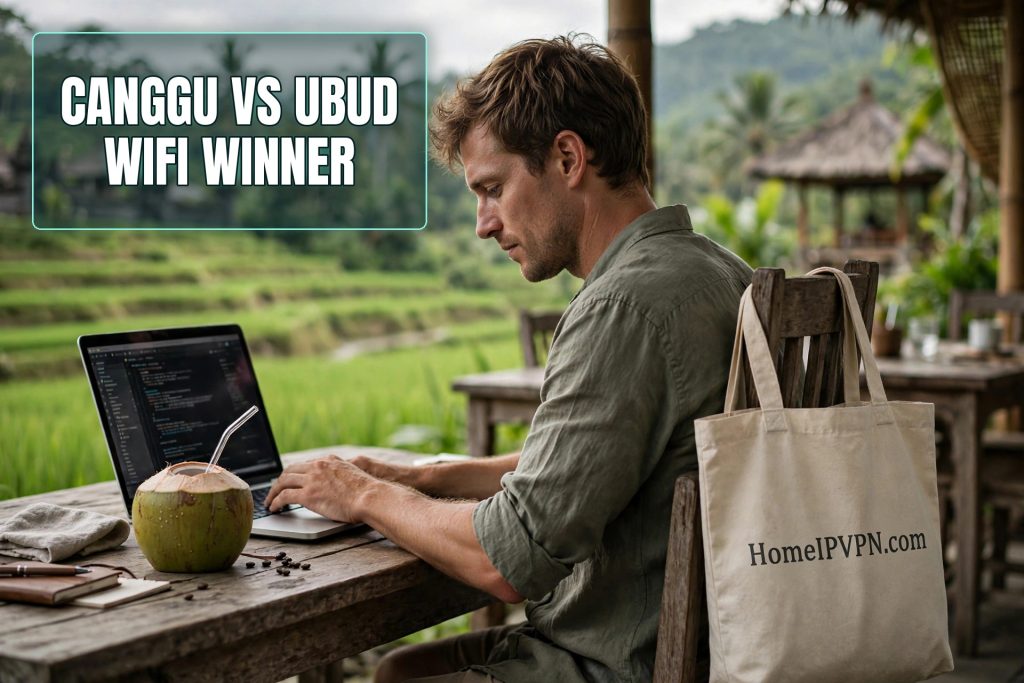
Every Bali nomad eventually faces the choice. Canggu or Ubud. Surf town or jungle town. Sunset beach bars or morning yoga. It feels like a lifestyle question, and it is. But underneath the lifestyle question sits a practical one that will shape every single workday: where is the WiFi actually better?
We have worked from both, through deadlines and downpours and the particular chaos of a client call during a tropical storm. Here is the honest neighborhood-level breakdown, because “Bali internet” is not one thing and the two towns are more different than the travel blogs admit.
Canggu: the infrastructure winner
Canggu is Bali’s remote work capital for a reason, and the reason is infrastructure. The town grew up around digital nomads, and the internet grew with them. Fiber coverage is dense through Batu Bolong, Berawa, and Pererenan. A modern villa or apartment here typically tests at 50 to 200 Mbps down with uploads in the 20 to 50 Mbps range. That is genuinely good by any standard.
The coworking density is the real advantage. You are never more than a ten minute scooter ride from a space with business-grade fiber, backup connections, and a generator. On the days your villa WiFi misbehaves, and there will be such days, the fix is a short ride, not a ruined workday. Day passes cost roughly 150,000 to 250,000 rupiah, and monthly memberships are competitive because the spaces actually compete with each other.
Canggu’s cafes are also more work-oriented than Bali’s average. Plenty of them were designed with laptop workers in mind: outlets at every table, WiFi passwords printed on the menu, staff who will not glare at you for staying three hours. It is not perfect. The lunch rush still saturates the popular spots, and a big storm can take a whole street offline. But as a baseline for daily remote work, Canggu is the most reliable town on the island.
Ubud center: good, with a smaller margin
Central Ubud, the area around Monkey Forest Road and the palace, has solid internet. Fiber is available, cafes in the center test at 50 to 150 Mbps, and the coworking spaces are excellent. If you stay in town, your workdays will be fine.
The catch is the margin. Ubud has fewer coworking spaces than Canggu, and they are more spread out. The cafe scene leans wellness-tourist rather than laptop-worker, which means fewer outlets, more side-eye for long stays, and WiFi that was sized for Instagram uploads rather than Zoom calls. It works, but you feel the difference on a heavy meeting day.
Ubud also sits in a valley, and weather hits harder here. Afternoon storms are a daily event in the rainy season, and they take the internet with them more often than in Canggu. The nomads who thrive in Ubud are the ones with a coworking membership and a phone hotspot as a matter of routine, not as an emergency plan.
The Ubud outskirts: where the WiFi goes to struggle
Here is the part that surprises people. The dream Ubud stay is a villa in the jungle, rice paddies on both sides, geckos on the ceiling. It is also, very often, where the internet is worst. Once you get a few kilometers outside the center, in Penestanan, Pengosekan, or up toward Tegalalang, the infrastructure thins out fast.
Many of these villas run on 4G routers or on copper lines that were never meant to carry a remote worker’s upload load. Speeds of 10 to 30 Mbps are common, and they can collapse to single digits when it rains, which is often. For email and writing, that is survivable. For a day of back-to-back video calls, it is a slow-motion disaster.
This does not mean you cannot live in the jungle. Plenty of nomads do. But go in with a plan: test the actual villa connection before signing anything, confirm whether the line is fiber or 4G, and budget for a coworking membership in town for your heavy days. The villa is for living. The coworking space is for working. Trying to make one building do both jobs is where people get frustrated.
Head to head: the workday test
Let us compare a normal Tuesday. In Canggu, you wake up, your villa WiFi is running 120 Mbps, your 9am call is flawless, and when the afternoon storm knocks the power out for forty minutes, you hotspot from your phone and nobody notices. In central Ubud, the morning is the same, but the storm hits harder and the hotspot is slower, so you learn to schedule important calls for the morning.
In the Ubud outskirts, the same Tuesday starts with a 15 Mbps connection that drops to 4 during the rain, your screen share freezes twice, and you spend the afternoon at a coworking space in town after all. The lifestyle is unbeatable. The workday takes management.
None of this is a verdict on which town is better to live in. Ubud’s calm, green, community feel is real, and plenty of people choose it with open eyes. It is a verdict on where the WiFi is better, and the answer is Canggu, by a clear margin.
Power and outages in both towns
Bali-wide, power outages are a fact of life, and both towns get them. Canggu’s denser infrastructure means power usually comes back faster, and more businesses have generators. Ubud’s outages can linger, especially in the outlying areas where repair crews take longer to reach.
The preparation is identical in both places: a local SIM with generous data, a power bank, a laptop charged above 80 percent, and knowledge of your nearest generator-equipped refuge. Join the local expat groups for outage announcements. After a month, checking for blackout news becomes as automatic as checking the weather.
Cost comparison: what the WiFi costs you
Canggu is the more expensive town, and the gap has widened. A decent one bedroom runs 8 to 15 million rupiah a month in the popular areas. Ubud center is somewhat cheaper, and the outskirts cheaper still, which is part of why people accept the worse internet out there.
But do the real math. If you live in the Ubud jungle for 6 million a month but need a 2 million coworking membership plus daily transport to use it, the savings shrink. Meanwhile the Canggu nomad paying 10 million works from home most days. The cheapest option is only cheap if your work actually fits the connection.
The hidden problem in both towns: where your logins appear to come from
Speed is only half the story, in Canggu and Ubud alike. The other half is that every sensitive account you own watches your location. Log in to your bank from an Indonesian IP and you can trigger the fraud gauntlet: verification texts to a phone you cannot access, temporary locks, the dreaded “unusual activity” email at midnight.
The fix has nothing to do with which town you pick. A home IP connection routes your banking and work logins through your own home internet back home, so everything looks normal to the systems watching. HomeIPVPN packages this as a small travel router: plug it in at your villa, connect your laptop, and your accounts see the same home IP they have always seen.
So where should you base yourself?
If your work means daily video calls, big uploads, or anything where a dropped connection costs you money or credibility, choose Canggu. The infrastructure margin is real, and it buys you peace of mind that is hard to price.
If your work is mostly asynchronous, writing, coding, design, email-heavy roles, Ubud is wonderful, especially if you stay near the center or commit to a coworking membership for the days that matter. The lifestyle payoff is genuine.
And if your heart is set on the jungle villa, go in with open eyes and a tested connection. The rice paddies are worth it. Just do not let a 4G router decide your career.
Whichever town you choose, the deeper issue is the same one every nomad faces: your accounts were built for someone who stays home, and the internet keeps telling them you are somewhere else. That mismatch is exactly what HomeIPVPN was built to solve, by keeping your connection anchored at home wherever you actually sleep. If you would rather have someone set it up and verify it works, the Pre-Travel Audit & Advisory session is 1 hour, costs $79, and that fee comes straight off the $279 Secure Home IP VPN System session if you go ahead.
Test the WiFi, keep the hotspot ready, and enjoy both towns. Most nomads end up splitting their time anyway. The island is small. The WiFi differences are not.