REMOTE WORK & DIGITAL NOMAD
Banking in Portugal as a Digital Nomad: What to Set Up First
I landed in Lisbon with a plan I was proud of. I had my NIF appointment booked, a list of banks recommended by three different nomad friends, and a folder full
✓Step Zero: The NIF (Your✓Opening a Portuguese Bank Account✓What the Local Account Is Actually
Quick Answer
Start with a Portuguese bank account for daily life, keep your home-country account for income and savings, and set up a low-fee transfer service between them. You will need your NIF tax number, proof of address, and your passport to open a local account, and most nomads get it done within their first two weeks.
- Get your NIF first: the tax number is the key that unlocks everything, including bank accounts; arrange it before or immediately after arrival.
- Open a local account early: you need it for rent, utilities, and the phone contract; most banks open non-resident accounts with a passport and NIF.
- Move money cheaply: use a low-fee transfer service instead of bank-to-bank wires, which eat 3 to 5 percent in fees and bad rates.
- Keep home banking reachable: HomeIPVPN makes sure your home-country bank keeps seeing your familiar home address while you manage money from Portugal.
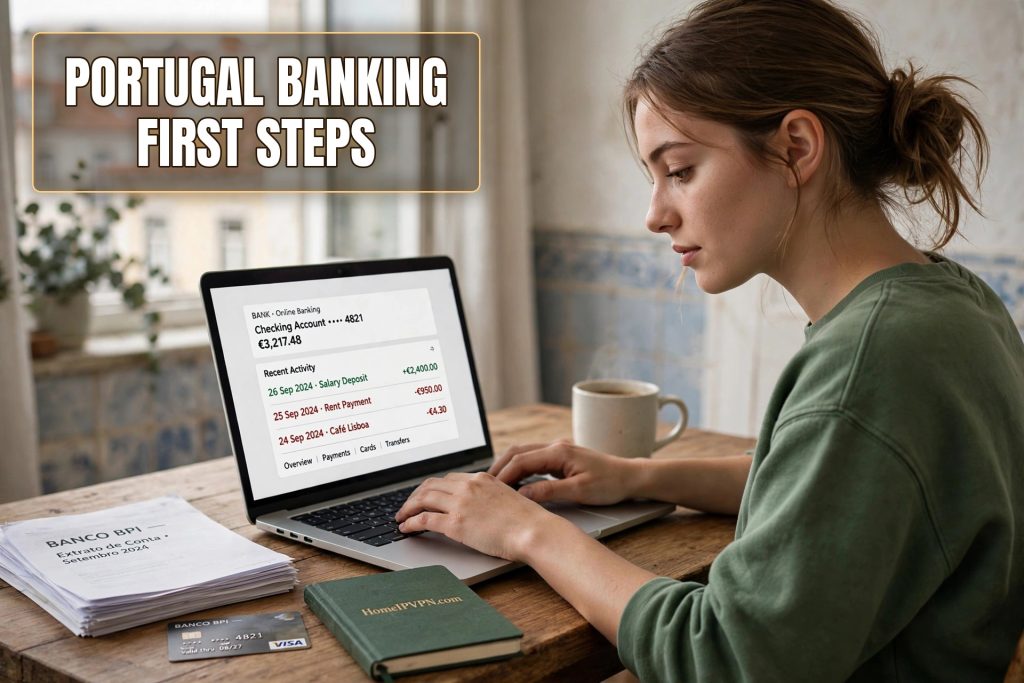
I landed in Lisbon with a plan I was proud of. I had my NIF appointment booked, a list of banks recommended by three different nomad friends, and a folder full of documents. By day three, I had been turned away from two banks, told my passport was not enough at a third, and learned that the bank my friend swore by had changed its non-resident policy the previous month. Banking in a new country is a scavenger hunt where the clues keep changing.
Here is what I eventually figured out, and what will save you the two weeks of wandering I did. This is the practical order of operations for getting your money life working in Portugal: the NIF, the local account, the transfer setup, and the care and feeding of the home-country accounts you are keeping. No finance degree required.
Step Zero: The NIF (Your Portuguese Tax Number)
Before the bank, before the apartment contract, before almost everything, there is the NIF, the Numero de Identificacao Fiscal. It is Portugal’s tax identification number, and you need it for an astonishing range of daily life: opening a bank account, signing a lease, getting a phone contract, even some gym memberships. Think of it as your Portuguese administrative identity.
Getting a NIF as a non-resident used to require an in-person visit to a tax office (Financas) with a fiscal representative, a Portuguese resident who vouches for you. Many nomads still do it this way, often through a lawyer or a relocation service that charges 100 to 200 euros to act as your representative and handle the appointment. It is money well spent if you want it done without drama.
More recently, the process has gotten easier, with some tax offices accepting applications with simpler representation arrangements, and online options expanding. The details shift, so check the current state in a recent nomad forum before you fly, but the principle holds: arrange your NIF before you need it, not when a landlord is waiting for it. I know people who sorted it in their first week and people who delayed it and spent a month paying for things in awkward workarounds. Be the first kind of person.
Opening a Portuguese Bank Account
With NIF in hand, you can open a Portuguese bank account. As a digital nomad, you will typically open a non-resident account (conta de nao residente), which later converts to a resident account once you have your residence permit. The distinction matters less than the banks make it sound; the account works the same for daily life.
The documents you will need: your passport, your NIF, proof of address (this can be your home-country address at first, or your Portuguese rental contract), and proof of income or employment (a work contract, client agreements, or recent bank statements). Some banks also ask for your tax return. Bring everything, including things they did not ask for, because bank number three will ask for the thing bank number one ignored.
Which bank? The big names nomads cycle through are Millennium BCP, Novo Banco, Santander Totta, and Caixa Geral de Depositos. They all offer non-resident accounts, they all have English-speaking staff in the Lisbon and Porto branches (ask for the international desk if the first person looks confused), and they all charge some kind of monthly maintenance fee, usually 5 to 8 euros, often waivable if you keep a minimum balance or set up direct deposits.
Here is the honest truth about choosing: the differences between these banks matter less than getting the account open quickly. Pick the one with a branch near your apartment, open the account, and move on with your life. You can always switch later. The nomad forums love to debate which bank is best, but the best bank is the one where you walked out with an account number on day one.
A newer alternative worth knowing: Portugal-friendly digital banks and fintech accounts. Services like Revolut, Wise, and N26 give you Portuguese-compatible IBANs (or at least euro accounts that work seamlessly for Portuguese payments) with signup from your phone in an afternoon. Many nomads now run their daily Portuguese spending through one of these and keep a traditional Portuguese account only for the things that specifically require it, like some rental deposits or utility contracts. This hybrid approach is the path of least resistance.
What the Local Account Is Actually For
A question worth answering: if you can pay for most things with your home-country cards or a fintech account, why bother with a Portuguese bank at all? Because Portugal still runs on local rails for the boring important stuff.
Rent is the big one. Many landlords, especially outside the Airbnb-style short-term market, want rent by bank transfer to a Portuguese account, or at least a Portuguese IBAN for the direct debit. Utilities, electricity, water, internet contracts, often require a Portuguese IBAN for the monthly direct debit (debito direto). Your phone contract, your gym, your coworking membership: all smoother with local account details.
Then there is Multibanco, Portugal’s beloved ATM and payment network. With a Portuguese debit card you can pay for almost anything, withdraw cash free at Multibanco ATMs everywhere, and use the MB Way app, which is how half the country splits bills and pays small merchants. It is one of those local systems that feels archaic until you have it, and then you wonder how you lived without it.
So the local account is not really about storing your wealth. It is your operational account: money flows in from your income, money flows out to rent and life. Keep a month or two of expenses in it, no more. Your savings and your main financial life stay where they are.
Keeping Your Home-Country Account (and Keeping It Happy)
Do not close your home-country bank account. I cannot stress this enough. Your home account is where your clients pay you, where your savings live, where your credit history continues to exist. Closing it to “simplify” is one of the most regretted moves in nomad life, because reopening an account from abroad is dramatically harder than keeping one open.
What you need to do instead is keep it healthy from a distance. That means logging in regularly (dormant accounts get flagged), keeping the contact details current, and making sure the bank can reach you. Many banks now accept international phone numbers or authenticator apps for two-factor authentication, but some still insist on texting codes to your home-country number. If yours does, keep that number alive (a cheap VoIP or eSIM solution works) rather than discovering the problem the day you need to approve a transfer.
The other thing to watch is the bank noticing your new location. When every login for months comes from Portugal, some banks’ fraud systems start asking questions. Usually it is just a verification prompt, but occasionally it escalates to a frozen account or a demand to visit a branch in person, which is a special kind of impossible when you live 5,000 miles away.
The practical fix is to make your connection look like it always did. HomeIPVPN routes your banking sessions through your own home internet connection, so your bank sees the same home address it has always trusted. It is the difference between your bank thinking “our customer is traveling” and your bank thinking “our customer is home,” and for fraud algorithms, that difference is everything.
Moving Money Between Countries Without the Pain
You will be moving money regularly: income lands in your home account, expenses need to come out of your Portuguese account. The naive way, a wire transfer from your home bank to your Portuguese bank, is also the expensive way. Traditional banks typically charge 15 to 45 dollars per wire and then take their cut on the exchange rate, often 3 to 5 percent worse than the real rate. On a monthly transfer of a few thousand, that is real money evaporating every month.
The services built for this are dramatically cheaper. Wise is the nomad standard: transparent fees, the real exchange rate, transfers that usually arrive the same day or the next. Revolut offers similar rates with its own account ecosystem. Even PayPal, for all its fees, is sometimes competitive for smaller amounts. The right choice depends on your amounts and frequency, but any of them beats a bank wire by a wide margin.
My setup, which I recommend as a starting template: income arrives in the home-country account, a monthly transfer goes through Wise to the Portuguese account covering rent and expenses plus a buffer, and daily spending goes on a no-foreign-transaction-fee card. Once a quarter I review whether the amounts still make sense. It takes about twenty minutes a month to run, and the savings versus bank wires paid for a very nice dinner in Porto every single month.
One caution: keep records. Portugal’s tax authorities can ask about the source of funds in your Portuguese account, especially if you later apply for residency renewals or permanent status. A simple spreadsheet noting each transfer’s date, amount, and source takes seconds to maintain and saves hours of reconstruction later. Future you, sitting across from a bureaucrat, will be grateful.
The First-Two-Weeks Checklist
Here is the order that works, distilled from my mistakes and those of everyone I have compared notes with since.
Before you fly: make sure your home bank knows you are moving (a travel notice or an updated address on file), confirm your two-factor authentication works with whatever phone setup you will have, and download your bank’s app if you have not. Set up a Wise or Revolut account if you do not have one.
Week one: get the NIF sorted, open the Portuguese bank account, and set up the transfer service with a small test transfer. Get a local SIM and sort out which of your home services need your new reality reflected.
Week two: sign the lease using the local account details, set up the utility direct debits, move your first full month of expenses over, and confirm your home-country logins still work smoothly. This is also when you discover the three things you forgot, which is normal and fine.
After that, it is maintenance: monthly transfers, quarterly reviews, and the quiet confidence of a money system that just works while you get on with the actual adventure of living in Portugal.
The Deeper Pattern
Banking abroad is really a story about one thing: your financial life was built around the assumption that you live in one place, and now you live in two. Every friction in this post, the NIF, the non-resident account, the fraud alerts, the wire fees, comes from systems noticing the gap between where you are and where they think you should be.
The parts you can control, you control with paperwork and planning. The parts about how you appear to the systems back home, those are the problem HomeIPVPN was built to solve: your logins come from your own home address, so your bank sees the customer it has always known, even while you are building a new life in Portugal.
If you would rather have someone set it up and verify it works, the Pre-Travel Audit & Advisory session is 1 hour, costs $79, and that fee comes straight off the $279 Secure Home IP VPN System session if you go ahead.
Boa sorte with the banks. The bureaucracy is real, but so is the pastel de nata waiting at the end of the errand run.