REMOTE WORK & DIGITAL NOMAD
Portugal Digital Nomad Visa: The Income Requirement Explained in Plain English
The first time I heard the number, I thought someone was joking. Three and a half thousand euros a month, just to be allowed to live in Portugal and work on my
✓The Number: Four Times the Minimum✓What Counts as Income✓The Paperwork: Proving It Without
Quick Answer
Portugal’s digital nomad visa requires remote workers to prove monthly income of roughly four times the Portuguese minimum wage, currently around 3,480 euros per month. You show this with bank statements, contracts, or client invoices covering the months before your application, plus proof you work remotely for clients outside Portugal.
- The magic number: about 3,480 euros per month (4x the minimum wage); it rises slightly whenever the minimum wage goes up, so check the current figure before applying.
- Proof they accept: three to six months of bank statements, freelance contracts, or employer letters showing steady remote income from outside Portugal.
- Remote work only: your income must come from clients or an employer outside Portugal; you cannot take a local Portuguese job on this visa.
- Keep your home accounts healthy from Portugal: HomeIPVPN keeps your home-country banking and work logins looking normal while you live in Lisbon or Porto.
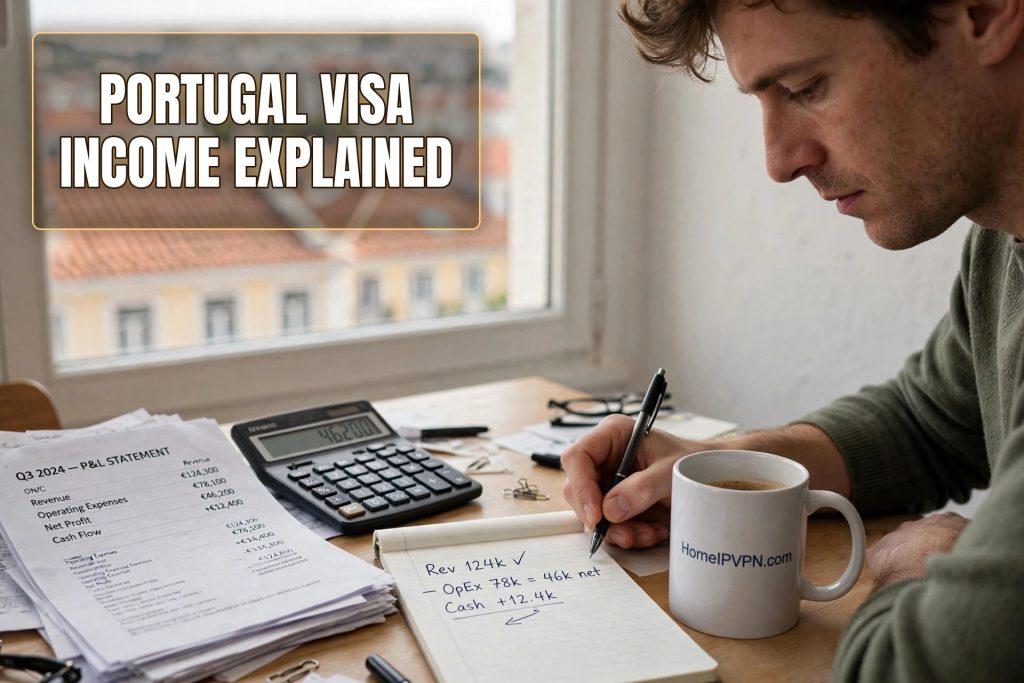
The first time I heard the number, I thought someone was joking. Three and a half thousand euros a month, just to be allowed to live in Portugal and work on my laptop. I was sitting in a cafe in Alfama, nursing a one-euro espresso, doing the mental math on whether my freelance income would clear the bar. The good news, which nobody explained clearly at the time, is that the number sounds scarier than it is, and the way Portugal calculates it is more generous than it first appears.
If you are a remote worker eyeing Portugal, the income requirement is the gate you have to walk through. It is the part of the application that causes the most anxiety and the most confusion, because the official documents are written in bureaucratic Portuguese and the expat forums contradict each other. This post untangles it in plain English: what the number is, what counts toward it, how to prove it, and the mistakes that get applications sent back.
The Number: Four Times the Minimum Wage
Portugal’s digital nomad visa (officially the D8 visa, for remote workers) requires you to show monthly income of at least four times the Portuguese national minimum wage. When the minimum wage goes up, the requirement goes up with it, so treat any number you read as “current as of now” rather than carved in stone.
As of 2026, the Portuguese minimum wage sits around 870 euros per month. Multiply by four and you get roughly 3,480 euros per month. In dollars, at recent exchange rates, that is somewhere around $3,700 to $3,800 per month, or about $44,000 to $46,000 per year.
Let me put that in perspective, because context is what the official documents never give you. For a salaried remote worker in the US, UK, Germany, or most of Northern Europe, this is not a high bar. It is roughly the take-home pay of a mid-level professional. For freelancers, it means showing that your client work consistently brings in at least that amount. For couples applying together, each person needs to meet the requirement individually (more on dependents below).
One thing people get wrong: this is about income, not savings. Portugal does not currently let you substitute a big savings account for the monthly income requirement on this visa. They want to see money coming in, month after month, from work you can do from a laptop in Porto. A healthy savings balance helps your overall application look strong, but it does not replace the income proof.
What Counts as Income
The question everyone asks next is: does my income count? The short answer is that if you earn it remotely from clients or an employer outside Portugal, it almost certainly counts.
Salaried remote workers have the easiest path. A letter from your employer stating your salary, your role, and that you work remotely, plus a few months of pay slips, covers it cleanly. The employer needs to be based outside Portugal, and the letter should make that clear. If your employer has a Portuguese office or entity, get advice before applying, because the lines get blurry fast.
Freelancers need to show a bit more paperwork, but it is very doable. Portugal wants to see contracts or client agreements plus bank statements showing the money actually arriving. Three to six months of statements is the standard ask. What the consulate is really looking for is a pattern: regular deposits, from multiple clients or one steady client, that average out above the threshold. One huge month followed by two dry months looks worse than three solid average months. Consistency is the story you want your bank statements to tell.
Business owners, people running their own companies or agencies, can apply too, showing income through their business. You will need business registration documents, tax returns, and bank statements that connect the dots between the business revenue and your personal income. It is more paperwork, but consulates see these applications regularly and know what to look for.
What does not count: income from Portuguese clients or a Portuguese employer (that defeats the purpose of the visa), passive income alone like rental properties (this is a worker visa, not a passive-income visa), and vague promises of future work. Portugal wants proof of what you already earn, not projections of what you might earn once you are sipping vinho verde in the Douro Valley.
The Paperwork: Proving It Without Losing Your Mind
Here is where applications usually stumble, not on the income itself but on the proof. The consulate reviewing your file is a person who has seen a hundred of these, and they have a checklist. Your job is to make their job easy.
Start with bank statements. Get three to six months of official statements, not screenshots, from your bank. If your bank lets you download stamped or certified statements, do that. Highlight or annotate the incoming payments if it helps, but keep it clean. If your income arrives in a different currency, the consulate will convert it at their own rate, so leave a little margin above the threshold rather than cutting it close.
Next, the proof of remote work. For employees, that is the employer letter on company letterhead: your name, your position, your salary, confirmation that your work is remote, and confirmation that the company is based outside Portugal. For freelancers, it is contracts or engagement letters with clients, ideally showing ongoing work rather than one-off gigs. If you have long-term retainer clients, those agreements are gold.
Then the supporting documents: your tax returns from the previous year (showing the income matches what you claim), proof of accommodation in Portugal (a rental contract or a hotel booking for the initial period), health insurance valid in Portugal, a clean criminal record from your home country, and your passport with the usual validity. The visa application form itself is straightforward if tedious.
A practical tip from people who have been through it: organize everything into a single neat folder, in the order the consulate lists the requirements, with a one-page summary on top. “My name is X, I earn Y per month from remote work for [employer/clients], as shown in the attached statements.” The reviewer spends a few minutes per file. Make those minutes pleasant.
Dependents and the Higher Bar
If you are bringing a partner or children, the income requirement goes up. Portugal requires additional income for each dependent, roughly 50 percent of the main requirement for a spouse and 30 percent per child (these figures shift, so confirm with the consulate). In practice, a couple needs to show something like 5,200 euros per month combined.
Both partners can also apply as individual remote workers if both meet the threshold on their own, which sometimes works out cleaner than one primary applicant with dependents. If only one of you works remotely, the primary applicant needs to clear the higher combined bar. Plan for this early, because it changes how much margin you need in your bank statements.
The Mistakes That Get Applications Sent Back
Talk to enough people who have done this and the same failure patterns show up. First, applying with income that dips below the threshold in recent months. If your last three months include a bad month, wait and build a stronger run before applying. Recency matters more than history.
Second, messy or incomplete bank statements. Screenshots with half the page cut off, statements in a format the consulate cannot read, deposits with no explanation. Get proper statements, make them legible, and add a brief note explaining anything unusual, like a large one-time payment.
Third, the accommodation proof being too thin. A two-night hotel booking does not convince anyone you are moving to Portugal. A three-month rental contract, or at least a month-long Airbnb booking with a clear address, tells the story they want to hear.
Fourth, forgetting that the minimum wage number moves. If you planned your application around last year’s figure and the wage went up in January, your math is suddenly short. Check the current minimum wage in the month you apply, multiply by four, and add a comfort margin of ten percent.
What Happens After Approval
Once approved, the visa lets you live and work in Portugal, travel freely within the Schengen area, and after the initial period, renew. Many nomads use it as a path toward longer-term residency. The first residence permit is typically issued for two years, renewable for three more, and time on this visa can count toward permanent residency and eventually citizenship for those who stay.
You will need to register with the local authorities, get your tax number (NIF), and sort out the practical pieces of life: a Portuguese bank account for rent and utilities, health coverage, and a fiscal representative if you are handling taxes from abroad. None of this is hard, but all of it is easier with the paperwork organized from day one, which is why the application folder habit pays off twice.
One ongoing obligation worth knowing: you need to actually live in Portugal. This is a residence visa, not a travel document you keep in a drawer. Extended absences can cause problems at renewal. If your lifestyle involves constant movement, be honest with yourself about whether this visa matches it.
Keeping Your Home-Country Life Running From Portugal
Here is the part nobody puts in the visa guides, because it is not a visa issue at all. Once you are living in Lisbon, your bank back home, your investment accounts, and sometimes your employer’s systems will start seeing you log in from Portugal every day. For most people this is fine. For some, it triggers exactly the kind of fraud alerts and access questions that turn a peaceful morning into a stressful one.
The calmer approach is to make your connection look like it always did. HomeIPVPN routes your traffic through your own home internet connection, so your bank and your work systems see the same home address they have always trusted, whether you are in a Lisbon apartment or a Porto coworking space. It is the kind of thing you set up once, before the move, and then never think about again while you are busy enjoying the actual Portugal.
Think of it as part of the same preparation as the visa paperwork: one more piece of your home life that keeps running smoothly while you build the new one abroad.
The Bottom Line on the Number
Four times the minimum wage. Roughly 3,480 euros a month as of 2026. Proven with bank statements and remote-work contracts, with a margin above the line and paperwork organized like you mean it. That is the whole game.
It is a meaningful threshold, but it is not an exclusive one. It is set at a level that says: this person can support themselves in Portugal without strain, which is really what the country wants to know. If your remote income is steady and you can document it, the income requirement is a hurdle you step over, not a wall you hit.
A Bridge, Not a Leap
The deeper pattern in all of this, the visa, the paperwork, the move, is that relocating your life means relocating your digital footprint too, and the services back home do not always handle that gracefully. Looking like you never left home is the problem HomeIPVPN was built to solve: your logins come from your own home address no matter which Portuguese city you wake up in.
If you would rather have someone set it up and verify it works, the Pre-Travel Audit & Advisory session is 1 hour, costs $79, and that fee comes straight off the $279 Secure Home IP VPN System session if you go ahead.
Boa sorte with the application. The espresso really is that cheap, and the light in Lisbon really is that good.